
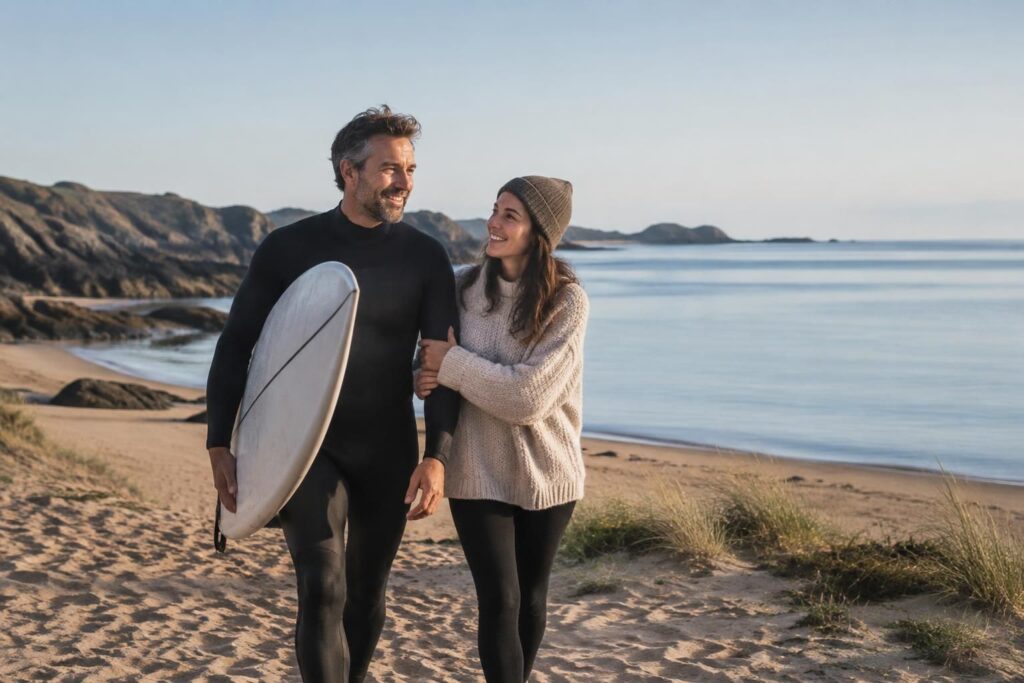
In Brittany, a surfer returned to the ocean after going through illness. “I didn’t think I’d be able to surf again”: behind these words lies a personal challenge requiring patience, courage, and resilience, where each session gradually finds its place again.
In Brittany, returning to surfing after illness
Getting back to the waves does not necessarily mean picking up where everything left off. Paddling, the take-off, balance on the board: these familiar movements may require new adjustments after a period marked by illness.
The account does not detail the diagnosis or the medical stages of recovery. It highlights an essential milestone: getting back in the water, rediscovering sensations, and measuring progress session after session, without letting old habits dictate the pace.
A return built at each person’s own pace
After an illness, returning to surfing depends on the situation and the recommendations of the care team. Energy, mobility, and balance may vary: it is better to adjust the length of a session, the choice of spot, and the conditions rather than trying to immediately regain one’s previous level.
Sheltered water and a short session can provide more accessible benchmarks than a powerful peak or a demanding tide. Returning to the ocean is not about a single wave: it is built through consistency, listening to the body, and the pleasure of reconnecting with the ocean.
Surfing, a personal challenge beyond performance
For enthusiasts, surfing is not just about the number of waves caught. Returning to the lineup, putting the leash back on, and rediscovering the feeling of riding already represent a significant milestone, especially when uncertainty has kept them away from the water for so long.
This experience echoes other journeys of surfers facing illness, such as the one featured in this account of surfing and Parkinson’s disease. Every story is unique, but they all remind us that access to the sport can be reinvented, without confusing pushing oneself with taking risks.
Practical guidelines for rediscovering the feeling
A cautious return can be based on simple steps, adjusted with healthcare professionals. The goal is not to check off a list at all costs, but to regain confidence and enjoy yourself in suitable conditions.
- Choose a suitable spot: favor a familiar environment and conditions compatible with how you feel that day.
- Shorten the session: getting out of the water before exhaustion helps preserve good sensations for next time.
- Gradually resume the movements: paddling, positioning on the board, and the take-off can be relearned step by step.
- Take stock after the session: fatigue, pain, or renewed energy can help adjust the next session with the necessary medical advice.
These guidelines do not constitute a recovery protocol: illness and its effects vary from one person to another. The priority remains a supervised, tailored return, far from the pressure of the clock or past performance.
Returning to the ocean: steps for a tailored comeback
The table below presents general points to consider, not the precise progression of the Brittany journey. It reminds us that a successful session can be measured by the quality of the sensations as much as by the number of waves surfed.
| Guideline | Considerations | Goal |
|---|---|---|
| Before heading out | Talk with the care team and check the conditions at the spot | Go out with appropriate support |
| In the water | Assess your energy and adjust the length of the session | Maintain positive feelings |
| After the session | Monitor recovery and share any difficulties | Plan a consistent progression |
Getting back into it can also be supported by a caring community and adapted practices. To discover other stories related to this passion, surf as a driving force in daily life in Landes offers another perspective on this lasting connection with the ocean.
A victory that cannot be measured by ranking
The journey described in this account is a reminder that courage does not erase the constraints of illness. Rather, it makes it possible to seek a new way of living out one’s passion, with adjusted goals and particular attention to the body’s signals.
Getting back in the waves, even in a different way, can thus become an important milestone in recovery. In surfing, good timing does not always mean taking off on the best set: sometimes, it simply means being back in the water.
What illness does the Breton surfer have?
The account mentioned here does not specify the diagnosis. It focuses on his return to surfing and the difficulties he faced, without detailing his medical situation.
How should you approach returning to surfing after an illness?
Returning to surfing should be adapted to the person’s health condition and discussed with their care team. The choice of spot, session length, and intensity of effort should be adjusted gradually.
Does returning to the ocean mean getting back to your previous level?
Not necessarily. Feelings and abilities may change; the return can be built around new reference points, without immediately aiming for past performance levels.
Why does this account resonate with surfing enthusiasts?
It shows that surfing can remain an important part of life even after a period of illness. Here, resilience is reflected in a gradual return and the renewed pleasure of being in contact with the ocean.