
In Hossegor, a few hundred meters can separate reassuring whitewater from a fast, hollow, and frankly intimidating beach break. For a first independent session after surf lessons, the right approach is not to aim for the most famous spot, but to look for an easy-to-read, low-power, sufficiently open area. The resort’s worldwide reputation is built on its quality waves, notably thanks to the underwater trench that concentrates the energy of Atlantic swells: a fantastic playground, but no guarantee of easy conditions.
Beginner surfing in Hossegor becomes enjoyable when surfers know how to choose their time slot, observe Hossegor beach before carrying their board into the water, and accept changing their plans. A small swell, light wind, a supervised area, and consistent whitewater often provide a far more useful session than a famous peak. The goal is not to surf La Gravière at all costs: it is to build lasting independence, with enjoyment, respect for others, and a genuine surf safety culture. 🌊
Beginner surfing in Hossegor: assess your level before choosing a spot
The term “beginner” covers very different realities. Someone who has taken two surf lessons, caught a few whitewater waves, and stood up for three seconds does not yet have the independence needed to position themselves at an unsupervised peak or handle a Landes current. Conversely, someone who has completed several sessions, knows how to return to shore, control their board, and identify a breaking zone can consider a first independent session in particularly gentle conditions.
In Hossegor, skill level is never just about the ability to stand up. You also need to be able to swim confidently, carry a board through the waves, handle wipeouts without panicking, and decide to get out before becoming exhausted. An independent beginner surfer is not someone who wants to catch the biggest waves: it is someone who knows how to identify the day’s limits. Choosing not to surf a session that is too technical is part of progressing.
Signs of a truly independent beginner
Before surfing alone after lessons, certain skills need to be solid. Surfers must know how to push their board through the water without letting go, lie on it correctly, look around before taking off, and avoid swimming areas. They must also be able to get through a small whitewater zone without losing their calm or clinging to their board like a float.
The example of Léa, a fictional surfer who took five sessions over the summer, clearly illustrates this difference. She can take off in whitewater, turn slightly to the right, and return to shore without difficulty. Yet when faced with a set breaking far offshore with a lateral current, she prefers to stay in shallow water. This is an excellent decision: her technical movements are improving, but her ability to read the ocean is still developing.
- 🏄 Supervised beginner : first sensations, uncertain trajectory, need for an instructor and a marked area.
- 🌊 Independent beginner : consistent whitewater takeoffs, equipment control, adequate swimming ability, and the ability to get out quickly.
- ⚠️ Developing intermediate : getting through a modest break, choosing a non-hollow wave, basic turns, and understanding priority rules.
- 🚫 Insufficient level : quick fatigue, anxiety in whitewater, frequently letting go of the board, or inability to read currents.
The most publicized surf spots are not proof of skill level. La Gravière, La Nord, or some peaks at La Centrale may seem accessible from the sand during a lull, then become very demanding as soon as a larger set arrives. Beach breaks change from one day to the next, sometimes from one hour to the next, as sandbars shift after tides and swell events.
A sensible first step toward independence often means staying in the whitewater near a supervised area, away from peaks used by experienced surfers. This choice may seem less spectacular, but it is much more educational. A controlled takeoff on a soft wave lets you work on foot placement, vision, and balance; a rushed takeoff on a wave that is too hollow mainly teaches you to fall quickly.
Surf lessons remain valuable beyond the first lessons. A session focused on reading the water, getting through the whitewater, or managing channels can sometimes offer more than simply renting a board. To compare the available options and prepare for a supervised return, it is useful to check out the surf lessons in Hossegor suited to different levels.
The best beginner spot is never a name written in the sand: it is an area suited to your actual level, the day’s conditions, and your available energy.
Where beginners can surf in Hossegor based on sandbars and crowds
Finding the best beginner surf spot in Hossegor requires distinguishing learning areas from expert spots. This distinction is not absolute: La Sud can be gentle in small swell and become powerful as wave size increases; La Centrale may offer easy whitewater in one place while producing a hollow wave a few dozen meters away. Watching from the sand is therefore essential before every paddle out.
La Sud is often mentioned as a more approachable option for learning or getting back into surfing. Its proximity to several coaching facilities, easy access, and the possibility of finding less powerful sections make it a relevant area when the swell remains moderate. However, it should not be viewed as an automatic beach for novices: a high tide, a long set, or wind that roughens the water can completely change its character.
La Sud, La Centrale, and sensible alternatives
At La Sud, beginners should look for a section of beach where waves break close to shore in whitewater, without a vertical wall of water or an offshore takeoff. A useful session often takes place when surfers can stand in reasonably shallow water, while avoiding staying directly in the shorebreak. When a wave breaks abruptly in less than three feet of water, the board can hit the bottom, wipeouts become harder, and the fun quickly disappears.
La Centrale requires more discernment. Highly visible, crowded, and easy to access, it naturally attracts visitors. Yet its sandbar can create fast peaks, especially when the swell gains energy. Beginners may sometimes find a nice whitewater area at one edge of the zone, but should not join a crowded lineup to imitate experienced shortboarders.
To the north, Les Culs Nus and certain areas near Seignosse may offer more space. The sandbars are mobile and no promise can replace real observation, but surfer density is sometimes lower there than in the center of the resort. For surfers who are still unsure, space matters enormously: fewer boards to avoid means more mental bandwidth to watch the wave and work on their movements.
| Area or reference point | Recommended level | What a beginner is looking for | What to watch out for |
|---|---|---|---|
| 🏖️ La Sud | Beginner to intermediate, depending on the day | Whitewater waves, easy access, and sometimes more predictable areas | Can become powerful with swell |
| 🌊 La Centrale | Varies depending on the sandbar | Less crowded outer area, consistent whitewater | Central peak often crowded and shifting |
| 🏄 Les Culs Nus | Cautious intermediate | More space, with sandbars that are sometimes less hollow | Distance, currents, and lifeguard coverage vary by season |
| ⚡ La Gravière | Advanced to expert | Not suitable for beginners | Fast, hollow, powerful wave |
| 🔵 La Nord | Strong intermediate to advanced | Observe without assuming it will be easy | Heavy sets and experienced surfers |
La Gravière deserves a simple rule: it is great to watch, but best surfed later. Its international reputation comes from its ability to produce fast tubes over a sandy bottom. That is exactly what someone learning to surf is not looking for. When the swell exceeds around two meters, the energy and speed of the breaking waves require a solid skill level, excellent physical condition, and experience getting out of the impact zone.
A good spot meets three criteria: accessible whitewater, low to moderate power, and enough space around the surfer. If any one of these elements is missing, the smartest solution is to walk a few minutes, change beaches, or postpone the session until later. In Hossegor, mobility is a surfer’s strength.
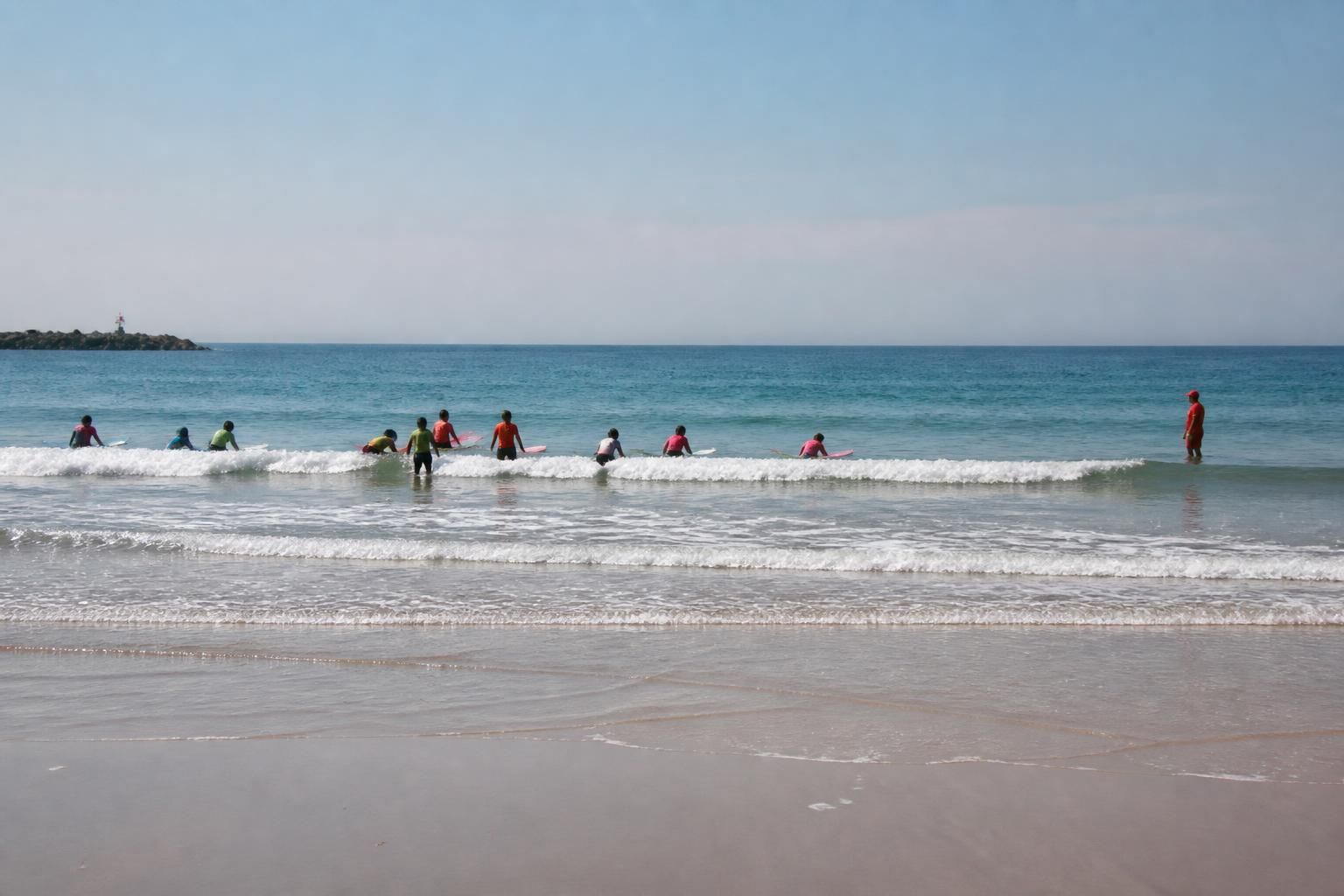
Surf conditions in Hossegor: reading swell, period, wind, and tide
Surf conditions are never just about the predicted wave height. A forecast showing 0.8 m can mean small, easy waves if the period is short, the wind is light, and the sandbar is even. The same height can become more challenging with a long period, a tide that makes the peak steeper, or a current that forces you to paddle constantly. The right approach is to compare several pieces of information, then check them from the beach.
Height indicates the overall size of the swell or estimated waves, but it does not tell the whole story about their energy. Period, expressed in seconds, measures the interval between two swell sets. A period of 6 to 8 seconds often means a shorter, less organized sea. Between 9 and 11 seconds, waves generally gain shape and power. Beyond that, the energy can become very pronounced, even if the height figure seems reasonable.
Why a forecasted small wave can be difficult
A beginner may look at a webcam and see modest-sized waves, yet still find themselves in difficulty. First, because the camera flattens the contours: a peak that looks small on screen can break quickly and far from shore. Then, because sets are not consistent. Between two calm periods, five stronger waves can arrive, move the surfer around, and push them toward deeper water.
Wind also plays a decisive role. A light easterly wind, often called offshore along this coast, smooths the surface and helps the wave hold up. A crosswind creates chop, makes boards unstable, and makes it harder to read the takeoff. An onshore wind, coming from the ocean, distorts the lips and clearly complicates first attempts. A “glassy” surface, smooth as glass, does not guarantee an easy session, but it makes the water’s movements easier to understand.
The tide changes the water depth over the sandbanks. At low tide, some areas may break closer to the sand and offer useful whitewater; elsewhere, they become steep or too shallow. At high tide, the wave may move farther from shore, lose its shape, or concentrate its energy in a smaller area. No fixed rule can replace the combination of forecast, webcam, and direct observation.
- 📱 Check the size, period, swell direction, and wind on a local report.
- 🕒 Check tide times to understand how the window will evolve.
- 👀 Watch from the beach for at least fifteen minutes, including a full set.
- 🏊 Identify rip currents, swimming areas, groups of surfers, and current exits.
- ✅ Choose an easier area than originally planned if doubts remain.
Forecast platforms provide a useful baseline, but data is never permission to go in the water. Webcams make it possible to check the surface conditions, crowds, and overall shape of the lines. A surf report in Hossegor checked before leaving, then again just before putting on your wetsuit, greatly reduces unpleasant surprises.
Summer often brings smaller waves and warmer water, between around 20 and 22°C depending on weather patterns. This is ideal for learning, but crowds can become the limiting factor. In fall, conditions are often magnificent for experienced surfers, while the energy of Atlantic swells requires even stricter selection for beginners.
For your first session on your own, thirty minutes in clean, small whitewater is better than an hour spent struggling in poorly chosen conditions.
Surf safety in Hossegor: rip currents and shorebreak
Surf safety on the beaches of the Landes starts with understanding rip currents. These natural pools form between sandbanks; water pushed toward the beach by waves then seeks a way back out to sea. This return flow can sometimes concentrate in a channel, creating a current capable of quickly carrying away a swimmer, bodyboarder, or surfer who did not anticipate it.
A rip current does not always look like an obvious danger. It may appear as a calmer area, with fewer breaking waves. For a beginner, this lack of whitewater may seem reassuring, even though it can sometimes signal an outlet flowing offshore. Differences in color, darker water, a line of foam moving out to sea, or people drifting sideways are useful clues.
How to respond to a rip current
If the current carries you offshore, do not fight directly against it by trying to reach the beach at all costs. That reaction quickly leads to exhaustion. Keep your board, signal for help if necessary, then move parallel to the shore to get out of the channel. Once you are in an area where the waves are pushing toward the beach again, you can return at an angle without panicking.
For a beginner surfer, the wisest approach is never to deliberately use a rip current to get offshore. Experienced surfers can sometimes use one as a natural elevator, but they understand positioning, paddling effort, and lateral exits. Copying this strategy without knowing the spot increases the risk of ending up too far out, too tired, and in an area where the waves break harder.
Shorebreak is another common danger. It is a wave that breaks violently very close to shore, often in shallow water. With a large foam board, the main risk is colliding with your own equipment or another person. Walk beside your board while the water is shallow, hold the rail firmly, and do not try to get through a powerful wave with the board between you and the wave.
- 🚩 Green flag : swimming allowed in a supervised area, but not entirely risk-free.
- 🟡 Yellow or orange flag : supervised swimming, but conditions may be challenging; ask lifeguards for advice.
- 🔴 Red flag : swimming prohibited; entering the water is not open to negotiation.
- 🟣 Purple flag : indicates potentially dangerous marine animals, including jellyfish.
- 🏊 Swimming area : do not surf there, even if a wave looks perfect and empty.
Supervised areas provide a valuable reference point during the season, but they do not automatically turn the ocean into a swimming pool. Supervision hours, marked access points, and local instructions must be respected. If lifeguards recommend another area or advise against entering the water, their knowledge of the conditions is far more valuable than a forecast checked an hour earlier.
Injury prevention also relies on one essential rule: never throw your board. Even a foam board with a leash can become a projectile when the wave pulls hard. Before letting go of your equipment in a fall, check whether someone is behind you. In a crowded area, the best approach is to keep the board close and protect your head with your arms.
A cautious surfer does not try to conquer the ocean: they choose an area where they can stay clear-headed, breathe calmly, and make it back on their own.
Surf equipment for your first independent session in Hossegor
The right surf equipment makes progression and safety easier. For beginners, a large 8- to 9-foot foam board provides volume, stability, and better flotation. It allows you to catch whitewater waves earlier and reduces the force of an impact compared with a hard board. It is not just a teaching tool: in small conditions, it remains the most sensible choice for building good habits.
The temptation to switch to a shortboard often comes too soon. A short, narrow board may seem more maneuverable, but it requires more paddling, precise positioning, and a later takeoff on the wave. For someone still learning to pop up, it turns an easy session into a series of frustrating misses. A mini-malibu or funboard can become relevant later, once takeoffs are consistent and the surfer begins catching gently sloping green waves.
Board, leash, and wetsuit: the essential trio
The leash must be in good condition, suited to the board’s length, and securely attached. It does not eliminate the need to hold onto your equipment, but it limits drift after a fall. Before entering the water, inspect the cord, Velcro, and plug attachment. A damaged leash that breaks in a rip channel or in the middle of a surfing area turns an ordinary incident into a serious problem.
Your wetsuit depends on the water temperature and wind. In July and August, a shorty or lightweight 2 mm wetsuit may be enough depending on your sensitivity to cold. In June and September, a 3/2 mm is often suitable. From October to May, a 4/3 mm, then a 5/3 or 5/4 mm, becomes necessary, along with booties, gloves, and sometimes a hood in winter. Cold reduces mobility, accelerates fatigue, and impairs judgment: proper thermal gear is therefore a safety essential.
| Equipment | Recommended choice for beginners | Main purpose | Mistake to avoid |
|---|---|---|---|
| 🏄 Board | 8- to 9-foot foam board | Stability and early takeoff | Choosing a shortboard that is too small |
| 🔗 Leash | Length suited to the board | Prevent equipment from drifting away | Using a worn cord |
| 🧥 Wetsuit | Thickness based on the season | Maintain warmth and mobility | Underestimating the effects of cold |
| ☀️ Sunscreen | Water-resistant sunscreen | Limit sunburn and glare | Forgetting the neck, ears, and lips |
| 💧 Water and snacks | Bring them before the session | Avoid low energy | Entering the water dehydrated |
Water-resistant sunscreen is useful even under overcast skies. Glare off the ocean surface and time spent sitting on the board heavily expose the face, neck, and legs. Mineral formulas, when suitable for the skin, can help limit the release of certain chemical components into the marine environment.
Equipment should be carried carefully. On the sand, carry the board at your side, nose facing forward, while watching out for children and swimmers. In the water, it should never be left loose between waves. After a session, rinsing with fresh water extends the life of the wetsuit and leash while allowing you to check the overall condition of your equipment.
The right board isn’t the one that looks impressive on the beach: it’s the one that lets you catch waves without putting yourself or others in danger.
🌊 Safety & conditions quiz
Ready to surf Hossegor with confidence?
8 real-life situations to learn how to read the ocean, follow the rules, and progress without skipping steps.
Crowds and priority rules at surf spots in Hossegor
Crowds are a full-fledged part of surf conditions. A gentle but overcrowded wave can be more difficult than a slightly more powerful wave on a quiet beach. In summer, Hossegor’s central peaks bring together local surfers, vacationers, surf schools, bodyboarders, and swimmers. For a beginner, this density increases the risk of collisions and makes reading the wave pattern much more complex.
Choosing a sensible time helps enormously. In the morning, before the thermal wind picks up and before most summer visitors arrive, the water is often cleaner and access points less crowded. That does not mean every morning is easy; swell and tide still take priority. But all else being equal, an early session often offers more space and less pressure.
Priority keeps surfers safe and the lineup flowing
The basic rule is simple: priority goes to the surfer already riding the wave or to the one closest to the point where it starts to break, known as the peak. If a wave breaks to the right, the surfer positioned farthest left of the peak generally has priority; if it breaks to the left, it is the opposite. Beginners do not need to make complicated calculations: they should look before taking off and let the wave go when someone is already on its path.
A “drop-in” means taking off on a wave that someone is already riding. It can lead to a head-on collision or force the surfer with priority to stop their line. “Snaking,” which means constantly paddling around others to move ahead in the lineup’s unspoken order, is just as frowned upon. On a first independent session, the goal should not be to catch every wave, but to catch the right ones without getting in anyone’s way.
It is useful to watch other surfers from the sand before entering the water. Where is the group positioned? Which way are the waves breaking? Do people consistently return on the same side? Reading these patterns helps avoid crossing the impact zone or ending up in front of an active peak. A practical rule is not to stay still just behind the area where others finish their waves.
- 👀 Look behind you before pushing off on your board.
- ↔️ Keep a safe distance from other surfers and swimmers.
- 🏄 Move out of the line by heading toward the whitewater, never toward the shoulder where the wave is breaking.
- 🗣️ Communicate simply when in doubt: a gesture or a “go ahead” avoids many misunderstandings.
- ⏳ Wait your turn in the lineup rather than rushing every set.
A common scenario sums up the issue well: a surfer who has only recently started going out independently sees a nice whitewater wave coming and takes off without looking. Another person, already standing on an unbroken wave coming in from offshore, has to fall to avoid them. Even without contact, the situation is dangerous and ruins the session for both surfers. The solution is not to have less fun, but to add one second of observation before every takeoff.
Respecting the spot also includes respecting the coastline. Picking up packaging found on the sand, using a reusable water bottle, and avoiding walking on protected dune areas are all part of a consistent approach. Hossegor owes much to its natural environment; protecting it also means being able to continue enjoying its beaches in good conditions.
In a crowded lineup, the most visible progress is not only technical: it is measured by the ability to share the water calmly and predictably.
First independent session after surf lessons: a practical method
Your first session alone should be prepared like a small project, not improvised. Choosing a short time slot, a familiar beach, and modest surf increases the chances of success. Ideally, go back out shortly after your last lessons, with the same type of board and in conditions similar to those you experienced with your instructor. Changing your board, spot, and wave size all at once is a classic recipe for losing your bearings.
Before heading out, make sure you have the physical energy. Too little sleep, a poorly digested meal, dehydration, or shoulder pain can be enough to derail a session. Surfing puts significant strain on the back, arms, neck, and core. Injury prevention therefore involves a brief but serious warm-up: shoulder rotations, wrist mobility, leg activation, and a few core exercises.
A simple scenario for avoiding skipped steps
Imagine Thomas, who has just completed a five-day course. He decides to surf at La Sud on a summer morning, with small waves forecast, light wind, and a tide suited to the area he has observed. Once there, he spends twenty minutes on the sand. He notices that the whitewater breaks consistently on one side, that a darker channel forms farther out, and that experienced surfers stay grouped in the center.
Thomas deliberately chooses the less crowded whitewater area. He enters with his foam board, stays close to shore, sets a maximum session time of forty-five minutes, and gets out at the first sign of fatigue. He catches fewer waves than the surfers farther out, but each one suits his goal: stand up cleanly, look ahead, and stabilize his line. This session is a success, even without a spectacular photo.
A first independent session can also be done with someone close to you, provided that person is truly able to help if there is a problem. A friend who is also discovering the ocean is not a safety measure. Let someone know when you will be surfing, keep your phone dry on the beach or in a vehicle, and never venture beyond the area you observed.
When conditions are uncertain, a supervised stay can provide a reassuring framework without turning the trip into a rigid program. A surf camp in Hossegor focused on board sports can help you get practical advice, share observations, and avoid finding yourself alone in a changing ocean.
Progress is never linear. A great session can be followed by a day when nothing works: the wind shifts, the tide is not right, or fatigue sets in. That is not regression. Regular surfers build their level by accumulating varied experiences, always within a realistic safety margin.
A successful first independent session ends with the desire to do it again, energy to spare, and the confidence of having respected your limits.
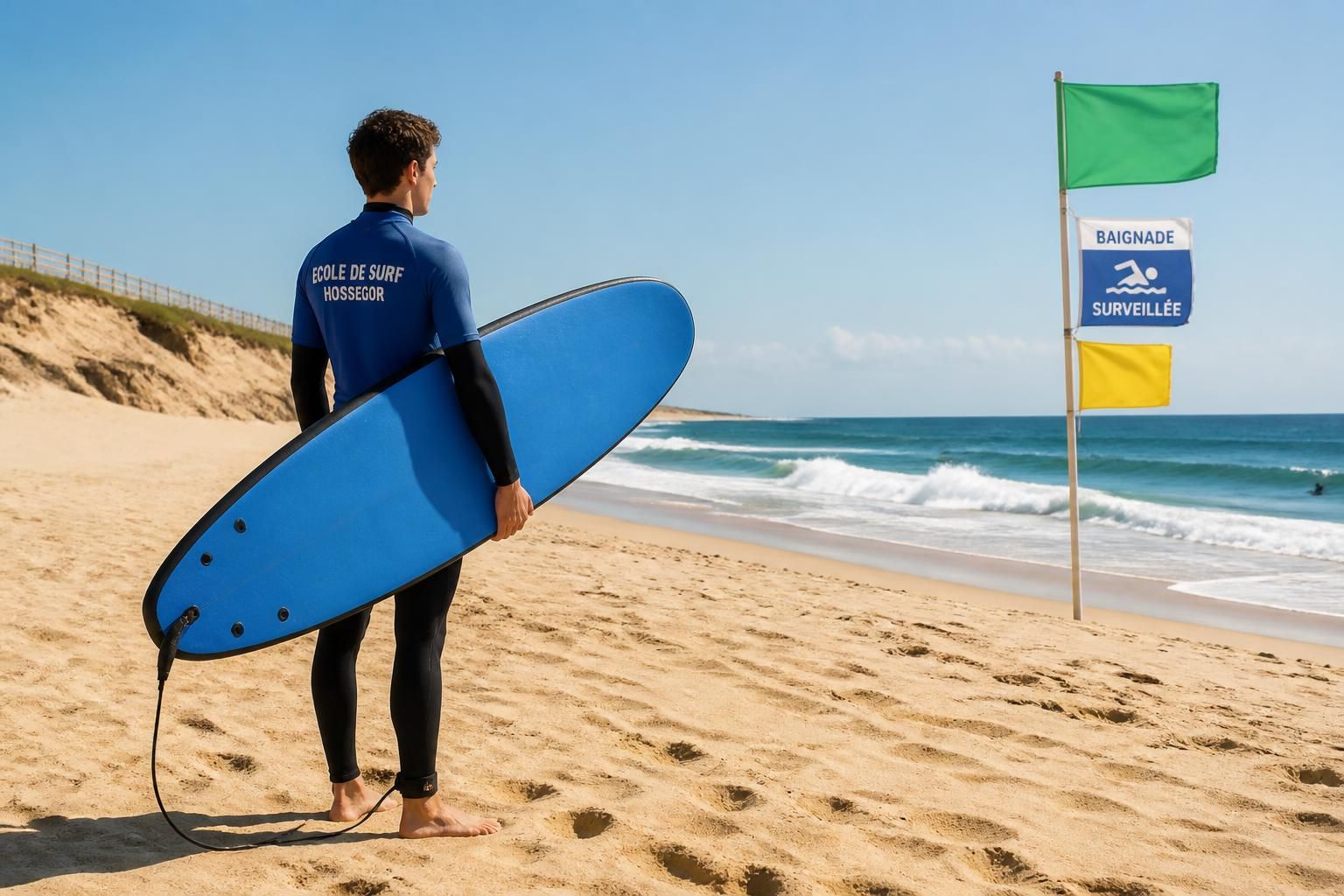
Beginner surf checklist for Hossegor: do I surf, change spots, or call it off?
A checklist helps avoid emotionally driven decisions like, “The ocean is here, so I have to go.” In Hossegor, that pressure can be strong, especially after planning an entire day around surfing. Yet the ocean owes nothing to a vacationer’s schedule. Being able to change spots, wait for the next tide, or choose a land-based activity is a safety skill just as important as the take-off.
The decision should be made before entering the water, then reassessed during the session. The ocean may seem manageable from the beach but become more tiring once you are out back. A more powerful set, a fast drift, or a sudden crowd are enough reason to get out. There is no merit in staying in a situation you no longer control.
I surf if the signs are favorable
The decision to “surf” makes sense when waves break into predictable whitewater, the area has enough space, the wind does not make the water excessively choppy, and the surfer can explain their way in and out. Active lifeguard supervision, when the beach is open, provides a useful reference point. The board should be suitable, the leash checked, and your physical condition satisfactory.
The decision to “change spots” becomes wise when the wave is surfable but too crowded, when the current runs directly through the target area, or when the sandbar creates a break that is too steep. Walking to another part of the beach, asking the lifeguards, or checking the report again may reveal a calmer option. One of Hossegor’s advantages is the proximity of numerous access points: it would be a shame to get stuck on a single idea.
The decision to “call it off” is necessary when the red flag is flying, when sets clearly exceed your ability level, when the rip channel is pronounced, or when fatigue sets in before you even enter the water. It is also necessary when doubt remains after observing the conditions. Persistent doubt is not a lack of courage: it is information.
- ✅ I surf : consistent whitewater, low power, space, checked equipment, sufficient energy.
- 🔄 I change spots : area too crowded, localized current, wave too hollow on this particular sandbar.
- ⏱️ I wait : tide or wind likely to significantly improve the window in a few hours.
- 🚫 I call it off : red flag, strong current, exhaustion, poor visibility, or conditions beyond my level.
This decision framework remains valid in every season. In winter, cold water and powerful swells reinforce the reasons to call it off. In summer, crowds, swimming areas, and boards moving through the water require extra vigilance. In spring and fall, changing conditions call for even more careful forecast checks.
The beaches of the Landes have a distinctive character, combining wide-open spaces, shifting sandbars, and Atlantic energy. This richness is what makes surfing in Hossegor so exciting. It simply requires putting your reading of the environment ahead of the desire to perform. A beginner surfer who knows how to postpone a session quickly becomes safer, more respected, and above all happier in the water.
A good surf day is not one where you go in at all costs: it is one where every decision remains under control, from the parking lot to your return to the sand.
What is the best spot for beginner surfing in Hossegor?
La Sud is often the easiest starting point when the swell is moderate, the whitewater is consistent, and the area is not overcrowded. However, the choice depends on the sandbar, tide, wind, and crowds that day.
Can you surf alone after a few surf lessons in Hossegor?
Yes, in very gentle conditions and with a suitable board, provided you know how to control your equipment, recognize swimming areas, observe currents, and stay in the whitewater. If the waves break far out, quickly, or with power, supervision remains preferable.
Why can small waves be difficult?
Wave height alone is not enough to measure difficulty. A long period, a tide that makes the sandbar steeper, a rip current, cross-shore wind, or shorebreak can make a small forecast far more technical than it appears.
What should you do if a rip current carries you out to sea?
Do not fight directly against the current. Keep your board, stay calm, signal that you need help, and move parallel to the beach to get out of the channel before heading back toward shore at an angle.
What board should you choose to start surfing in Hossegor?
An 8- to 9-foot foam board remains the safest and most effective choice for your first independent sessions. Its volume makes paddling and catching whitewater easier, while reducing the risk of impact compared with a hard board.