
A surf contest becomes clear once three mechanisms are separated: heat formats, wave scoring, and priority. On a beach in Hossegor, the spectacle can seem chaotic: several colored rash vests wait offshore, the announcer calls out “a 6.84 needed,” a siren sounds, and the standings shift after a wave that was not necessarily the biggest. Yet every decision follows a precise logic. Competitors surf within a defined area and time period, their performances are evaluated according to technical criteria, and only the best scores specified by the rules count toward their total.
The figures commonly encountered—20- to 30-minute heats, scores out of 10, and a total out of 20 with two waves—are solid reference points, but not universal constants. A French federal competition, an international event, an ISA championship, a team contest, or an associated discipline may apply different formats. The official rules for the season and the event-specific bulletin always take precedence. This guide helps you read a draw, calculate the required score, understand an interference, and interpret a site change when the swell, wind, tide, or sandbanks of Hossegor change the game.
Heat, round, and draw: understanding the vocabulary of a surf contest
The word most often heard during a competition is probably heat. This Anglicism simply refers to a heat, meaning a timed matchup between several competitors. A surf heat is therefore neither a single round valid for the entire event nor a free session: it belongs to a specific round and produces a ranking that determines what comes next.
The round, sometimes called a tour, brings together several heats at the same level of the draw. If 32 competitors start in eight groups of four, those eight matchups make up the first round. Depending on the chosen format, the top two in each group may advance, while the others are eliminated or sent to a repechage.
Reading the draw without losing track of qualification
The draw represents the path leading to the final. Names, heat numbers, rash vest colors, and qualifying positions are organized in advance, subject to withdrawals and reseeding rules. On a digital display, Q generally means qualified, while another indicator may signal elimination, advancement to the repechage round, or a result that is still provisional.
A seeded competitor is a competitor placed in the draw based on a ranking or status provided for in the rules. This method prevents all the favorites from meeting in the first round. It provides no advantage in scoring: once the siren sounds, reputation, track record, and world ranking must not influence the judges.
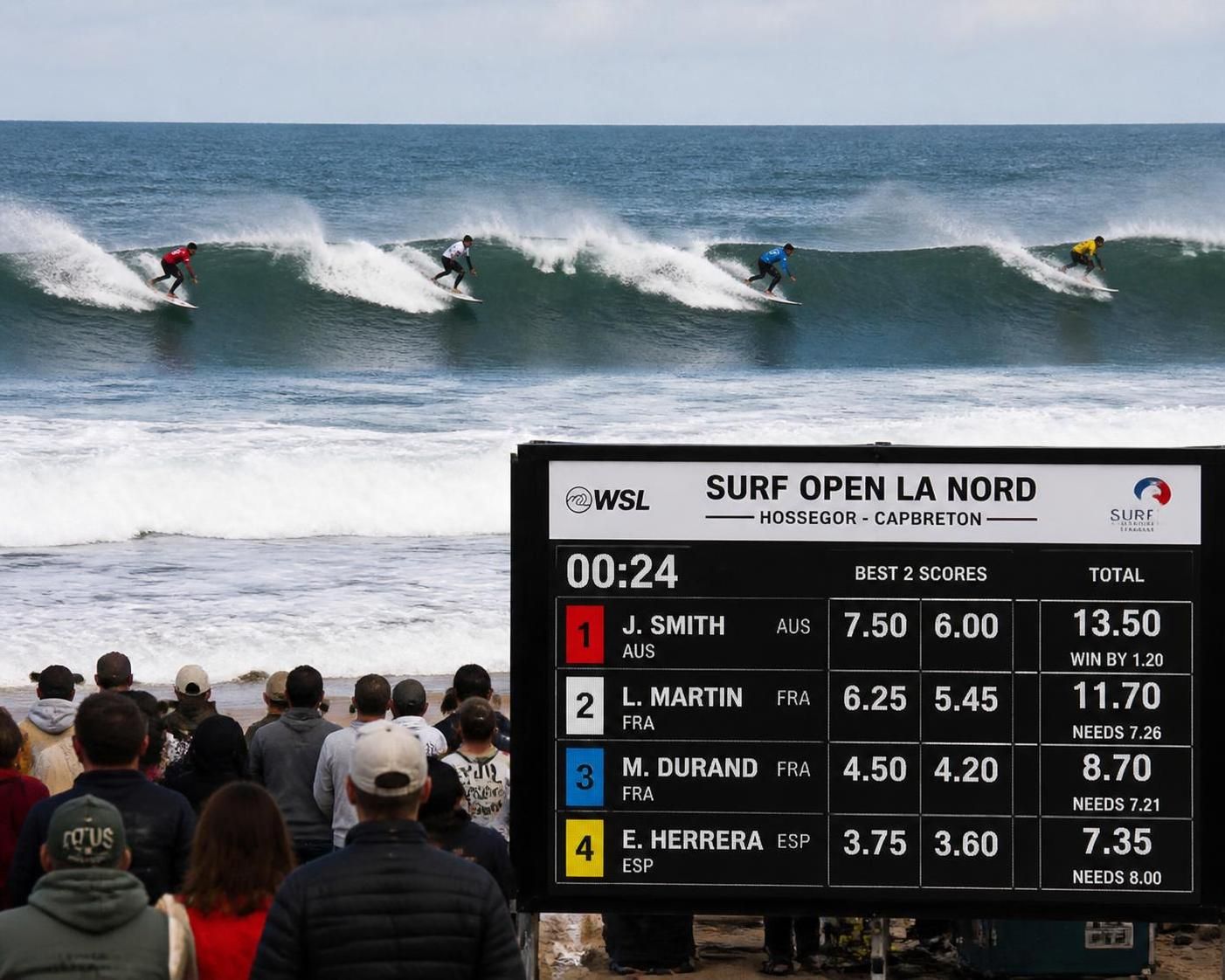
Imagine Maël, a fictional surfer competing in Hossegor. He appears in heat 3 wearing a white rash vest, against competitors in red, blue, and yellow rash vests. The top two places qualify. Maël finishes second with 12.70 points: he advances even though the winner scored 15.10, because his immediate goal was to finish ahead of at least two opponents, not necessarily to post the best total of the entire round.
Repechage, elimination, and required score
The repechage gives a second route to certain competitors who did not secure a qualifying place in their first appearance. This mechanism is notably associated with double-elimination formats and various ISA competitions. It should not be confused with a non-elimination round, in which lower-ranked competitors are redirected without having yet lost a first chance.
The required score, or score to beat, corresponds to the minimum score needed to move up in the rankings. It depends on the best waves already counted. If two waves count and Maël has 6.00 and 4.50, his total is 10.50. To overtake an opponent on 12.00, he needs to improve his lowest counted score: a wave above 6.00 is needed to move ahead, with a small margin due to hundredths and tiebreak rules.
- 🌊 Series or heat: timed matchup between the listed surfers.
- 🧭 Round: all heats belonging to the same stage of the event.
- 🗂️ Bracket: competitors’ path to the final rounds.
- 🔁 Repechage: a route that allows competitors to remain in contention after an insufficient initial result.
- ⭐ Seed: athlete positioned according to a ranking or seeding rule.
- 🎯 Required score: score needed to improve the total and secure the targeted position.
This terminology avoids a common misunderstanding: winning a wave means nothing in itself, because it is the heat ranking that opens or closes the door to the next round. A complementary overview of the how a competition bracket works also helps visualize the sequence of stages. The first key to understanding is therefore to look at the qualifying position before focusing on the scores.
Heat duration and number of waves: the rules of the surfing competition format
A heat has a start time, a duration, a competition area, and an official end. Heats often last between 20 and 30 minutes, but this range is not an absolute rule. A final, a particular discipline, a two-person format, or unusual conditions may justify a different duration set out in the rules or decided under the authority granted to the competition director.
The clock starts at the official signal, generally marked by a siren and a change of flag or display. A wave must be taken within the allotted time to count. Simply being on your feet after the end signal is not enough to disqualify it: officials verify when the wave was actually taken, according to the definitions applicable to the event.
Two, three, or four competitors in the water
A heat can pit two, three, or four surfers against each other, and sometimes more in specific formats. Four-surfer heats are common in the early rounds because they make it possible to process a large bracket. Head-to-head matchups become common in direct-elimination final rounds: each wave then directly changes the gap between two opponents.
The number of people changes the strategy. With four surfers, the risk of being poorly positioned increases and priority rotation can become complex. With two, each can watch the opponent more easily; the leader can use priority to control wave selection, without deliberately causing interference contrary to the rules.
At Hossegor, this difference is particularly evident on a shifting peak. In a four-surfer heat, a competitor may choose to stay slightly offset to find less contested waves. In a head-to-head matchup, they may instead seek to maintain tactical contact, especially in the final minutes, when their rival needs only an average score.
How many waves are ridden and how many are counted?
The rules may set a maximum number of waves allowed. This limit prevents a competitor from monopolizing all opportunities and makes sporting management easier. It should be distinguished from the number of scores included in the total: an athlete may ride several waves, while only their two best are usually added together in individual shortboard.
The standard format therefore produces a maximum total of 20 points: 10 + 10. A third wave scored at 7.00 remains visible in the history, but it does not change a total already made up of 8.00 and 7.50. If this third performance earns 8.20, it replaces the 7.50 score and the total rises from 15.50 to 16.20.
| Element | Common benchmark | Point to check |
|---|---|---|
| ⏱️ Duration | Often 20 to 30 minutes | Official bulletin and daily announcements |
| 🏄 Competitors | Often 2 to 4 per heat | Round format and discipline |
| 🌊 Waves ridden | Several, with a possible cap | Maximum allowed for the heat |
| 🧮 Scores counted | Usually the best two | Individual, team, or special format |
| 📊 Typical total | Out of 20 points | Number of waves counted |
What happens when the ocean is almost flat? The competition director may delay the start, suspend operations, or apply the procedures set out for a heat affected by exceptional circumstances. It is not enough for a competitor to consider the waves poor: the decision belongs to the officials and must preserve the fairness of the entire draw as much as possible.
Conversely, a heat can provide plenty of opportunities without becoming easier. A fast pace forces competitors to choose: go immediately on a decent wave or keep priority for a deeper, more powerful one? The number of waves does not win a heat; the value of the scores counted and tactical management make the difference.
How do judges score a wave in a surfing competition?
The surf competition scoring does not reward a maneuver using a fixed scale. A roller is not automatically worth two points, and a tube does not automatically earn a 9. The score reflects the overall performance on the wave, taking into account what it allowed, the level of risk taken, and the actual quality of execution.
Contemporary rules are based on several key criteria: commitment and degree of difficulty, innovation and progression, combination of major maneuvers, variety, speed, power, and flow. Their weighting varies depending on the wave and discipline. At La Gravière, a deep tube can represent a wave’s full potential; on a more open peak, a sequence of powerful, perfectly placed turns may be valued more highly.
Commitment, difficulty, and wave selection
Commitment measures, among other things, athletic risk and how a critical section is used. A late takeoff under the lip, followed by a controlled line, shows more commitment than a cautious start on the shoulder. Difficulty also depends on the section’s speed, verticality, and the precision required.
Size alone therefore does not determine the score. A large wave poorly handled can score less than a slightly smaller wave surfed perfectly in its most powerful section. At Hossegor, two waves of similar height can offer opposite possibilities: one closes out abruptly, while the other offers a tube followed by a workable exit.
Innovation, variety, and combination
Innovation rewards surfing that pushes beyond the expected level, provided the maneuver is controlled. An air with rotation, landed cleanly and followed by another move, has strong potential value. A spectacular attempt that ends without control may receive a lower score, even if the crowd reacted loudly.
Variety prevents a performance made up of repetitive moves from being automatically overrated. Linking an aggressive carve, a vertical attack on the lip, and an aerial maneuver demonstrates a broader technical range. Combination assesses the coherence of this whole: the actions must be connected by an effective line rather than artificially placed one after another.
Execution, speed, power, and flow
A maneuver must be completed. Judges observe the landing, the maintenance of control, and the ability to continue down the wave. A fall does not necessarily erase everything that came before, but it often reduces the value of the unfinished action and can undermine the overall impression of control.
Speed is not only what the wave provides. It also comes from generating drive, choosing the right line, and maintaining momentum between two sections. Power is evident in the intensity of direction changes and water displacement, while flow reflects the absence of unnecessary breaks.
Consider two fictional waves. On the first, Maël makes five cautious turns far from the pocket and finishes standing. On the second, he performs only two maneuvers, but attacks the most vertical section with speed, projection, and control. The second can score significantly better because quality and degree of difficulty take precedence over the raw number of moves.
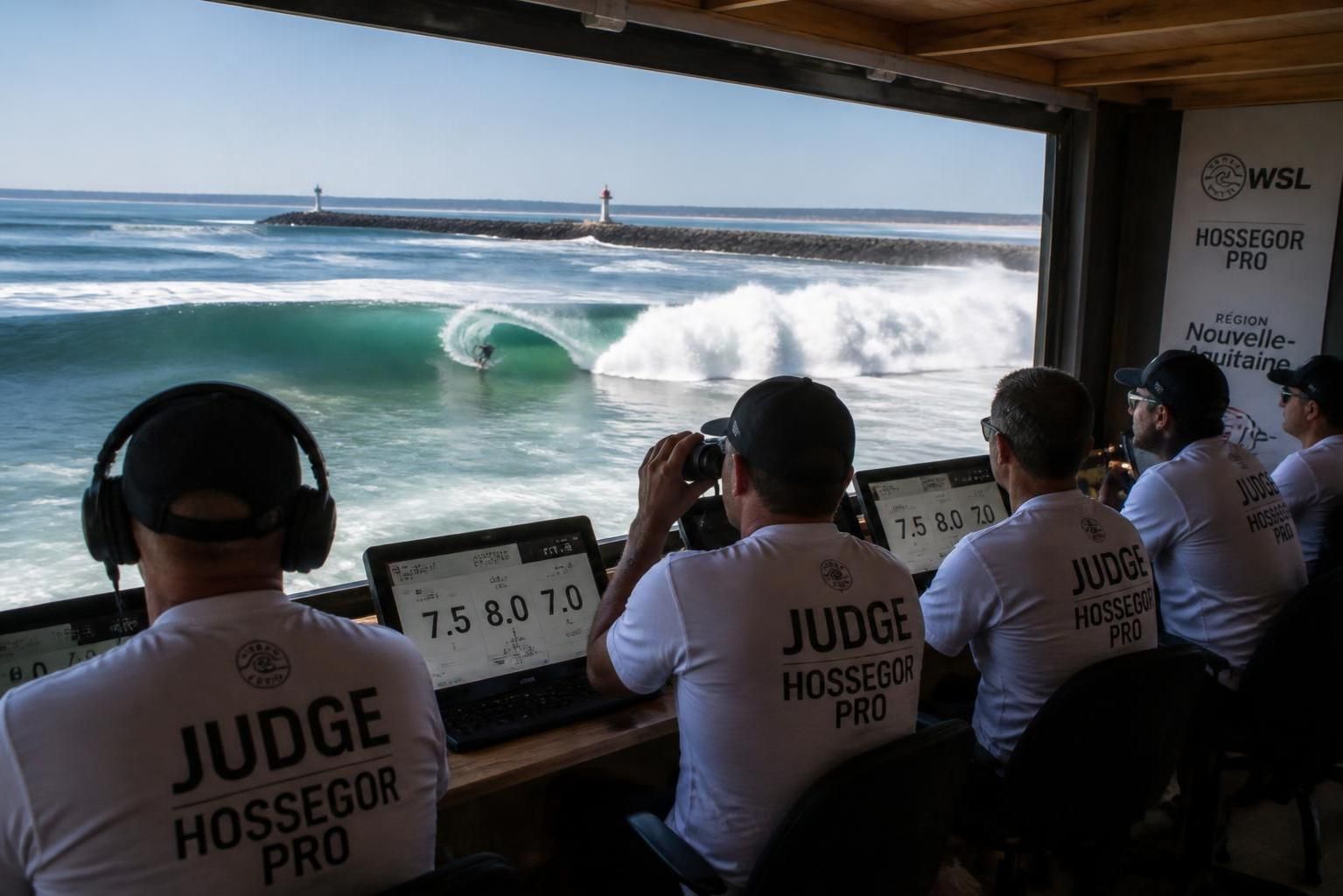
Each judge gives a score on a scale from 0 to 10. In many systems, the panel’s extreme scores are removed before calculating the average, in order to limit the impact of an isolated assessment. However, the exact composition of the panel and the calculation method should be checked in the organizer’s rules.
The descriptive categories sometimes used—poor, fair, average, good, excellent—help maintain internal consistency. They are not a rigid catalog. To compare this mechanism with the perspective of a top-level athlete, the Johanne Defay’s explanations of judging provide concrete insight.
Finally, judges implicitly compare performances to the level of the day. An 8 must remain excellent in the context of the heat and the event, rather than being awarded for the first clean move. The score evaluates what the surfer actually produced from the available potential, not what the wave could have become.
Scale of 10, total of 20, and calculating the score needed
The system may seem mathematical, but understanding it requires distinguishing between three values: the score for a wave, the surfer’s total, and the displayed score needed. Each performance is generally scored out of 10, then the two best scores form a total out of 20. The other scores remain in reserve and can be replaced as soon as a better wave is validated.
Maël has 7.20 and 6.80. His total is therefore 14.00. A new wave scored 6.50 adds nothing, since it remains below his two counting scores. With a 7.60, it replaces the 6.80 and raises the total to 14.80.
Calculating the score needed without making a mistake
To overtake an opponent, you need to identify the lower of the two scores currently counting, then calculate the difference from the target total. Suppose Léa leads with 13.50 and Maël has 7.00 + 5.20, for a total of 12.20. His next performance will replace the 5.20 if it is higher. He therefore needs a score above 6.50 to pass 13.50.
The live scoring may display “needs 6.51” depending on the precision applied and tiebreak rules. The word need refers to the score required on one new wave, not the number of points to add directly to the total. That is why a competitor trailing by 1.30 points may need a 6.51: the score being replaced is simultaneously removed from the calculation.
When the score needed exceeds 10, the competitor is in a combination situation. They can no longer regain the lead with a single wave, even a perfect one. They must improve both counting scores. The announcer may say that “two waves” are needed without yet knowing their exact breakdown.
What score is needed on the next wave ?
Enter the surfer’s two best scores and the total to beat. The calculator automatically keeps the best score and replaces the lower one.
Minimum score required
7,71/ 10
The 5,25 score is replaced. A wave scored at least 7,71 would beat the opponent’s total.
Important : this result adds one hundredth to beat the entered total. In the event of a tie or special situation, the official competition rules determine the tiebreakers.
Calculation : 14,50 − 6,80 + 0,01 = 7,71
Provisional scores, validation, and tiebreakers
A displayed score may be provisional for a few moments. Judges finish entering their scores, the system calculates the value retained, and a review may take place. In a very long heat, the announcement sometimes comes while the competitor is already paddling back out.
A review is not intended to satisfy the reaction from the beach. It follows the judging system’s procedures: data-entry error, administrative verification, or a mechanism expressly permitted by the rules. The announcer informs the public, but does not choose the score or how it changes.
A tied total may be broken according to the event rules, often based on the best individual wave, then subsequent scores if necessary. A surfer with 8.00 + 6.00 can therefore move ahead of a competitor with 7.50 + 6.50 despite their identical total of 14.00, if the best score is the first criterion.
Why can the announced score change?
The requirement changes as soon as an opponent improves one of their waves. With three minutes remaining, Maël may need a 5.90. If the leader then receives an 8.20 on a new attempt, Maël’s requirement immediately increases. This movement explains the importance of the digital scoreboard and audio announcements.
A subtler example occurs when a score comes in after simultaneous waves. Maël is surfing while Léa finishes another right on the opposite side of the peak. His displayed requirement at takeoff may become outdated before he even exits the wave. Judges still score each maneuver on its quality; they do not inflate a score because it is decisive.
Spectators can practice using a simple method: identify the two highlighted boxes, add those values, then observe which score will be replaced. A guide to heat scoring provides a deeper understanding of these basics.
It remains essential not to read a 7 as an average school grade. In a high-level heat, 7 points generally represents a good wave, and two scores of that quality make for a solid 14. The required score tells the strategy in real time: it indicates less the raw deficit than the exact quality needed from the next wave.
Priority in surfing competition and interference penalties
The surf competition priority gives a competitor the right to choose a wave without others reducing its scoring potential. It structures the contest and prevents a constant battle at takeoff. Its operation varies according to the number of participants, the peak configuration, and the system used, hence the need to follow the priority board.
In a two-person heat, the surfer without priority can take a wave left open. After certain actions defined by the rules, the order changes. With three or four competitors, a priority ranking may be displayed: first, second, third, or no acquired priority.
The inside position is not always enough
In free surfing, priority is often summed up as “the deepest surfer.” In competition, that formula becomes insufficient as soon as an official system is active. A competitor better positioned near the breaking wave may have to yield the wave to the one holding displayed priority.
Calling out creates no right. Raising arms, paddling earlier, or calling “left” does not replace the order established by officials. On a peak clearly opening in two directions, two competitors can sometimes each go their own way, provided their lines correspond to distinct potential and no interference is created.
In Hossegor, sandbar peaks shift and can form a right and a left from the same bump. The priority judge must then observe positioning, available directions, and each surfer’s actions. A valid reading at the start of the heat may change after a lateral shift in the peak.
What is interference?
An interference is called when a competitor affects another’s scoring potential under the conditions defined by the rules. A collision is not necessary. Forcing a rival to alter their line, blocking a section, or hindering their paddling may be enough if the action has compromised a real opportunity.
The classic case involves a surfer without priority taking off in front of the priority holder. Even if they quickly pull out, they may have delayed the ride or changed its line. Judges assess the entire action, not just physical contact.
Interference can also occur while paddling back to the lineup. The competitor paddling out must avoid the active zone as much as possible. If their presence, board, or leash forces the surfer on the wave to go around an obstacle, a penalty may be considered depending on responsibility and the realistic possibility of avoiding the situation.
Sporting consequences of a foul
The exact penalty depends on the applicable rules. It may affect the value of a wave, the number of scores counted, or the priority order. The often-repeated idea that “the second-best wave is always canceled” oversimplifies the regulatory variations.
In a system where only one score remains counted after the penalty, the impact becomes enormous. A competitor with 8.00 and 7.00 may end up with a competitive total based only on 8.00 or be subject to the mechanism provided by the rules. A foul late in the heat can therefore turn a comfortable qualification into elimination.
Priority does not allow everything. Its holder must not use their position to artificially provoke a foul or deliberately hinder an opponent without competitive necessity. Officials distinguish lawful tactical management from unsporting behavior.
- 🚦 Check the priority indicator before interpreting a simultaneous takeoff.
- 👀 Check whether the priority competitor had genuine potential on the wave.
- ↔️ Observe whether the lines could coexist in two distinct directions.
- ⚠️ Look for a line change, a lost section, or a created risk.
- 📋 Wait for the official decision rather than assuming a penalty from the beach.
Competitors do not call interference on themselves, and the announcer does not decide it. Any protest follows a regulated procedure; it does not involve publicly debating the technical assessment of each score. To keep a reminder handy, a memo on waves, scores, and priorities brings together the essential principles.
Priority protects an opportunity to score, while interference penalizes the destruction of that opportunity. This distinction helps explain why an action without a collision can cost more than a spectacular fall.
Competition formats: elimination, repechage, round robin, and teams
The surf competition format determines the number of chances granted, the qualifying spots, and how the winner is determined. Two events held on the same beach can use very different structures. Spectators should therefore check the bracket before applying habits learned on another tour.
Single elimination is the most intuitive. The top finisher or finishers advance, while the others leave the bracket. In a head-to-head matchup, only one spot is available; in a four-surfer heat, two qualifying spots may be available. This format creates high tension, but a single poor performance is enough to end a run.
Double elimination and repechage rounds
Double elimination generally offers a second chance. After an initial loss, the competitor moves into a repechage bracket or round. Another loss then results in elimination. This system requires more heats and can affect the schedule when the weather window tightens.
ISA competitions have historically used repechage formats, particularly at events where individual results also contribute to a national ranking. The path of a finalist coming through repechage can become especially long: they must survive several additional heats.
Repechage is not a favor granted afterward. It is built into the event structure and applies to everyone under the same conditions. A spectator who sees a defeated athlete appear again should check the bracket column before suspecting an anomaly.
Round robin and groups
A round robin organizes several matchups within a group. Each competitor faces different opponents or takes part in several heats, then a cumulative ranking determines the qualifiers. This method reduces the impact of a single unfavorable heat, but requires precise criteria to break ties.
Points may be awarded based on finishing position, total score, or an event-specific scale. An excellent wave score does not always guarantee first place in the group if consistency across several rounds is the main objective.
Finals and team competitions
A final may feature two or four competitors depending on the organization. It generally resets the sporting totals: scores from previous rounds are not added to the final total. The ranking in the last heat determines the winner, unless a different format is explicitly stated.
In team events, individual results contribute to a collective total. Some events use relays, split times, or a mandatory return zone. A timing error can then cost points for the entire group, even if the waves surfed were excellent.
Coaching and communications may also be regulated. Instructions allowed in a school competition or relay are not necessarily permitted in an individual event. Equipment, substitutions, and start orders must be checked before the start.
| Format | Principle | Strategic effect |
|---|---|---|
| 🏁 Single elimination | One loss can end the run | Immediate decision-making |
| 🔁 Double elimination | A second path after an initial loss | Managing a longer progression path |
| 🔄 Round-robin | Several results determine a ranking | Consistency becomes decisive |
| 👥 Teams | Performances contribute to a team total | Coordination and tactical discipline |
| 🏆 Final | Final matchup for the title | Previous scores are generally reset to zero |
Modern surfing has not always had these sophisticated brackets. The practice comes from Polynesian cultures, particularly Hawaiian culture, while modern competitions gradually became structured during the 20th century. An event organized at Corona del Mar in 1928 is often cited among the first official American contests; the 1964 world championship then marked the sport’s internationalization.
This history explains the current coexistence of federated, professional, and national models. The WSL, ISA, and federations do not pursue exactly the same institutional objectives. Before counting the remaining chances, it is therefore necessary to identify the organizer and the branch of the bracket in which the competitor stands.
Competition director, judges, announcer, and safety: who decides what?
A contest relies on a chain of responsibilities. The public mainly hears the announcer and sees the judges’ scores, but decisions begin well before the first horn sounds. Spot assessment, course marking, rescue, timing, priority, and result validation form a coordinated whole.
The competition director manages the sporting proceedings within the framework of the rules. They can start heats, reorganize the schedule, suspend the event, or propose a relocation when conditions no longer allow for a fair and safe matchup. They do not choose a wave’s score.
Head judge and scoring panel
The head judge oversees the panel, ensures consistency in the scale, and reiterates the applicable criteria. They monitor scoring trends, organize the prescribed procedures, and handle matters within their area of responsibility. Their role is not to arbitrarily impose the same score on everyone.
Judges assess waves independently from a vantage point that allows them to follow the trajectories. They must remain focused even when two competitors surf almost simultaneously. In this case, identifying the jerseys and internal communication become essential.
A priority judge or dedicated system tracks the order of rights to waves. The information is communicated by board, screen, or visible signal. A competitor’s misreading does not automatically cancel the consequences of their action.
The announcer informs without officiating
The announcer announces the time remaining, validated scores, requirements, and jersey colors. Their voice makes the heat easy to follow from the beach, but it is not always the primary official display. In the event of a temporary discrepancy, the scoreboard and officials’ decisions prevail according to the event procedures.
An announcement such as “blue needs a 7.14” must be understood in its time context. If another score comes in a few seconds later, the requirement changes. The announcer may also specify that a result is provisional or that an interference decision is under review.
Water safety and competitors’ responsibility
The safety team monitors currents, collisions, lost equipment, and medical incidents. In Hossegor, channels, lateral currents, and the power of the shorebreak require particular vigilance. Watercraft or rescue personnel positioned on shore may be deployed depending on the level of the event.
The presence of a rescue team does not relieve competitors of their obligations. Equipment must comply with regulations, the leash must be used when required by the rules, and zone instructions must be followed. An injured or disoriented competitor should report their condition rather than try at all costs to save a qualification.
The director may suspend a heat in the event of sudden danger: a storm, poor visibility, a drifting object, pollution, concerning animal presence, or a sudden change in ocean conditions. The terms for resuming then depend on the applicable rules and when the interruption occurred.
Jerseys, flags, and sirens
Colored jerseys identify competitors. Red, white, blue, and yellow are common colors, but the order and palette may vary. Matching each name to the right color before the start prevents a wave from being credited to the wrong athlete.
Sirens generally signal the start and end, with distinct sequences announced during the briefing. Flags may indicate a heat in progress, a transition, or a suspension. It would be dangerous to automatically apply the codes from one event to another: the day’s briefing takes precedence.
- 📣 Follow the official timing and validation announcements.
- 🎽 Match each name to its jersey color.
- 🚩 Check the local meaning of the flags.
- 📱 Check the live score for detailed scores.
- 🛟 Follow any safety instruction immediately.
For spectators, the best approach is to cross-reference three sources: the action on the water, the official board, and the audio commentary. Each role has its boundaries: the director organizes, the judges assess, the announcer explains, and safety personnel protect.
Swell, wind, tide, and sandbanks: why a contest in Hossegor changes
A surfing competition does not take place in a fixed stadium. In Hossegor, a few hours can turn a barreling peak into a fast wall or an almost unrideable zone. The morning call, spot selection, and any potential wait therefore reflect a technical reading of the ocean, not merely organizational convenience.
The swell is described in particular by its height, period, and direction. A long period carries more energy and can produce powerful sets with significant waiting times. Its angle determines how the lines meet the sandbanks and spread across different sections.
Wind changes the surface and shape of waves
Offshore wind can hold up the lip and clean up the water surface, but excessive strength makes takeoffs more difficult and blows spray into the field of vision. Onshore wind often degrades the surface, shortens clean sections, and makes landings less stable.
Judging remains based on the performances actually available. However, if the wind changes suddenly between two parts of the draw, the organizers seek to maintain reasonable fairness. They cannot guarantee identical waves for every heat, as this variability is part of the discipline.
Hossegor’s tides and sandbanks
The tide changes the depth over the bottom. On some banks, a tide that is too low can make the wave extremely hollow and dangerous; too high, it can weaken the break or shift the effective zone. The ideal time depends on the current bank, the swell, and the tidal coefficient.
Sandbanks are reshaped by storms, currents, and sediment deposits. A high-performing peak can disappear after a strong swell. That is why a spot’s reputation is not enough to make a decision: an on-site inspection, supplemented by forecasts and observations, remains essential.
On a hypothetical morning, the main site has fast closeouts on the outgoing tide. A nearby section offers more consistent right-handers and a better-controlled safety zone. The director may move the call if the regulatory window, permits, and logistics allow it.
Postponement, hold, and relocation
A postponement occurs when conditions do not allow the event to start or continue properly. A hold keeps competitors available while a new assessment is carried out. A relocation changes the competition area and requires clear communication with athletes, officials, and emergency services.
These decisions take sporting quality into account, as well as safety and the time remaining in the event window. Waiting for hypothetical perfection can prevent the draw from being completed. The aim is to find a fair and workable window, not to guarantee flawless barrels for everyone.
Spectators should follow the time of the next call rather than a rumor circulating on the beach. Official channels, the live feed, and the sound system specify the status: on hold, off for the day, site change, or new inspection. To plan a session around these variations, this guide to surf seasons in Hossegor helps explain the local ocean conditions.
Different conditions, the same judging framework
A small wave does not necessarily diminish the spectacle. It can favor generated speed, quick combinations, and airs. A heavy swell places more value on commitment at takeoff, tube riding, and control under pressure.
The criteria remain the same, but their expression changes. Relevant innovation on a one-meter wave is not the same as what is expected in a two-meter barrel. Judges assess what constitutes major surfing within the possibilities offered at that moment.
Local knowledge earns no extra points, but it helps with choosing the right area and anticipating the tide. Maël may know that a right-hander gradually shifts north; he still has to turn that reading into successful maneuvers. In Hossegor, the playing field is constantly changing: the organizers seek fairness, while the surfer turns uncertainty into strategy.
French regulations, international circuits, and related disciplines
The surf competition rules share a common foundation, but their details vary according to the organizing authority, season, category, and discipline. As of the 2026 reference date, any changes must be checked in the regulations published for the year and in the event-specific documents. An educational guide never replaces these texts.
In France, federation competitions may take place at different regional and national levels. Categories, registration procedures, qualifications, equipment, and disciplinary procedures are governed by the current federation documents. The French Championships bring together several disciplines and age groups according to the selected schedule.
WSL, ISA, and federation structure
The World Surf League organizes professional circuits with their own rankings, formats, and seasonal regulations. The Championship Tour represents the professional elite, while other levels contribute to qualification pathways. As roster sizes and qualification methods have changed over the seasons, historical figures should not be treated as constants in 2026.
The International Surfing Association is recognized by the International Olympic Committee as the global governing body for Olympic surfing. Surfing was added to the Olympic program in 2016 and made its debut at the Tokyo Games, held in 2021 despite the Tokyo 2020 name. ISA events often have a strong national dimension and team rankings.
French federation regulations govern national competition; the ISA oversees its international championships and the framework linked to the Olympic movement; the WSL manages its professional circuits. These worlds overlap through athletes and judging principles, without becoming legally interchangeable.
Shortboard, longboard, bodyboard, and para surfing
In shortboarding, the emphasis is generally on major maneuvers, progression, speed, power, and control. Longboarding values elements specific to its practice, including board use, movement, control, and traditional and modern sections according to the stated criteria.
Bodyboarding has its own maneuvers, lines, and execution requirements. A tube, roll, or rotation is not assessed like a shortboard turn. Drop-knee categories and other variations must be judged according to their own criteria.
Para surfing classifies athletes according to functional categories defined by the relevant regulations. Judges adapt their assessment to the potential specific to each class without abandoning sporting standards. An overview of para surfing performances at the French Championships shows the technical diversity of these events.
The checklist to review before each heat
An informed spectator starts by identifying the organizer. They then check the discipline, category, number of waves counted, duration, qualifying spots, and priority system. This simple routine prevents almost all misunderstandings.
- 📘 Applicable text: season regulations and event-specific rules.
- 🏄 Discipline: shortboard, longboard, bodyboard, para surfing, or another board type.
- ⏳ Heat: duration, area, and any wave limit.
- 🧮 Scoring: number of scores retained and tiebreaking method.
- 🚦 Priority: system used and consequences of an interference.
- 🏁 Qualification: advancing spots, repechage, or elimination.
Regulatory updates must be dated, as a rule learned during a previous edition may have changed. This applies to penalties, protest procedures, circuit roster sizes, and certain formats. A general resource on heat rules and priority rules provides guidance, but the organizer’s official document takes precedence.
From the beach, the ideal way to follow the action ultimately comes down to five steps: spot the jerseys, read the clock, identify the two counting scores, watch priority, and check the qualifying places. Everything else—strategies, wave choices, and turnarounds—then becomes much more exciting. Understanding a contest is not about memorizing a universal number, but knowing which rules turn the day’s waves into a sporting result.
How many waves count in a surf heat?
In the most common individual format, the two best waves are added together for a total out of 20. Some team formats, disciplines, or specific rules may count a different number of scores: the event’s official announcement takes precedence.
How do you calculate the score needed to move ahead?
You need to replace the lower of the two counting scores. If a surfer has 7.00 and 5.20 against a total of 13.50, they need more than 6.50 to surpass that total, subject to hundredth-place precision and tiebreak rules.
What is interference in a surfing competition?
Interference is an obstruction that reduces a competitor’s scoring potential under the conditions set out in the rules. A collision is not required: cutting off a line, hindering paddling, or forcing a change of line may be enough.
Why is a heat moved or postponed in Hossegor?
Swell, wind, tides, and shifting sandbanks can make an area dangerous, unfair, or difficult to use. The competition director may wait, suspend, or move the event within the limits of the rules and the competition window.
Does a fall invalidate a wave score entirely?
No. Judges may reward maneuvers successfully completed before the fall, but an unfinished action, loss of control, and failure to ride out generally reduce the overall score.