
In Hossegor, surfing did not become established by chance or through a simple succession of competitions. This Landes resort built its reputation by combining a coastline particularly exposed to Atlantic swells, an already well-established beach culture, highly active communities of surfers, and an industry able to circulate boards, wetsuits, images, and ideas. From the 1960s onward, the first surfers understood that the long sandy beaches of southern Landes offered a unique playground. From the 1980s onward, the arrival of international brands and sporting events turned this recognition among insiders into a European phenomenon.
The term European surfing capital therefore does not merely describe the quality of the waves. It tells the story of a town where surfing shapes the seasons, shop windows, employment, commercial architecture, and collective imagination. Between La Gravière, La Nord, Les Estagnots, and Plage Centrale, Hossegor has become as much a technical benchmark as a place for passing on knowledge. Its history remains linked to Biarritz, the Basque Country, Capbreton, and the entire Atlantic coastline, but it has its own trajectory: that of a seaside resort turned into a laboratory for surfing 🌊.
Hossegor Before Surfing: From a Landes Seaside Resort to an Ocean-Facing Coastline
Before becoming a name immediately associated with shortboards, sandy barrels, and international competitions, Hossegor was first and foremost a seaside resort built around the forest, marine lake, and its opening onto the Atlantic. Its urban development accelerated in the early 20th century, amid the garden city movement and the growth of seaside leisure. Basque-Landes villas, pine forests, promenades, and seasonal shops created a setting that attracted families, spa-goers, and vacationers seeking sea air.
This first identity plays a major role in the future history of surfing. A resort already organized to welcome visitors has beach access, accommodations, restaurants, and the ability to live by the rhythm of summer. Surfing therefore did not arrive in an empty space: it was added to an existing tourism economy, then ultimately reshaped its codes in profound ways. Swimwear, terraces, shop windows, and conversations gradually adopted a new vocabulary.
The area also has a decisive geographical feature. Hossegor lies near the Capbreton canyon, a vast underwater canyon extending into the Bay of Biscay. The canyon does not mechanically “create” every wave, but its bathymetric environment, combined with the coastline’s shifting sandbanks, contributes to the complexity of local conditions. Northwest and west swells find open, long, ever-changing beaches here.
This configuration explains why the coastline does not offer a single fixed surf spot. Reading the ocean changes with tides, storms, shifting sand, and winds. An area that performs very well in fall may become less interesting a few weeks later. It is precisely this variability that has shaped a technically skilled local culture: knowing a place is not enough; you have to observe it regularly.
Beaches That Support Both Learning and Performance
The roughly seven kilometers of beach between the Plage Centrale area, Les Estagnots, La Gravière, and La Nord form a continuous but uneven stretch. Plage Centrale can offer more accessible conditions when the swell is moderate. Les Estagnots retains the atmosphere of a busy beach, while La Gravière is sought after for its sandbanks capable of producing hollow, fast waves. Farther north, La Nord reveals its full potential during strong swells, with energy that demands solid experience.
This diversity is a rare advantage for a destination. During the same stay, a beginner can catch their first whitewater waves with an instructor, while an experienced surfer watches a more powerful set a few hundred meters away. The important thing is not to confuse proximity with difficulty level: a very well-known beach is never automatically suited to everyone.
- 🌊 Plage Centrale : often chosen for lessons and beginner sessions when conditions allow.
- 🏄 Les Estagnots : a versatile area, highly dependent on sandbanks and the tide.
- ⚡ La Gravière : a fast, hollow, technical wave, famous among experienced surfers.
- 🌬️ La Nord : an exposed surf spot, particularly demanding during major fall and winter swells.
The seaside resort thus provided surfing with a logistical framework, while geography supplied it with exceptional raw material: frequent, changing, and sometimes spectacular waves. This meeting of resort urbanism and ocean energy explains the first layer of Hossegor’s identity.
The Origins of Surfing in Hossegor: The Spread of the Sport Along the Landes Coast
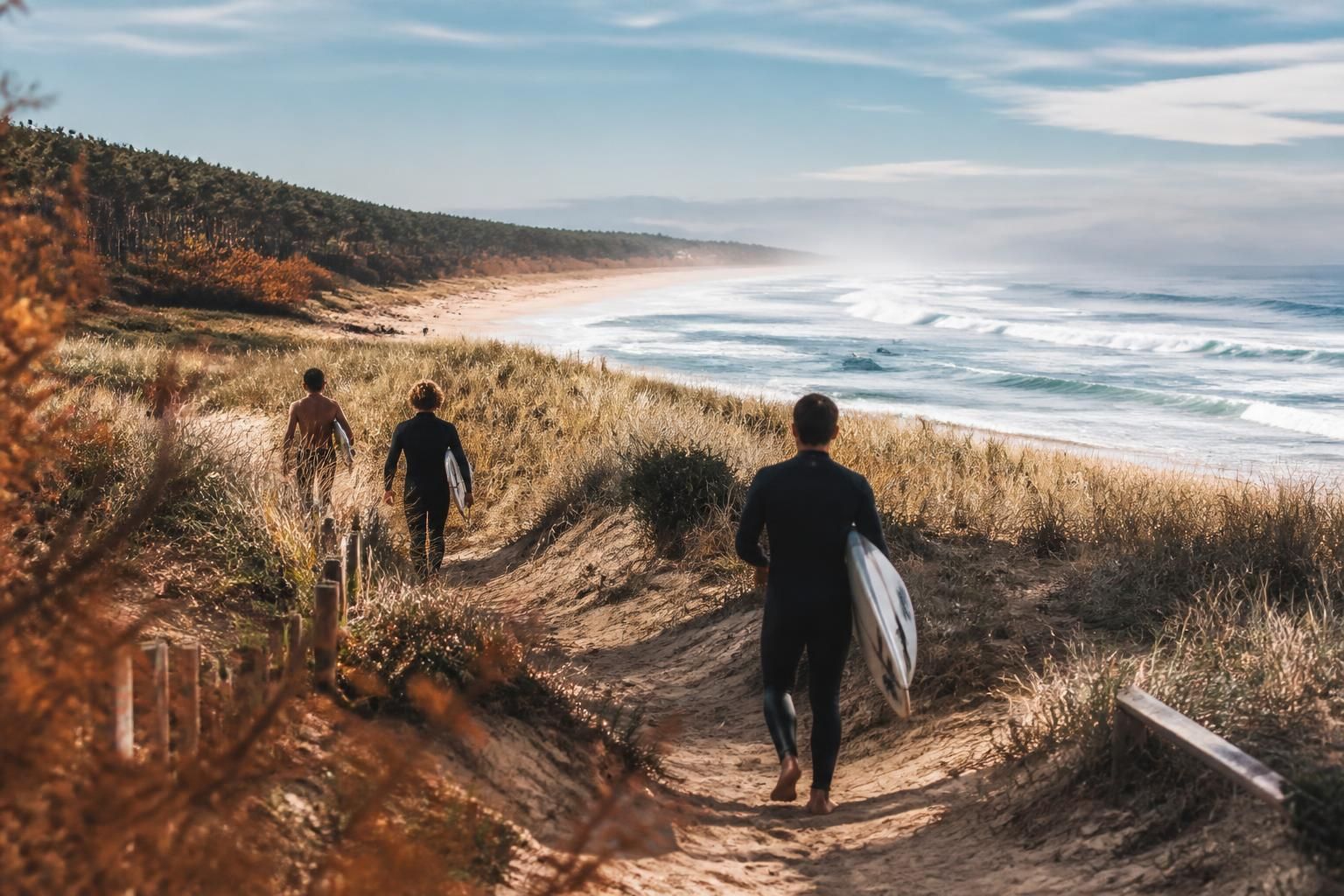
Modern surfing arrived in France in the late 1950s, first becoming highly visible on the Basque coast. Biarritz played a pioneering role in this spread, notably through encounters with surfers from California and the presence of an international beach culture. The first boards, long and heavy, were difficult to transport, and the sport remained marginal. Yet the idea quickly spread along the Atlantic coast.
Les Landes became a natural land of exploration. Its beaches are long, less developed than certain Basque areas, and regularly reached by Atlantic swells. Surfers then discovered that the Landes sandbanks could offer waves very different from those at point breaks or rocky beaches. In Hossegor, the consistency of the conditions drew a small community whose habits would permanently transform the local landscape.
National organization supported this growth. The first French surfing championships were held in 1960, while the French Surfing Federation was created in 1964. These dates do not mean the sport immediately became widespread; rather, they indicate that an imported pastime was beginning to acquire rules, clubs, competitions, and institutional representation. Hossegor took part in this movement by becoming one of the key hubs on the southwest coast.
In the 1960s and 1970s, surfing spread through very tangible networks: cars loaded with boards, photos printed in magazines, travel stories, and exchanges between beaches. Equipment was still scarce. A board was repaired, loaned out, and discussed. Every new rail or fin shape fueled passionate conversations on the sand. This era laid the foundations for a culture of resourcefulness and observation.
Clubs and Schools: Driving Forces of Local Surf Culture
Clubs quickly gave the sport a backbone. They organized training, supervised young people, made it easier to take part in events, and created collective habits. For a town like Hossegor, this local foundation is crucial: a destination does not become a lasting benchmark through passing visitors alone. It needs regular surfers, volunteers, instructors, and families who pass on safety practices.
Schools play a complementary role. France’s first surf school is generally said to have been established in Biarritz in 1966, but the model then spread along the entire coast. In Hossegor, instruction allows tourist visitors to discover the ocean within a suitable framework: beach selection, tide schedules, stable equipment, warm-ups, and right-of-way guidelines. Progress is not limited to standing up on a board; it also includes being able to spot a current, leave a swimming area, and respect others.
To prepare for a supervised stay, visitors can consult the information dedicated to surf lessons in Hossegor. The value of local instruction lies in this day-to-day knowledge of the sandbanks, far more useful than generic advice found far from the ocean.
Surf culture thus took root in successive layers: pioneers, clubs, schools, competitors, photographers, and shopkeepers. The image of a board under one’s arm gradually became an everyday sight in the city. In the following years, advances in equipment would accelerate this growth even further.
Surfboards, wetsuits, and surf equipment: the innovations that accelerated Hossegor’s rise
Hossegor’s history cannot be separated from the evolution of equipment. A high-performing wave alone is not enough to create a lasting local scene: it must also be possible to surf it regularly, in water that can be cold, with boards suited to fast waves. Between the 1960s and the decades that followed, the changes were considerable.
The first longboards made of polyurethane foam and fiberglass made surfing more accessible than heavy wooden boards, but their maneuverability remained limited. The arrival of shorter boards in the 1960s and 1970s radically changed the relationship with the wave. Surfers could make tighter turns, accelerate through a hollow section, and adapt their approach to the beach breaks of the Landes. The barrels at La Gravière, for example, became more accessible to surfers with the required technical level.
Fin systems also evolved. Single-, twin-, and then three-fin configurations expanded control options. The thruster, popularized in the early 1980s, became a benchmark because it combines hold, maneuverability, and speed. This evolution was particularly important in Hossegor, where a wave can go from a gentle slope to a very vertical section in a matter of seconds.
The wetsuit: a subtle but essential revolution
The neoprene wetsuit changed the seasonality of surfing. Before it improved, sessions were more constrained by water and wind temperatures. With better-cut, more flexible, and warmer models, surfers could visit the beaches in spring, fall, and winter. This helped keep Hossegor alive beyond summer alone.
This evolution also supports training. A young club member can multiply sessions in the off-season, work on paddling, positioning, and reading the sets. Preparation methods gradually became more structured: cardiovascular training, functional strengthening, mobility, video, and wave-selection analysis. Surfing remains dependent on the weather, but the modern athlete learns to make the most of every window.
The right surf equipment always depends on skill level, season, and spot. A high-performance shortboard is not necessarily the best choice for learning. A higher-volume board makes paddling and catching waves easier; a suitable wetsuit prevents exhaustion caused by the cold; a leash in good condition protects other water users as much as the surfer.
- 🧭 Observe the tide, wind, and set size before entering the water.
- 🧤 Choose a wetsuit suited to the temperature without neglecting freedom of movement.
- 🏄 Choose a board volume compatible with your actual skill level.
- 🪢 Check the leash, fins, and overall condition of the board before every session.
- 🚩 Identify flags, supervised areas, and currents before entering the water.
Technical innovation therefore expanded the surfing window and increased the variety of surfer profiles in Hossegor. It also paved the way for a specialized economy of shaping, repair, and distribution workshops.
La Gravière and La Nord: why Hossegor’s waves have gained legendary status
Hossegor’s prestige rests first and foremost on the quality of its waves. The reputation of La Gravière and La Nord is not an advertising slogan: it comes from decades of images, competitions, and memorable sessions, but above all from a hydrodynamic reality. The beach breaks of the Landes work thanks to sandbanks that channel and concentrate swell energy. When a sandbank is well positioned, a wave can rise quickly, hollow out, and peel with remarkable power.
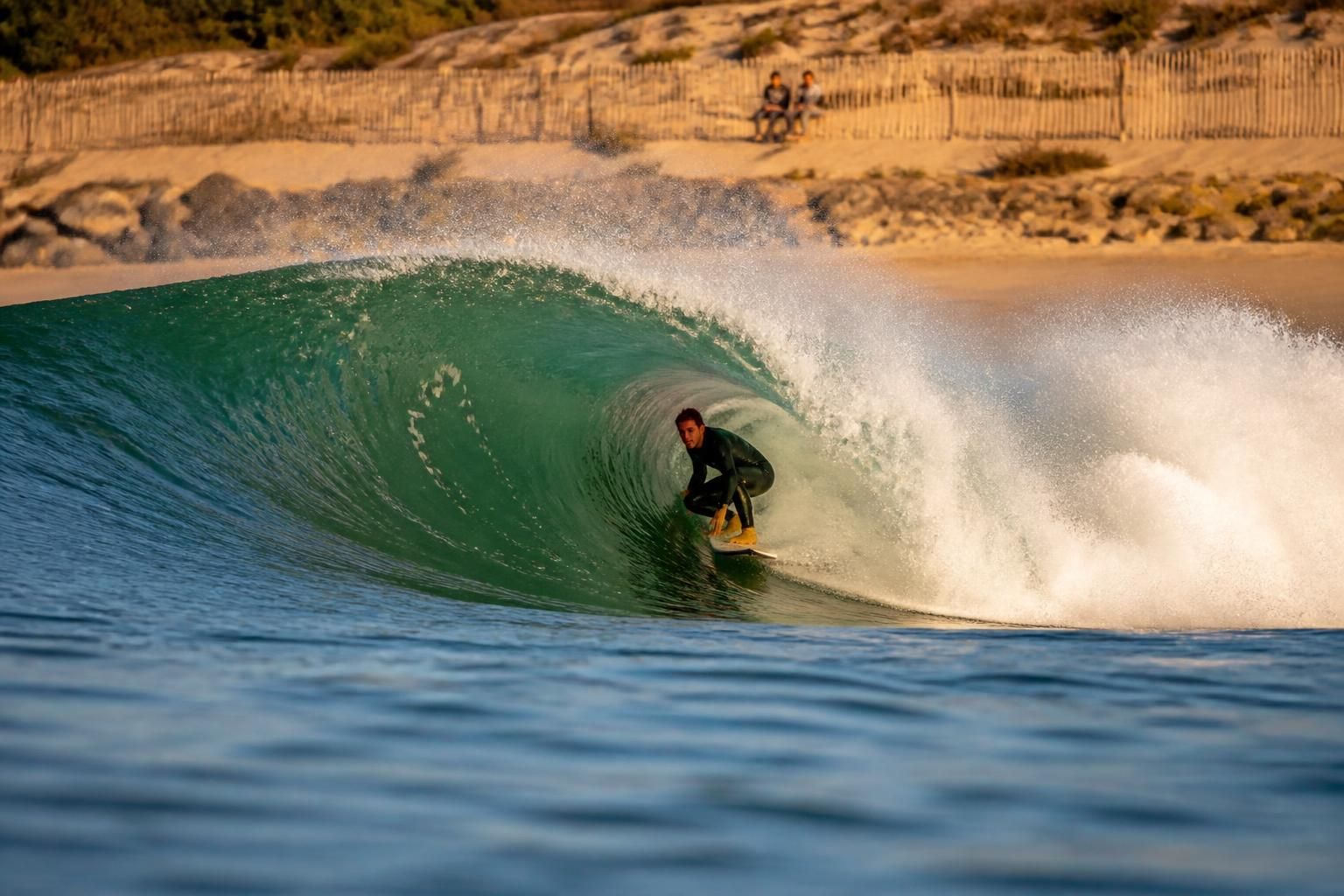
La Gravière has become the symbol of this phenomenon. Its reputation comes from the possibility of deep, fast barrels appearing, sometimes very close to shore. This proximity makes for a fascinating spectacle, especially during sporting events, but it should not obscure the level of commitment required. A bad fall in a hollow wave over a shallow, shifting bottom can lead to a collision with the board or brief disorientation.
La Nord offers a different kind of thrill. When North Atlantic low-pressure systems send in a long, powerful swell, this area can produce demanding big waves. Paddling, offshore positioning, and the ability to manage sets become decisive. It is not a training ground for beginners, even though conditions can of course vary.
A surf spot that changes with the seasons
In Hossegor, the best session cannot be planned simply by looking at a date on the calendar. Conditions depend on the height and period of the swell, wind direction, tide, and the shape of the sandbanks. A light offshore wind can smooth the surface and hold up the lip; an onshore wind can quickly make the water surface messy. A rising tide can improve a peak for an hour, then make it harder to read.
The fictional character Maël, a young surfer learning the ropes, illustrates this reality well. When he arrives, he immediately looks for “the best beach.” After a few weeks with a supervised group, he understands that there is no single answer. In the morning, one area may be too fast for him; two hours later, a different tide opens up a gentler section nearby. This understanding is worth more than a list of secret spots.
Safety therefore comes before prestige. Experienced locals observe for a long time before going in: the number of sets, the location of channels, their ability to get back to shore, and the density of people in the water. It is essential to know when to pass on a spot that exceeds your level. This rule also protects the quality of shared use: less panic, fewer unpredictable lines, and greater respect for priority.
A historic swell line
Hossegor, from wild coast to surf capital
Explore the milestones that shaped Hossegor’s surf identity, from the first enthusiasts to international events.
Scroll through the timeline or use the left and right arrow keys.
Hossegor’s strength lies precisely in this alliance between world-class waves and local knowledge. Without a careful reading of the ocean, the myth remains an image; with it, it becomes a demanding, living practice.
History of surf competitions in Hossegor: a lasting European showcase
Competitions have played a major role in Hossegor’s recognition. They transformed waves known to surfers into images seen by an international audience. From 1980 onward, the town hosted major amateur events. These events showed that the area not only has outstanding surf conditions, but also organizational capacity: welcoming athletes, beach safety, logistics, partners, and media coverage.
The move toward professional visibility marked another milestone. The early 2000s, particularly with events linked to the professional world tour from 2001 onward, strengthened the association between Hossegor and elite-level competition. The competitions held along the Landes coast are not merely demonstrations. They influence how young people view the sport, boost clubs, and provide a meeting point for industry stakeholders.
Australian brands such as Quiksilver, Rip Curl, and Billabong contributed to this international momentum. Their presence in Europe was part of the global expansion of the surf industry from the 1970s and 1980s onward. Hossegor then became a strategic location: close to surf spots, rooted in a strong local culture, and accessible enough to attract media, distributors, and consumers.
A timeline to read carefully
| Reference point | Verifiable date | Significance for Hossegor | Archive sources to consult |
|---|---|---|---|
| 🏄 First French Championships | 1960 | Competitive structuring of French surfing | French Surfing Federation archives |
| 📘 Creation of the French Surfing Federation | 1964 | Federation framework for clubs, licenses, and competitions | Federation archives and Official Journal |
| 🎓 First French surf school in Biarritz | 1966 | Spread of surf instruction to the Landes coast | Biarritz municipal archives |
| 🌍 Major amateur competitions in Hossegor | 1980 | Rapid growth in European recognition | Regional press and federation archives |
| 🏆 Landmark professional world tour event | 2001 | Strengthened international visibility | WSL archives and specialist press |
| 📍 End of a regular presence on the world tour | Since 2021 | Reshaping of the local event strategy | WSL, municipal and organizer communications |
Recent years, however, require a more nuanced account. The absence of a regular World Tour event since 2021 has reduced some of the immediate media exposure. This does not erase the waves or surf culture, but it does shift the balance of power with other European destinations. Portugal, in particular, has increased its visibility through globally recognized sites and ambitious tourism development policies.
Hossegor still hosts events, brand gatherings, and cultural happenings. To follow federation events without confusing local history with an annual calendar, it is useful to distinguish this trajectory from information about the French Surf Championships. This distinction provides a clear perspective: the town remains a major hub even as the world tour schedule changes.
Competitions have created a collective memory and considerable image-making power. Above all, they have shown that a beach can become, for a few days each year, a true European stage facing the Atlantic.
The surf industry in Hossegor: workshops, shops, brands, and local expertise
Hossegor’s growth also rests on a tangible economic sector. Surfing generates a wide range of jobs: shapers, glassers, repair technicians, specialist salespeople, instructors, photographers, organizers, logistics professionals, event technicians, designers, and communications managers. This diversity explains why surf culture extends far beyond simply being in the water.
Board workshops hold a special place in this ecosystem. Shaping a board involves choosing a foam blank, drawing an outline, working on the rocker, rails, concaves, and fin placement. Every detail affects speed, stability, and performance through turns. In Hossegor, proximity to the waves creates a direct connection between manufacturing and testing: a board can be adjusted after a session in the very conditions it was designed for.
Repairs are just as essential. A crack in the fiberglass lets water in and can make the board heavier. Getting a board repaired quickly extends its lifespan and reduces waste. From an environmental standpoint, this technical step makes more sense than systematic replacement. News from workshops also highlights their vulnerability, particularly when an incident affects production; this article about a fire at a surfboard factory helps illustrate the consequences such an event can have on a local supply chain.
Pédebert, specialist retail, and brand image
The Pédebert area has become one of the commercial faces of this economy. Outlet stores, specialty shops, and company headquarters sustain foot traffic that does not depend solely on the weather. For visitors, it is an opportunity to gear up; for the area, it is a hub for jobs and services. Surf tourism thus extends into the act of purchasing.
However, the local economy should not be reduced to major brands. Independent businesses provide expertise that online shopping cannot always replace: assessing board volume, choosing a wetsuit, repairs, rentals, or guidance toward a suitable school. Advice is especially important for beginners, who are often tempted to buy surf equipment that is too technical because it resembles what is used in competition.
Large companies have given Hossegor international reach, while craftspeople have preserved a precise connection to local waves. This complementarity is one reason why the town remains associated with innovation. It does not merely sell a beach image: it brings together the expertise that makes surfing possible.
The development of trade shows, equipment demos, exhibitions, and gatherings centered on shaping illustrates the desire to keep the sector visible even outside world tour events. This approach is valuable: it attracts enthusiasts, stimulates professional exchanges, and reminds us that surfing is also a creative industry.
In Hossegor, a board is not just a product. It is where craftsmanship, performance, tourism, and local identity meet.
Surf tourism and culture in Hossegor: a town transformed by board sports
Tourism has changed profoundly with the rise of surfing. A resort once associated with family summer vacations has gradually become a sought-after destination in spring, fall, and during winter swell events. Visitors no longer come only to swim: they follow forecasts, book a lesson, rent equipment, join a surf camp, or try to attend a competition.
This evolution supports many seasonal and permanent jobs. Hotels, rentals, restaurants, shops, schools, and transportation services benefit from the ocean’s appeal. A surfing weekend can simultaneously employ an accommodation provider, an instructor, a bike rental operator, a restaurateur, and a shopkeeper. To plan this type of stay without reducing the town to its surf spots alone, a surf weekend in Hossegor and the Landes offers a way to explore the area’s different facets.
The visual identity has followed suit. Storefronts, signage, event posters, and certain clothing styles now draw on board-sports codes. Boards leaning against walls, photos of tubes, bikes fitted with racks, and lively terraces after sessions create a recognizable urban landscape. This aesthetic is not just decoration: it reflects the ocean’s importance in daily rhythms.
A destination broader than its beaches
Hossegor’s strength also lies in what it offers when the waves are too big, too small, or messy. The marine lake, connected to the ocean by a canal, allows for other water activities. The pine forest opens up cycling routes. Basque-Landes architecture and markets contribute to an experience less dependent on a surf session alone. This diversity makes the destination more resilient and more enjoyable for groups with varied expectations.
Surf culture must not become commercial packaging disconnected from the sea. Its credibility rests on simple actions: respecting beaches, reducing waste, choosing low-impact transportation where possible, avoiding obstructive parking, and supporting local businesses. A town that lives from its coastline has every reason to protect what gives it its primary value.
Beach cleanups, repair initiatives, the use of more responsible materials, and raising awareness among students at surf schools all move in this direction. They do not solve environmental issues on their own, but they foster a practical culture of respect. A surfer who depends on water quality quickly understands that protecting the marine environment is not optional.
Surf tourism has therefore extended the season, supported the economy, and reshaped the town’s image. Its future will depend on its ability to preserve this energy without turning beaches into mere consumer backdrops.
Sharing surf spots in Hossegor: crowds, safety, and respect for the ocean
Hossegor’s popularity creates a paradoxical situation. The very qualities that attract surfers—accessibility, consistent waves, numerous schools, and an international reputation—increase the number of people in the water. During vacations or when the forecast looks promising, a peak can bring together beginners, competitors, longboarders, bodyboarders, and highly experienced surfers. Sharing the space then becomes an issue as important as the quality of the conditions.
The right-of-way rule is simple in theory: the surfer best positioned on the inside, closest to the breaking point, gets the wave. In practice, applying it requires good judgment. Look around, do not take a wave that someone is already riding, and avoid paddling directly into the path of surfers. These principles reduce collisions and make sessions run more smoothly.
Beginners benefit from staying in suitable areas and not positioning themselves at the heart of a fast peak simply because it looks photogenic. Consistent whitewater makes it possible to work on positioning, stability, and popping up. A hollow, crowded wave, on the other hand, adds stress and danger. The fastest progress often comes from accepting to spend time in easy conditions.
Safety, the foundation of long-term surfing
The beaches of the Landes have specific risks: baïnes, lateral currents, sets that are more powerful than expected, and rapid tidal changes. Lifeguarded areas and information from lifeguards must be taken seriously. If a current carries you offshore, stay calm, do not fight it head-on, and try to exit it sideways, following local safety instructions.
Adaptive surfing and para surfing also remind us that the sport can be designed for a wide range of people, with appropriate supervision and equipment. Initiatives dedicated to adaptive surfing and para surfing show that accessibility is a full part of contemporary board-sports culture. The enjoyment of the ocean grows when it is organized with care, expertise, and solidarity.
Crowds also call for environmental responsibility. Leaving packaging on the dune, cutting through protected access points, or disturbing sensitive areas weakens this shared playground. Dunes hold back sand and help protect the coastline; respecting them is not merely a matter of scenery, but a concrete necessity.
The right approach is to view every session as a shared use. A smile, an apology after a mistake, helping someone in trouble, and respecting right of way immediately transform the atmosphere at a peak. Hossegor’s reputation depends as much on the quality of its waves as on the behavior of those who surf them.
Hossegor, Ericeira, and the future of a European surf capital
The status of European surf capital is neither a single official title nor a permanent distinction. Hossegor earned it through its history, waves, competitions, and industry, but other European destinations have developed strong claims. Ericeira, Portugal, notably gained recognition in 2011 as Europe’s first World Surfing Reserve. This five-kilometer area includes renowned spots such as Ribeira d’Ilhas and Coxos.
Comparing Hossegor and Ericeira does not mean choosing a winner. The two places embody different models. Ericeira is built around a rocky coastline and heritage protection structured around a reserve. Hossegor stands out for its powerful beach breaks, high concentration of brands, and long history of competitions. One shows the importance of preserving waves; the other illustrates the strength of an economic and cultural ecosystem tied to board sports.
Portugal has strengthened its international appeal through public investment and a highly visible promotional strategy. Since the end of the regular presence of the world tour after 2021, Hossegor has undergone a period of restructuring. This should not be seen as a decline. Instead, it calls for diversifying formats: equipment events, festivals, shaper gatherings, national competitions, inclusive activities, and environmental projects.
A European capital reinventing itself
The town has lasting resources: a unique coastline, educational expertise, an established professional sector, and a strong collective memory. The challenge is not to depend exclusively on a single major international event. A world-class event brings unparalleled visibility, but a destination’s identity must also thrive every day, in clubs, schools, workshops, and on the beaches.
The generations discovering surfing today are also more attentive to environmental impact, inclusion, and safety. They expect better-designed infrastructure, less-polluting transportation, and clear information about ocean risks. Hossegor can retain its influence by turning these expectations into a strength, rather than simply trying to reproduce past models.
The idea of a European capital then retains its full meaning if it refers to a place of exchange. Hossegor brings together expertise, welcomes visitors from many countries, and continues to inspire photographers, creators, educators, and competitors. Its waves provide the spectacle; its community provides continuity.
Between the pine trees and the Atlantic, the story therefore remains open. The town is not defined solely by a competition poster or a successful season, but by its ability to bring together the ocean, technique, tourism, and a surf culture passed down from generation to generation 🌊.
Why is Hossegor often called the European surf capital?
Hossegor owes this reputation to the consistency and power of its waves, the renown of spots such as La Gravière and La Nord, its specialized industry, and several decades of international competitions.
What is the best surf spot in Hossegor for beginners?
The choice depends on the day’s conditions. Supervised areas near Plage Centrale are often more suitable when they offer gentle waves. A lesson with a local school makes it possible to choose an area suited to the tide and skill level.
Is La Gravière accessible to beginner surfers?
La Gravière can produce very fast, hollow waves over shallow sandbars. It is mainly recommended for independent, experienced surfers when conditions are challenging.
Can you surf year-round in Hossegor?
Yes, surfing is possible year-round, with suitable conditions and equipment. Fall and winter often offer more powerful swells, while summer periods may be better suited to learning depending on the day.
How can you respect other surfers on Hossegor’s beaches?
Observe the peak before entering, respect the priority of the surfer positioned on the inside, avoid taking a wave that someone is already riding, do not obstruct others’ paths, and choose a spot suited to your level.