
In Hossegor, a gap without waves can look more inviting than a line of whitewater. Yet this calm appearance says nothing about the force of the water: a deep channel can provide a pathway for water flowing out to sea. On the sandy beaches of Landes, the seabed shifts, currents reorganize, and a familiar access point never guarantees the next day’s conditions. Understanding baïnes in Hossegor therefore requires distinguishing underwater terrain, water movements, and the decisions to make from the beach.
Observing, asking for advice, and knowing when to opt out are the first lines of protection.Neither good physical fitness nor a board makes anyone invulnerable. For companions and participants alike, the goal is not to decipher the ocean perfectly, but to recognize the limits of one’s observations and adopt the right habits. A fictional example will illustrate these situations: Léa arrives at the beach with Noé, a beginner teenager, and a friend who already surfs independently. Three profiles, one shared requirement: choose a water entry that matches the actual conditions rather than the planned agenda.
Baïnes in Hossegor: Distinguishing the Pool From the Rip Current
A baïne is a depression in the sandy seabed, generally located between the beach and a sandbar. Depending on the water level, it appears as a pocket of shallow water or disappears completely beneath the surface. The term therefore first refers to a coastal feature, not automatically to a dangerous, permanent water movement.
A rip current is a movement of water toward the open sea, often concentrated in a deeper passage. Waves carry water toward the shore; that water must then redistribute and flow back out. When the terrain channels this return flow through a channel, the local speed can become difficult for a swimmer to overcome.
Why can a baïne feed a dangerous current?
The sandbar acts as a relative obstacle to water flow. Water crosses certain sections with the waves, accumulates in the area near shore, and reaches a passage where it can drain more easily. This process depends on the water level, wave breaking, and the shape of the seabed: it is not simply a bathtub emptying at a fixed time.
Speaking of a “Hossegor baïne current” thus describes a flow associated with this local configuration. However, not all rip currents are linked to a clearly identifiable baïne. Some develop through breaks in sandbars; others are influenced by structures or uneven wave distribution.
This distinction matters in the field. The absence of a visible pool does not mean swimming is risk-free. Conversely, a hollow observed at low tide does not by itself indicate the strength of the flow a few hours later: the terrain and how it functions must be considered together.
Being Carried Out to Sea, Not a Mysterious Suction
In its main component, this phenomenon carries people horizontally. The image of a hole that systematically sucks people downward is misleading and encourages panic. That does not make the situation harmless: waves, losing one’s footing, swallowing water, and exhaustion can quickly make breathing difficult and lead to drowning.
The difficulty often comes from an instinctive reaction: trying to get back to the sand immediately by swimming straight against the flow. The effort increases while the distance from shore changes little. The priority becomes preserving buoyancy and energy, then signaling that you are in difficulty, rather than winning a physical duel against the ocean.
In Léa’s example, Noé notices a pocket of water between the beach and an exposed sandbar. She does not simply tell him, “it’s dangerous”: she distinguishes the pool, its possible connection to the open sea, and the current conditions. This practical vocabulary helps explain why the same place can change in appearance and behavior.
The Sauveteurs en Mer recommendations on baïnes provide a reference point for connecting this mechanism to preventive behavior. They should be supplemented by guidance from lifeguards on site, as a general explanation never fully describes a specific beach area.
Finally, knowing the definition is not enough to determine a route in the water. Paths can be diagonal, feature recirculation, or change with wave sets. Always imagining a straight, narrow, easy-to-cross channel would create excessive confidence, especially for a beginner who quickly loses their bearings.
The right question, then, is not just “is there a baïne?” but “how is the water flowing here, right now, and is this situation suitable for the participant?” The pool explains the terrain; the flow determines part of the danger.
Sandbars in Hossegor: why the danger shifts location
Hossegor’s ocean beaches are beach breaks : the waves break mainly over shifting sandy bottoms. Unlike relatively stable rocky terrain, these seabeds are reshaped by waves, longshore currents, and periods of heavy surf. The channel seen during one outing may have shifted or changed by the next.
Sand moves at several scales. A storm can redistribute significant volumes between the upper beach, offshore sandbars, and neighboring areas. Less dramatic conditions can then alter an opening, deepen a hollow, or reorganize a breaking zone. Change therefore does not necessarily wait for an entire season.
How do basins and their openings form?
When waves break over a sandbar, their energy and movement shift sediment. Some sections build up while others remain deeper or erode. A depression may thus persist on the beach side, with a preferred channel allowing water to flow outward.
This geometry is far from uniform. Depth varies along the basin, its edges can be steep, and its opening can shift. A child walking in seemingly shallow water can therefore suddenly lose footing within a few steps, without having traveled far from their towel.
As sea level rises, visible markers disappear. The sandbar that appeared to form a barrier becomes partially submerged; waves may cross it differently. As the water recedes, a new configuration emerges, but that does not mean all circulation stops: activity still depends on incoming water and available channels.
The same access point does not mean the same seafloor
At La Centrale, La Gravière, or farther north toward Les Culs Nus, the place name remains fixed while the seafloor changes. This reality prevents habit from becoming a safety guarantee. A successful entry into the water the day before never removes the need to observe the area again.
Proximity to a jetty or a relatively sheltered area does not guarantee the absence of currents either. Structures can alter the swell and create particular water flows. An area with smaller waves may therefore still pose risks of drifting, losing footing, or having difficulty returning to shore.
The Capbreton Gouf contributes to the regional oceanographic context and to the transformation of certain swells. When deciding whether to enter the water, however, this major underwater feature offers no practical shortcut. It is the sandbars near the shore, the current waves, and local guidance that should inform an immediate assessment.
In Léa’s scenario, her surfer friend recognizes a passage used during a previous stay. From the beach, however, he notices that the foam is no longer distributed in the same way. Rather than trying at all costs to retrace his old route, he asks the lifeguard station how the area is functioning that day.
An aerial photograph can help explain the overall layout of a sandy coast. It can sometimes clearly show the light bands of shallow areas and the darker areas of depressions. But it is not a current navigation chart: the date it was taken, the tide, and sea conditions determine its value.
The same principle applies to a video posted on social media. Even if filmed recently, it may show a different opening, a different beach, or a different water level. Using these images to learn how the system works is helpful; treating them as permission to pass would be a methodological mistake.
In Hossegor, knowing a place above all means accepting that it changes. This mobility explains why observing from the sand remains essential, even for regular visitors, and why visible clues should then be interpreted cautiously rather than as a foolproof code.
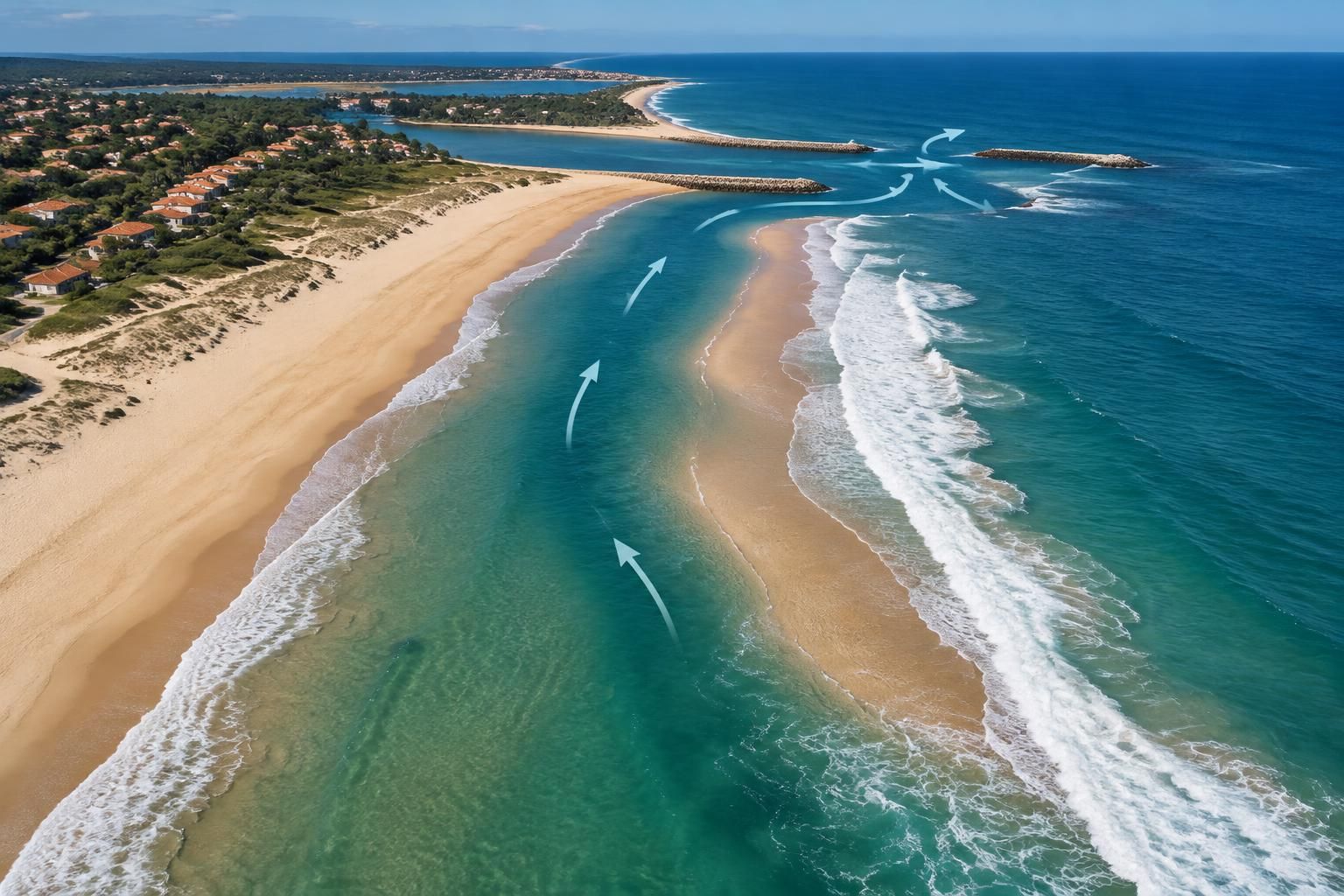
How can you spot a baïne from the beach without overestimating the clues?
To understand how to spot a baïne, it is better to look for several consistent clues than one dramatic sign. A break in the lines of breaking waves, a difference in texture, or foam being carried offshore may draw attention. However, none of these elements, taken individually, can measure the strength of the water movement.
Observation should begin from a spot offering a sufficiently wide view, without entering protected dunes. You need to watch several sets rather than a single wave: between two groups of breakers, almost the entire water surface may appear calm. A lull can easily create a misleading impression of stability.
Signs that should prompt you to seek advice
- 🌊 A persistent gap between two breaking zones may indicate a deeper channel that could funnel water back offshore.
- 🫧 Foam, suspended sand, or debris moving away may reveal a current, especially if their movement persists between waves.
- 👀 A different-looking surface, smoother or, conversely, choppy and uneven, may indicate a difference in depth or meeting water flows.
- 📍 People in the water repeatedly drifting relative to a building or fixed point indicates movement that should be taken seriously.
Color alone remains an unreliable guide. A dark band may be deeper, but it may also result from shadow, algae, or lighting. Conversely, sand-laden water can conceal a channel. Sunglasses and the sun’s position also affect what the observer perceives.
An area without waves therefore deserves special attention, without automatically being identified as an active outflow. Likewise, an area where waves are breaking is not necessarily safe : shorebreak, shallow water, collisions, and the force of the whitewater create other hazards. The rule of “go where it’s breaking” is far too simplistic.
Observe a path rather than a simple appearance
Watching a patch of foam can sometimes provide more useful information than a photograph of the water. Does it regularly return toward shore, move sideways, or cross the breaking line outward? This observation describes visible circulation, but not the full depth or all its variations.
A fixed point on the beach also helps distinguish between an impression and actual movement. From the water, a swimmer may believe they are staying in the same place while drifting along the shore. From the sand, a companion can more easily notice that they are gradually moving away from the original access point or an authorized area.
In Noé’s example, a smooth strip looks ideal for avoiding the waves. However, Léa notices fragments of foam moving seaward through it. This observation is not used to calculate an alternative route: it is enough to abandon the plan to swim there and go to the lifeguards.
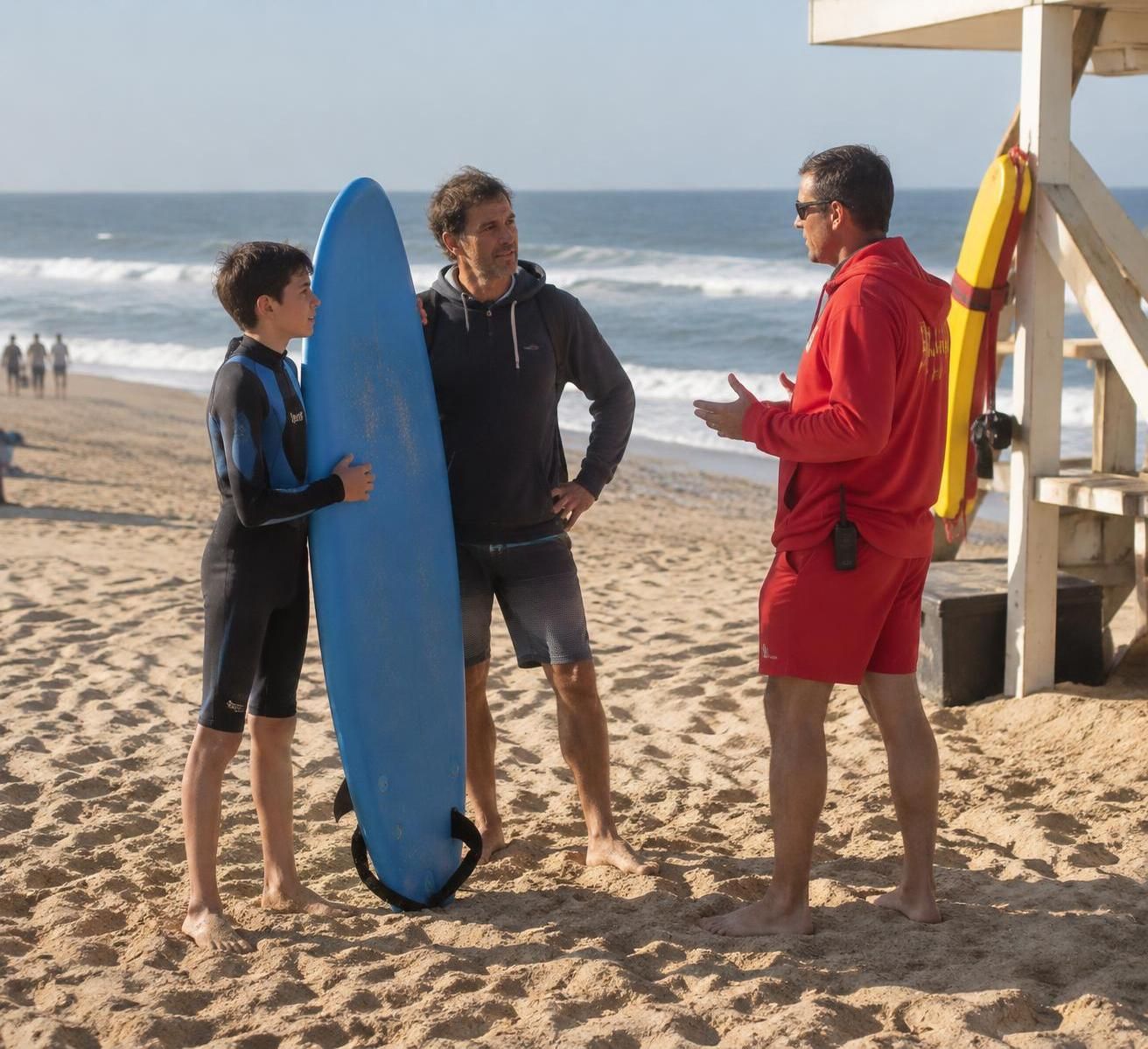
The lifeguard station has site-specific knowledge of the area, informed by monitoring and any interventions. Asking “where can we swim now?” provides a more practical answer than “are baïnes dangerous?” For surfing, the person’s actual skill level, equipment, and independence must also be specified.
Children should not be expected to carry out this assessment alone. They can learn to observe and report what they see, but the decision remains with responsible adults, in accordance with lifeguard guidance. Educational skills do not replace safety responsibility.
One concerning sign is enough to postpone entering the water; the absence of an obvious sign is not enough to allow it. This asymmetry is what makes observation useful: it helps rule out a doubtful situation without promising to certify a stretch of ocean.
Tide, swell, and wind: what changes the rip current in Hossegor
The danger does not depend on a single factor. Tide, wave height, swell period, direction, and wind interact with the seabed. Two days with comparable wave heights can produce very different conditions at the shore. A numerical forecast therefore provides context, not automatic approval for swimming.
The tide changes the water depth over sandbars and in channels. It shifts breaking zones and changes the connections between the beach, pools, and offshore waters. Some configurations become particularly active at intermediate water levels; others continue to generate circulation at different levels.
Why no time guarantees the absence of danger
Reducing the phenomenon to “it only drains at ebb tide” would overlook part of the mechanism. Waves can feed a basin while the sea level is rising, while a channel concentrates the return flow of that water. The direction of the tide is therefore not enough to predict the direction or strength of local movements.
The tidal coefficient indicates the tidal range, but does not directly provide the speed of a rip current on a specific beach. A low coefficient does not eliminate swell or uneven seabed conditions. Conversely, a high coefficient does not justify comparing two areas without examining their configurations.
The guide dedicated to the relationship between tide and surfing in Hossegor provides a deeper look at the context of water levels. For safety around baïnes, the key point is more specific: the situation must be reassessed during the session, as the usable area may change.
Swell period also changes how risk should be assessed
At comparable heights, a longer-period swell can carry more energy and produce more powerful sets. The intervals between groups of waves may seem comfortable, then give way to a significantly greater influx of water over the sandbars. A calm beach for a few minutes therefore does not necessarily reflect the next cycle.
The incoming direction also plays a role. Angled waves can strengthen a drift parallel to the shore, which sometimes feeds a return channel offshore. The person first moves sideways before discovering that they can no longer easily return to their starting point: the path is not always directly toward the horizon.
Wind adds another layer of complexity. An offshore breeze can smooth the surface without eliminating underlying currents; it can also carry floating objects away. An onshore wind can make the water more choppy, hinder breathing, and complicate visual monitoring from the sand.
| Parameter | Possible effect | Cautious decision |
|---|---|---|
| 🌗 Tide level | Changes to channels and breaking zones | Reassess throughout the outing |
| 🌊 Long-period swell | Spaced-out but powerful sets | Watch several cycles |
| 💨 Strong wind | Drift and reduced visibility | Ask for local advice and opt out if necessary |
| 🏖️ Recently reshaped seabed | Usual landmarks no longer apply | Do not reuse a former route out of habit |
In Léa’s case, a forecast of small waves had prompted the outing. Once there, more widely spaced sets nonetheless fill the shorebreak, and the whitewater flows back out through a clear channel. Current observation takes precedence over the reassuring label in the app: the session is moved or canceled.
There is no universal combination of numbers that gives you a personal green light. Acceptable thresholds vary depending on the site, supervision, and actual ability. The weather explains part of the risk; observed conditions and local guidance determine the decision.
Hossegor · Understanding baïnes
Before entering the water in Hossegor
Observe, ask, know when to opt out: five habits to keep in mind when swimming or surfing, without turning a check into a green light.
Read the water before entering
Interactive diagramWatch whether whitewater or people are shifting sideways relative to a fixed landmark on the beach. A lateral current can feed an offshore current.
Educational view, not to scale: neither a map of Hossegor’s baïnes nor real-time conditions. Currents shift, and these signs may be subtle or absent. An area with fewer breaking waves is not necessarily safer.
Five key reflexes to remember
Tap for detailsCheck active supervision, flags, and restrictions.
Watch several sets: drift, breaks in the surf, foam moving offshore.
Ask where to swim and where to practice based on your skill level.
Do not go out if conditions, fatigue, or instructions make it unsuitable.
In difficulty: do not fight head-on, float, signal, and follow the lifeguards’ instructions.
The illustrated reference points help you ask the right questions, not decide on your own that entering the water is safe.
Swimmers, children, and tired surfers: different vulnerabilities
The same movement of water does not have the same consequences for everyone. Breathing ability, the ability to float, fatigue, and understanding the situation strongly affect how someone responds. The distance to shore may seem modest to an observer while posing a considerable obstacle for someone who has just lost their footing.
A swimmer without flotation support is particularly vulnerable when trying to keep their head above water while swimming back head-on. Breathing effort increases, technique deteriorates, and anxiety speeds up movements. Knowing how to swim in a pool is valuable, but it does not fully prepare you for waves, salt in your eyes, and drift.
Why shallow water can be misleading for children
Shallow water does not guarantee stable footing. The bottom can drop off suddenly, and a wave can sometimes knock a child off balance before a lateral movement carries them away. The risk therefore begins before actual swimming, even in an area an adult considers just a wading pool.
Supervision must remain active and close, adapted to the child’s age and abilities, with one adult clearly designated. Looking over occasionally from a towel does not allow for a quick response if they lose their footing. When there are several accompanying adults, the lack of a clear assignment can easily create a false impression of shared responsibility.
Inflatable toys are not lifesaving equipment. They can drift in the wind and encourage children to chase an object that is moving away. A child should know that a lost ball or inflatable ring should not be retrieved by going farther out: the object can be replaced, the safety margin cannot.
In surfing, the board helps but does not eliminate danger
A board provides buoyancy and improves visibility, but it does not eliminate being carried away or exhaustion. A beginner can be swept beyond their comfort zone, unable to return or handle breaking waves. Wearing a leash therefore does not turn an unsuitable outing into a safe one.
The surf rip current may even be sought out by experienced surfers to get through a wave zone. This technical use should not become a recommendation for beginners. It requires careful reading of conditions, physical ability, and a return strategy that cannot be improvised by following someone.
To learn the basics, beginner surf instruction in Hossegor helps, in particular, with choosing a suitable area and time slot. The benefit lies in the professional’s on-site judgment, not in a general promise that whitewater or a particular beach is always safe.
Experienced surfers, for their part, may underestimate their fatigue. After several trips through the break or a long session, paddling speed decreases and decisions become less clear-headed. An easy outing an hour earlier can then become difficult, especially if sea conditions and currents have changed in the meantime.
Cold, illness, injury, alcohol, or certain medications can further reduce one’s abilities. Good technical skills do not automatically offset these factors. To assess surf danger in Hossegor, you must compare the ocean’s demands with the resources available that day, rather than with your best memory of a session.
In the fictional group, Noé remains under supervision, while the experienced friend plans a limited duration and returns before becoming exhausted. Léa does not assume that the most independent person will automatically be able to rescue the others. Group safety begins with realistic individual limits, not with the presence of a “good swimmer” in the group.
Hossegor beach safety: prepare before entering the water and know when to give up
The most useful preparation takes place before you enter the water. For swimming, the priority is an area that is actually supervised, during lifeguard hours and between the flags designated for that purpose. Being physically close to a lifeguard station does not mean it is open or that the entire surrounding area has the same coverage.
Red and yellow flags usually mark the supervised swimming area. The flag flown at the lifeguard station indicates swimming conditions: green for supervised swimming with no apparent danger, yellow for limited or significant danger, and red for a prohibition. Signs and local notices specify the applicable uses and restrictions.
Check instructions before taking out your equipment
A green flag never means there is no risk at all. Area boundaries, swimmers’ abilities, and lifeguards’ instructions remain crucial. If you are unsure about the signage or whether an activity is permitted, the right approach is to ask at the lifeguard station before gearing up.
Areas reserved for swimming are not automatically areas for surfing. Boards would create a collision risk there, in particular. You must distinguish between the protection sought for swimming and the space authorized for surfing, then have the appropriate professional confirm where the planned activity can take place.
Municipal information dedicated to the ocean and beaches of Soorts-Hossegor provides a useful local framework. Any municipal alert concerning baïnes must be read together with its date and validity period: an old publication is not today’s bulletin.
Before traveling, checking information from the municipality, the Landes Prefecture, and marine forecasts helps anticipate unfavorable conditions. Upon arrival, posted information and lifeguards complement this preparation. A warning issued for the coastline as a whole does not replace a local prohibition; both must be respected.
Situations that require abandoning the original plan
A prohibition, a red flag, or an explicit instruction not to enter cannot be negotiated based on experience. You must also choose not to go in when returning to shore seems uncertain, the drift is obvious, or the waves exceed your abilities. The trip already made and the cost of a rental do not change this decision.
For a child or beginner, the absence of appropriate supervision and guidance is a strong reason to choose another activity. If no adult can provide close attention, swimming should not be continued simply for convenience. A walk on the sand is still a real outing, not a failed session.
Equipment deserves a proportionate check: a suitable board, a leash and attachments in good condition, and a wetsuit that keeps you warm enough. These checks reduce certain failures without eliminating physical limits or the danger of the conditions. Complete equipment does not justify ignoring unfavorable advice.
A companion should know the chosen area, the expected return time, and how to raise the alarm. The phone should remain accessible from the beach, with sufficient battery; the access point’s name and visible landmarks should be identified before an emergency. These details make a quick response easier if the person is delayed or appears to be in trouble.
In Léa’s scenario, the group discovers a stronger current than expected. Rather than looking a hundred meters farther on for a place without a sign, they go back to ask for advice and agree to postpone.Choosing not to go in is a sound technical decision when conditions do not match your abilities: the next session begins with that choice.
How to get out of a baïne: what to do if the current carries you offshore
The question “how to get out of a baïne” first requires a correction: it is not always about leaving a pool, but about dealing with being carried by a water current. The response depends on fatigue, waves, available flotation, and help nearby. No single route works in every situation.
The first goal is to keep your breathing as controlled as possible. Realizing that the shore is getting farther away often triggers a frantic, uncoordinated response. Do not try to swim directly against a strong current to avoid immediately using all your energy on an effort that may remain ineffective.
Float, signal, and conserve your energy
Without a board, look for a position that allows you to float and breathe with as little effort as possible. Depending on the waves and the person’s comfort level, this may mean floating on your back or using another stable position. The important thing is to keep your airways clear without forcing a position that cannot be maintained.
You need to call for help early: raise one arm when buoyancy allows, wave, and call out. Noise may limit how far your voice carries, but that does not make calling out useless. Alternating between signaling and staying afloat may be necessary; do not assume you will be spotted immediately, even in front of a lifeguard station.
With a board, stay on it or in contact with it as much as possible: it provides valuable support and generally makes you more visible. Abandoning it to attempt an improvised swim removes that support. Also avoid throwing it toward other people and remain aware of waves that may throw you off balance.
Lifeguards’ instructions take priority over general strategies. They may ask you to wait, move in a specific direction, or head toward rescue equipment. Their position often allows them to assess the overall water movement better than someone struggling at the surface.
Swimming parallel to shore: an option, not a guarantee
If the person still has energy and an exit direction can be identified, moving sideways, often roughly parallel to the beach, may help them leave a localized flow. But a channel may be wide, angled, or associated with recirculation: no swimming distance guarantees getting out.
This option should therefore not become a prolonged effort leading to exhaustion. If the attempt does not improve the situation, preserving buoyancy and signaling again become the priority. The advice that “a few meters are always enough” is especially dangerous for someone who is not confident in the water or is already out of breath.
Likewise, passively waiting to be automatically carried back by the waves is not a reliable plan. Returning to shore must take breaking waves, the seabed, and obstacles into account. A patch of whitewater may help in some cases, but it can also involve powerful waves or very shallow water.
In the fictional example, Léa’s friend feels that paddling no longer allows him to return directly. He stops forcing his way against the current, stays lying on his board, and signals that he is in trouble. This response does not magically solve the situation: it preserves his energy and gives rescuers more options.
After returning, respiratory distress, feeling unwell, a persistent cough, or unusual fatigue should prompt you to quickly seek emergency assistance or medical advice. A person who has experienced drowning, even if they appear to have recovered, needs an appropriate evaluation. The right answer to “what to do if the current carries you offshore” starts with surviving without exhausting yourself, not with reaching the sand at all costs.
Witnessing someone drifting at Hossegor: raise the alarm without creating a second victim
From the beach, seeing someone drift away creates an immediate urge to intervene. However, entering the water without equipment or training can turn an emergency into a multiple-person rescue. The witness’s first role is to raise the alarm quickly and keep precise track of the person, not to set off in pursuit without understanding the conditions.
A person in trouble does not always make dramatic gestures. They may struggle silently, make no progress, stop frequently, or appear unable to keep their head above water. A board separated from its user or unusual drifting should also draw attention, without waiting for a clearly recognizable call for help.
Who should you alert, and what information should you provide?
On a supervised beach, alert the lifeguards immediately. If several witnesses are present, one person can go to the lifeguard station while another keeps the person in sight and indicates their direction. Simple roles prevent everyone from running to get help while simultaneously losing visual contact.
In France, 196 connects you with maritime rescue services; 112 is the European emergency number, which can be used from the beach to dispatch the appropriate emergency services. State immediately that a person is in trouble in the ocean, in Hossegor, and describe the area concerned as accurately as possible.
Providing the beach name, the access point used, a distinctive building, or the nearby lifeguard station helps locate the response. Also indicate the number of people, whether there is a board, the color of a wetsuit, and the direction of drift. An approximate distance stated as such is better than a figure presented with false precision.
Stay on the line, answer questions, and follow the operator’s instructions. If the person disappears behind a wave or is no longer visible, report the last observed location without making up a new position. Keeping emergency access clear on the sand is also part of providing useful help.
Help from a safe location
A flotation device can be offered from a safe position if doing so does not require putting yourself at risk. However, swimming after a victim, improvising a human chain in a current zone, or heading out with a board without rescue skills creates additional risks. Equipment alone does not provide training.
In Léa’s scenario, she does not leave her observation point to run toward the water alone. She points out the friend in trouble precisely while another adult alerts the lifeguards. Noé stays away from the response area: his presence on the sand must not become another emergency to manage.
If the victim is brought ashore and is unresponsive or not breathing normally, raising the alarm remains the priority and rescue measures must begin according to the operator’s instructions. In a drowning situation, rescue breaths are particularly important. Recognized first-aid training teaches this care before you are faced with it.
A conscious person who is very short of breath, confused, or has a persistent cough should not simply be sent off to rest alone. They must be protected from the cold, monitored, and managed according to emergency services advice. Apparent improvement is not enough to decide that no medical assessment is needed after a drowning incident.
Before any outing, the lifeguard station’s practical contact details, hours, and access points should be confirmed using up-to-date local information. General numbers do not replace this preparation; conversely, the lack of an available local number must never delay an emergency call. Alerting early, describing the situation accurately, and not putting yourself at risk are already rescue actions.
Is a beach without waves safer for swimming in Hossegor?
Not necessarily. A gap without breaking waves may correspond to a deep channel where a rip current flows. Waves also present hazards: for swimming, choose an area that is actually supervised and follow lifeguards’ instructions.
Are baïnes dangerous only at low tide?
No. How they behave depends on the water level, waves, and sandy seabed. A current can be active at different stages of the tide. No schedule alone guarantees risk-free swimming.
Should you always swim parallel to the beach to get out of the current?
Moving sideways can help if your abilities and the conditions allow it, but it is not a universal solution. Do not fight directly against the current; preserving buoyancy, signaling that you are in trouble, and following lifeguards’ instructions remain priorities.
What should you do if the current carries you offshore with a board?
Stay on the board or in contact with it whenever possible, avoid exhausting yourself fighting the current, and call for help early. The board provides support, but it guarantees neither a self-rescue nor immediate detection.
What number should you call for someone being carried away in Hossegor?
Alert the lifeguard station immediately if it is operating. 196 connects you with maritime rescue services, and 112 can be used to request emergency services. Specify the beach, access point, visible landmarks, and number of people in trouble, then follow the instructions.