
In Hossegor, progressing is not just about surfing more often: it is above all about understanding what is really holding back your progress. An independent surfer can catch countless waves without improving their positioning, repeat a takeoff that is too late, or attempt maneuvers on a line that does not allow for them. In the beach breaks of the Landes, where sandbanks, wind, tide, and swell period change quickly, targeted guidance provides a particularly valuable outside perspective. 🌊
The Surf coaching in Hossegor is therefore aimed at those who can already manage a session but want to go further with a structured approach. The goal is not to promise a spectacular transformation in an hour: it is to identify a priority obstacle, set an observable objective, and build repeatable reference points. Between Hossegor, Seignosse, and Capbreton, the right spot of the day then becomes a true learning ground, chosen according to skill level, equipment, and ocean conditions.
Surf coaching in Hossegor: knowing when to move beyond general lessons
A beginner group lesson meets a specific need very well: discovering the ocean environment, learning to stand up on whitewater, understanding right-of-way rules, and acquiring basic safety reflexes. But when a surfer catches unbroken waves on their own, gets through a manageable break, and starts choosing their own peaks, their expectations change. They are no longer just looking to “catch a wave”; they want to know why some waves close out, why their bottom turn lacks amplitude, or why they paddle so much without getting to the right place.
Coaching is relevant for several profiles. The independent intermediate surfer generally wants to solidify their fundamentals in varied conditions. The advanced surfer seeks to refine their maneuvers, read a section better, or adapt their equipment. The amateur competitor can work on wave selection, commitment at takeoff, or managing limited time. Finally, someone returning after several years will find this format a reassuring way to recalibrate their technique and decisions before going back out alone in more challenging conditions.
Advanced surf lessons in Hossegor: autonomy prerequisites to validate
Autonomy is not simply about being able to stand up. It involves making safe decisions without depending on constant supervision. Before moving toward advanced surf lessons in Hossegor, you should know how to observe the area from the beach, identify sets, spot channels, and recognize currents. Surfers must also be able to get through the break while limiting their own exposure and that of others, hold onto their board, and respect right-of-way rules.
- 🏄 Paddle efficiently for several dozen meters without becoming immediately exhausted.
- 🌊 Get through an appropriate break by choosing a channel or a moment between two sets.
- 🧭 Reposition yourself after a wave, taking drift and other surfers into account.
- ⚠️ Know when to back out when the swell, current, or crowd exceeds your abilities for the day.
- 🤝 Follow right-of-way rules without turning the peak into a frantic slalom.
These skills are not an administrative test. They allow the coach to invest time in technique instead of having to ensure safety with every movement. In Hossegor, this distinction matters: a sandbank can produce a beautiful hollow right in the morning, then become far more demanding with a rising tide and increasing wind. A truly independent surfer retains the ability to reassess their choice every time they enter the water.
The case of “Mathieu,” a fictional surfer who has been surfing regularly for two summers, illustrates this boundary well. He caught unbroken waves and followed safety guidelines, but his sessions remained inconsistent. The assessment showed that he only looked at the peak at the last moment and took off too far inside. His first objective was therefore not to land a roller: he needed to catch five waves with wider positioning and an earlier takeoff. This simple adjustment improved his takeoff rate before any maneuver work even began.
Moving to a specialized option becomes useful when the surfer has a foundation in safety but encounters an identifiable obstacle. Good coaching does not replace autonomy: it organizes it and makes it more effective.
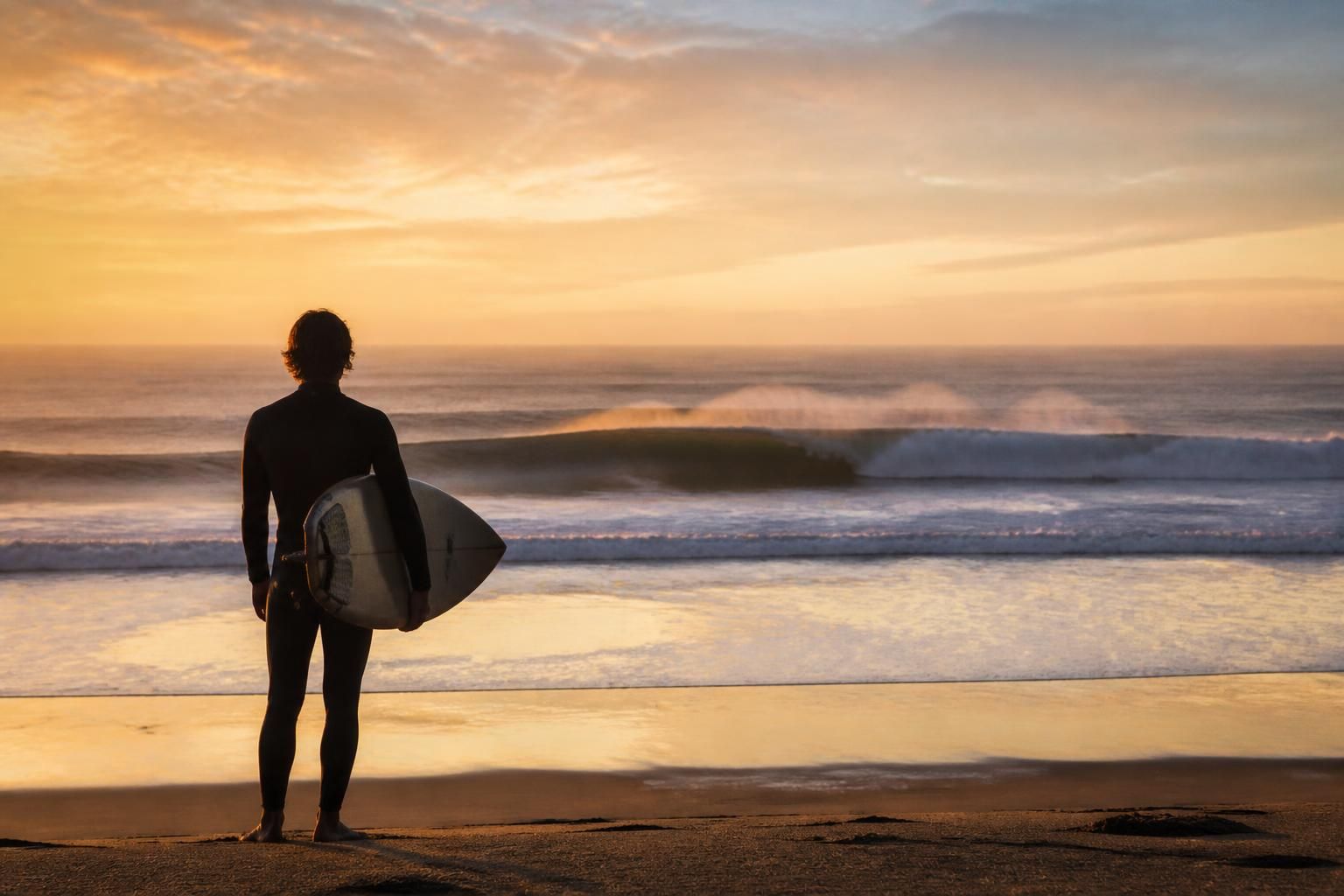
Technical surf assessment in Hossegor: turning an impression into a measurable objective
Saying “you need to improve your style” is too vague to guide a session. Saying “look at the section before the bottom turn on eight out of ten waves” is already an actionable goal. The first session with a useful Hossegor surf coach is therefore based on methodical observation: is the surfer in the right place? Is their paddling committed enough? Is their take-off late, too straight-on, or on the contrary rushed? The answer is built on facts observed in the water, from the beach, or through footage.
The assessment often begins before the first wave. The way the ocean is observed reveals a lot: fixed landmarks on the beach, the rhythm of the sets, the breaking zone, and lateral movement of the water. Next, the coach watches the paddling: upper-body position, depth of paddle strokes, cadence, leg stability, and when the surfer turns around. A delay of just a few seconds in deciding to go can turn an open wave into a fall on the lip.
Key checkpoints in well-structured one-on-one coaching
In a one-on-one coaching session, the limited number of participants makes it possible to prioritize corrections. Trying to change your focus, paddling, posture, take-off angle, and roller in a single session most often creates confusion. One technical priority is chosen, with one or two simple indicators. The surfer then knows what to work on during the next session.
| Area observed | Technical question | Measurable indicator 🎯 |
|---|---|---|
| 🏄 Take-off | Does the board take off early enough and at the right angle? | Take off on 6 waves without nose-diving or standing up too late. |
| 🧭 Positioning | Is the surfer positioned where the wave opens up? | Correct positioning before the next set using a beach landmark. |
| 🌊 Line | Does the first turn generate enough speed? | Reach the next section without pumping erratically. |
| ⚡ Maneuver | Do the eyes and shoulders set up the movement? | Initiate the movement at a chosen point on the wave. |
| 🪵 Equipment | Does the volume genuinely support the technical goal? | Compare the number of take-offs and stability on two boards. |
A common example is the surfer who feels they lack speed. The instinct is to pump more. Yet the issue may come from wave selection, a take-off that is too straight, or a bottom turn started without bending the knees. Coaching puts the causes in the right order. A lower line, initiated at the right time, often generates more speed than a series of forced movements.
The quality of the assessment also depends on honest teaching. A good coach explains what is already working, because preserving what has been learned avoids unnecessarily rebuilding a stance. They then identify the main lever, give a short instruction, and suggest a drill. For example: “on the next three waves, don’t go for the roller; look at the section as soon as you stand up and keep your leading hand pointed toward your exit line.” It is concrete, visible, and easy to remember.
At the end of a session, the surfer should be able to describe their area of focus without jargon. A measurable goal turns a vague feeling into verifiable progress.
Hossegor surf video coaching: see what feeling does not reveal
Feeling in surfing can sometimes be misleading. A wave that feels fast from the board may look flat on video; a turn that feels highly committed may reveal a posture that is too upright or eyes that remain fixed ahead. That is precisely the value of Hossegor surf video coaching : comparing how it feels with an image, then connecting that image to a correction that can be applied in the water. Video is not just an end-of-lesson extra, but a tool for technical analysis.
The options listed in the pricing information available on March 24, 2026 often have a format of around two hours, including approximately an hour and a half in the water, filming, and a debrief. Some options also mention sending the footage and a technical sheet remotely. Among the resources to consult, the details of a video coaching session in Hossegor allow you to check the actual content, booking conditions, and review arrangements before booking.
What video can really analyze
A useful sequence is not limited to the final maneuver. Ideally, it begins before take-off: position in the lineup, board orientation, when you start paddling, pop-up posture, first pressure point, and chosen line. On a Hossegor right-hander, the coach can pause at the moment the surfer stands up too early, loses the energy of the wave face, and is forced to muscle through the next move.
Analysis becomes highly effective when it follows a progression: an image, an observation, a consequence, an instruction. “Your eyes stay on the rail at the start of the bottom turn; your shoulders are slow to open; the board comes back up without projection; in your next session, look at the lip before the board reaches the bottom of the wave.” This sequence avoids purely aesthetic commentary and provides a specific action.
Video does have its limits. It cannot replace reading the current, the ability to feel pressure under your feet, or the experience of paddling in a longer set. The camera angle can also distort a trajectory. That is why the discussion with the coach matters just as much as the file sent: the footage must be placed in the context of the day’s conditions, wave size, equipment used, and stated objective.
Remote analysis can be useful for maintaining progress tracking between two stays. The surfer sends a recent sequence, receives annotations, and works on a targeted theme at home. The website presenting the principle of video surf coaching illustrates this approach: the footage is used to identify limiting factors and suggest technical focus areas, rather than multiplying general comments.
Create your coaching rhythm in Hossegor
A few choices are enough to create a realistic plan: time in the water, recovery, and concrete markers to observe.
Your plan for a typical week
A balanced rhythm to improve without piling up exhausting hours.
Work on one simple intention per session rather than trying to correct everything at once.
For Mathieu, video revealed that his presumed arm problem was only a consequence: he stood up with his feet too close together and remained stuck in the center of the board. By widening his stance, he was able to bend more and use his shoulders more naturally. Used properly, video does not judge the surfer: it shortens the path between the observed error and the understood movement.
Choosing between a single session and a surf improvement camp in Hossegor
A single session can be highly relevant, provided you have a clear goal. It is suitable for surfers passing through who want to assess their level, those preparing for a trip with more powerful waves, or those struggling with a particular movement. A session with observation and video analysis can, for example, reveal a positioning error that has been recurring for months. The immediate benefit is above all clarity: knowing what to work on next.
The surf improvement camp in Hossegor makes more sense when a change requires repetition. Adjusting your take-off timing, developing a new paddling line, or improving a maneuver requires several returns to the water. Between sessions, the body adapts, the surfer practices alone, and the coach makes adjustments. Three to five sessions spread over several days often make it possible to follow a logical progression: assessment, guided exercise, consolidation, adaptation to different conditions, review.
Building a coherent progression based on the obstacle encountered
A progression should not be chosen because it promises “rapid progress.” It should address a real difficulty. A surfer who simply lacks reference points at a spot can improve with a highly targeted session. Conversely, someone who wants to progress from going straight to a useful bottom turn will need several waves, several conditions, and some time out of the water to absorb the instructions.
- 📍 Session 1: observe, film if possible, and set a technical priority.
- 🏄 Session 2: repeat the exercise on suitable waves, without adding another major instruction.
- 🎥 Session 3: compare the footage or observations with the starting point.
- 🌊 Session 4: apply what you have learned in different conditions or on a different sandbank.
- 📝 Session 5: establish a realistic independent program for the following weeks.
Private offerings in the area vary in format, so they need to be compared on an equal basis. A session advertised at €120 for one person, a duo package at €160, or a small group of three at €200 do not tell the whole story if water time, board rental, insurance, travel to another spot, and video differ. The prices listed are reference points displayed as of March 24, 2026; they should be checked directly with the provider when booking.
The swell calendar also affects the format. A five-day stay does not guarantee five days of identical waves, which is actually a teaching advantage: small swell allows work on volume and line, a more hollow swell requires reassessing positioning, and a windy day can be devoted to debriefing, mobility, or sequence analysis. The details of surf camps in Hossegor provide a starting point for reviewing the advertised duration and organization.
The right choice is not measured by the number of hours sold, but by the continuity between the assessment, the situations encountered, and the assigned exercises. One session sheds light on a problem; a well-designed program builds a skill.
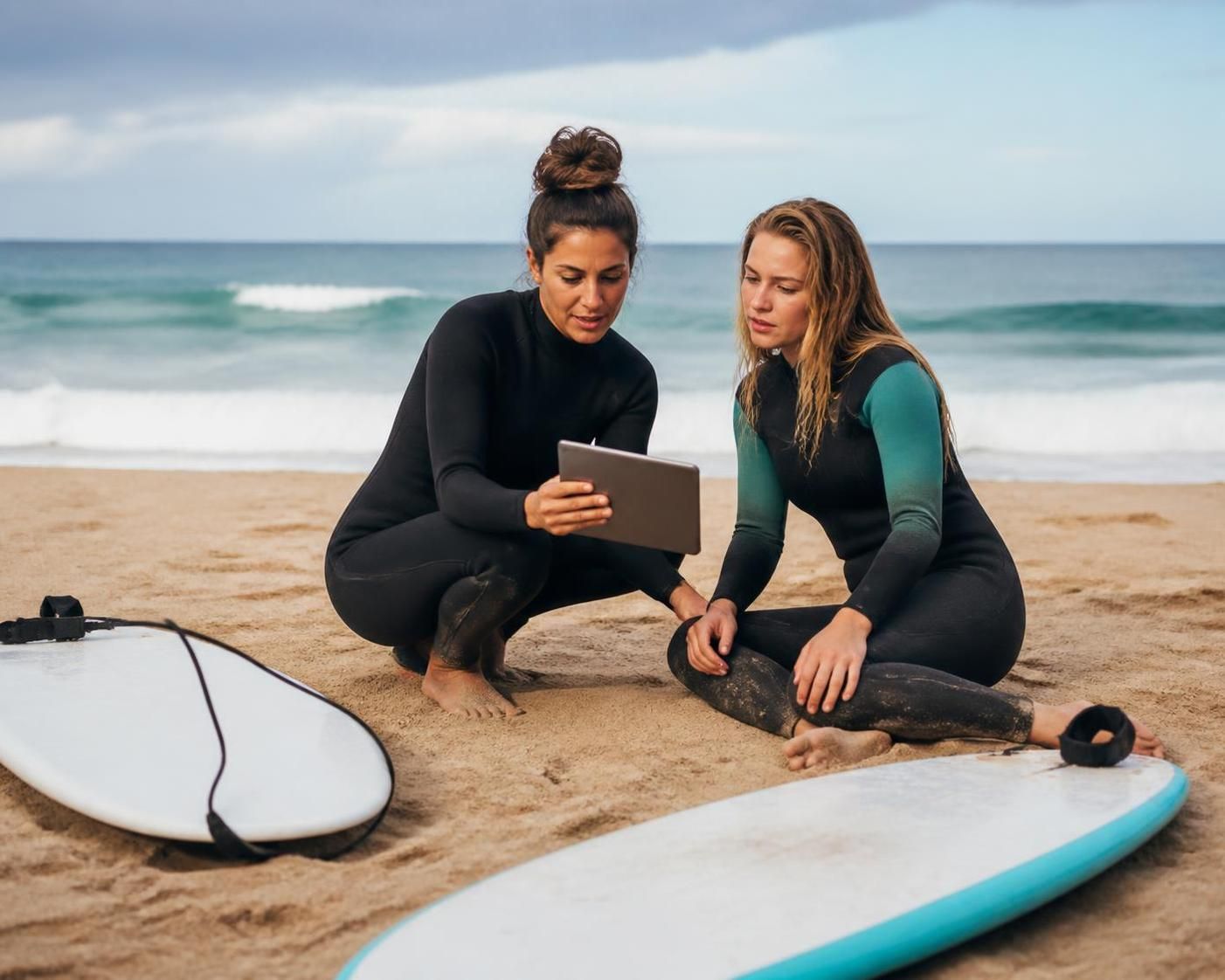
Board choice and progression: testing useful volume in Hossegor
Equipment is never a magic wand, but it can help or hinder learning. In Hossegor, the temptation to use a short, thin board is strong when the waves become more hollow. Yet a board with insufficient volume reduces the number of takeoffs, tires out the paddling, and prevents repetition of the movement that needs to improve. For serious progression, the right board is one that provides enough waves to practice without completely masking technical errors.
Testing several volumes or shapes during coaching can be very instructive. A wider, slightly longer board helps an intermediate surfer take off earlier and feel the speed line. A narrower model can then reveal the limits of their back-foot pressure or paddling. The goal is not to determine “the best board” in absolute terms, but to understand the relationship between body size, the day’s waves, paddling level, and the technical objective.
Comparing sensations without being misled by appearance
A meaningful test is based on simple criteria. How many waves were caught? When does the board accelerate? Does the surfer remain in control in the pocket? Can they commit to a turn without forcing it? Two or three waves are not always enough to draw conclusions, especially on an inconsistent beach break. A coach can organize the test by alternating boards during the same tide window, to avoid confusing the board’s effect with a sudden change in conditions.
Length is only one factor. Volume, its distribution, nose width, rocker, rails, and fin setup also change how a board performs. A board may offer good overall volume but place it very differently under the chest or toward the rear. For a surfer struggling to take off, useful paddling volume matters more than a tail’s spectacular design.
In some private lessons, board and wetsuit rental are included, which can make it easier to try suitable equipment. However, it is important to ask exactly which models are available: a foam board is ideal for working on catching waves and committing in gentle swell, but it will not provide the same feedback as a mid-length or a performance shortboard. The private lesson packages in the Hossegor area make it possible, in particular, to check the advertised equipment before setting a goal around a test.
Equipment should also be chosen with safety in mind. In a crowded session, a long, rigid board handles differently when duck diving and can pose a greater risk if it gets away from the surfer. The leash, fin condition, wetsuit fit, and board-to-wave suitability are part of technical preparation, not just comfort.
The best board for progressing is often the one that makes mistakes clear and repetition possible. More suitable waves mean more decisions to analyze, and therefore more usable progress.
Hossegor surf coach: checking supervision, group size, and weather protocol
Choosing a coach does not mean selecting the most enthusiastic promise. Quality coaching is based on concrete criteria: qualifications, teaching experience, knowledge of the spots, group size, ability to explain clearly, and the protocol used when conditions change. The Landes coast is generous, but it requires good judgment. A beautiful swell can become too technical depending on the level, and the “perfect” morning spot may no longer be suitable a few hours later.
The first thing to check is the professional legitimacy of the supervision: required qualification for paid instruction, liability insurance, practice framework, and clear contact information. Experience is just as important, because it translates into the ability to read a sandbar, move a group at the right time, or say that a condition does not match the day’s objective. A serious instructor does not sell the same session to everyone.
Small group or private format: compare what is actually included
A small group may suit friends of a similar level working on the same theme. The shared motivation is enjoyable, discussions enrich the debrief, and the individual cost decreases. However, as soon as differences in paddling, equipment, or ambition become significant, personal feedback time decreases. To correct a subtle difficulty, one-on-one coaching retains a clear advantage: every instruction, wave, and filmed sequence directly supports the person’s goal.
| Comparison criterion | Ask before booking | Why it’s useful 🔎 |
|---|---|---|
| 👥 Group size | What is the maximum number of participants? | Determines observation time and the number of personalized feedback points. |
| 🎥 Video | Are filming, debriefing, files, and a report included? | Avoid comparing a simple lesson with a full analysis. |
| ⏱️ Actual duration | How much time is spent in the water, excluding the briefing and travel? | Helps compare equivalent services. |
| 🌦️ Weather and spot | Who decides whether to postpone or change beaches? | Safety takes priority over the original plan. |
| 🛡️ Insurance | What coverage is provided during the activity? | Clarifies the framework in the event of an incident. |
The weather protocol deserves special attention. The information provided indicates that some providers reserve the right to choose the spot based on the weather, swell, and tides. This is a good sign when it is clearly explained: the session may shift to Seignosse, Capbreton, or a more sheltered area, be postponed, or be redirected toward technical analysis. Traveling by vehicle can add flexibility, but it never replaces a cautious decision.
Before paying, it is useful to ask how the review is conducted. Does the surfer receive the raw videos? A technical report? An immediate debrief? Exercises to continue with? An offer advertising “video analysis” without specifying these points remains difficult to compare. Information on surf coaching between Hossegor and Seignosse can serve as a reference for checking the options offered based on the desired level and format.
A smile and a positive attitude remain valuable, but they are ideally supported by a clear method. A good coach keeps the session safe, explains their choices, and gives the surfer benchmarks they can use on their own.
Improving after surf coaching in Hossegor: exercises and self-assessment
The course or session is not an isolated interlude. The value of coaching is measured above all by what remains once the instructor is gone: a more refined reading of the spot, a remembered instruction, a repeatable exercise, and a clearer way to assess one’s sessions. Without this independent follow-through, even excellent video analysis may remain just a good memory stored on a phone.
The progress plan must remain realistic. Two short, focused sessions are often better than one long session in which the surfer gets tired, loses concentration, and repeats their mistakes. Depending on the goal, one to three surf sessions per week may be enough, provided the same focus is maintained over several outings. Progress is not linear: a difficult session in a northwesterly wind does not cancel out an improvement noticed the day before in gentler swell.
Keeping a simple record of your sessions
A very simple surf journal helps enormously. After each session, note the approximate size, wind, tide, board, number of waves actually caught, and just one technical observation. This record helps identify patterns: perhaps the surfer paddles better with a little more volume, or their best takeoffs happen at a certain stage of the tide. The goal is not to produce perfect statistics, but to avoid basing every judgment on the last wave of the day.
- 📝 Note one success you can observe: “three takeoffs caught earlier thanks to continuous paddling.”
- 🎯 Keep a single focus : vision, compression, positioning, or wave choice.
- 📹 Film occasionally from the beach, with permission and while respecting everyone’s safety.
- 🧘 Add mobility, core-strengthening, and shoulder work on days without surfing.
- 🌊 Reassess the plan after four to six sessions, not after a single missed wave.
Appropriate physical preparation does not need to be complicated. A thoracic mobility routine improves paddling comfort; dynamic core-strengthening helps maintain a more stable posture; a few controlled push-ups and shoulder work can build endurance. It should all support surfing, never replace it. Nothing fully replicates reading the sets and timing a takeoff in the Atlantic.
For Mathieu, the post-coaching program was limited to three instructions for one month: observe for ten minutes before going in, position himself wider than his first instinct, and keep his eyes on the section during the pop-up. He was not looking for a new trick. After several sessions, he was catching more open waves and naturally found himself better positioned to commit to his first turn. This is how real progress is built: through the accumulation of simple, good decisions.
It makes sense to schedule another analysis when the initial objective becomes automatic or a new milestone appears. Lasting progress begins when the surfer knows how to observe themselves without putting themselves down and make adjustments without losing focus.
Hossegor, Seignosse and Capbreton: adapting coaching to the day’s conditions
The beaches of Hossegor, Seignosse and Capbreton are not interchangeable, even though they share the same Landes coastline. Sandbar shape, exposure, crowds, currents and access quality all affect how a session is planned. Well-designed coaching therefore does not promise a fixed spot: it selects an area that matches the surfer’s level, objective and the conditions observed on site.
In Hossegor, some waves can be powerful and fast, offering excellent conditions for analyzing timing and lines when they remain within the surfer’s ability level. Seignosse also offers many beach breaks, with areas that can sometimes be better suited to repetition work depending on the day’s sandbars. Capbreton, shaped by its underwater canyon and harbor environment, requires a specific reading of conditions. This diversity is an opportunity, provided that every move does not become a thoughtless hunt for “the best wave.”
Safety as the foundation of rapid progress
A serious coach observes the swell period, its direction, the wind, changing tides and how the sets behave before setting up a session. They also take the group’s condition into account: a surfer tired after a long paddle does not respond to instructions in the same way as at the beginning of a session. Changing spots, reducing time in the water or calling it off are sometimes the most instructive decisions.
Respect for the environment is also part of learning. Avoiding unnecessarily trampling sensitive areas, picking up trash, limiting unnecessary travel and respecting other beach users all help preserve this playground. The ocean is not merely a backdrop for performance: it demands constant attention, humility and a little patience, even on days when the sets seem to be playing hide-and-seek. 🌊
Ultimately, tailored coaching brings together several dimensions: safety, spot selection, technique, equipment, observation and consistency. An independent surfer gains freedom when they understand why the day’s plan has changed, why a wave should be let go, and why an apparently minor correction can unlock an entire line.
In Hossegor, the fastest progress is the kind that respects the surfer’s true level and the ever-changing rhythm of the ocean.
Do you need to be independent to take surf coaching in Hossegor?
Yes, advanced coaching is mainly intended for surfers who can manage an appropriate session: assess the spot, get through a manageable break, respect priority rules and catch unbroken waves. Beginners are better off building solid foundations in a traditional supervised lesson.
How many sessions should you plan to make progress?
A single session is useful for establishing a diagnosis or overcoming a specific issue. To make lasting changes to a take-off, positioning or line, a cycle of three to five sessions generally makes it possible to observe, repeat, correct and transfer what has been learned to different conditions.
Is Hossegor surf video coaching really useful?
Yes, when it comes with a clear debrief. Video makes it possible to compare feeling with the reality of positioning, eye line, posture and line. It should lead to one or two concrete instructions, not an accumulation of remarks.
Can you try another board during an advanced training camp?
It is possible if the equipment is available and the trial serves a specific objective. Comparing two volumes or two shapes in similar conditions helps assess paddling, the number of take-offs, stability and the ability to maintain speed.