
A rail that catches after an impact, an open nose in the parking lot, or a fin box that shifts after coming out of a wave: in Hossegor, a damaged board immediately raises a practical question. Should you stop the session, protect the damage to get back, attempt a minor repair, or look for a workshop? The answer depends less on how dramatic the impact looks than on its watertightness, its depth, and the part of the board affected.
The process begins with a dry inspection, may continue with drying, and then involves choosing a repair compatible with the materials. To compare professionals between Hossegor, Seignosse, and Capbreton, it is better to request a detailed quote than rely on a standard rate: a small dry crack and a torn-out fin box require neither the same work nor the same turnaround time. 🏄
Crack or simple dent: when should you stop surfing in Hossegor?
After an impact, the first instinct is to head back to shore without putting further strain on the affected area. Then laying the board flat in a safe place makes it possible to distinguish superficial marks from damage that exposes the foam or weakens the structure.
Take the example of Léa, a fictional surfer staying in Hossegor. After a rather hard encounter between her board and the sandbar, she notices a mark on the rail: her assessment begins with observation, not another set of waves.
Recognizing a cosmetic dent on a surfboard
A depression underfoot or on the deck can remain purely cosmetic when the lamination is intact, rigid, and unbroken. Pressure dents appear with use: they indicate localized compression, but do not automatically mean the board is taking on water.
A visual inspection from several angles helps identify a white line, a break, or a softened area. Very light pressure can reveal unusual behavior; do not press hard, as this could worsen existing delamination.
If the surface is sealed and the board remains rigid, professional advice can wait. However, a recent, deep mark or one located near a fin box deserves close inspection: its location matters as much as its size.
Can you surf with a crack?
The answer is no as soon as a crack is open, the fiberglass is visible, or there is serious doubt about watertightness. Water can seep beneath the board’s outer skin and complicate the repair; wave motion can also extend the break.
A simple surface mark in the paint does not necessarily have the same consequences. The distinction is difficult to make on the beach: if a fingernail clearly catches, the edges move, or the foam is visible, it is best to stop the session and have the area inspected.
For Léa, a split in the rail immediately changes the plan: back to shore, board out of the water, and a dry inspection. A piece of tape applied in a hurry does not turn an open break into a lasting repair.
Delamination, water ingress, and weakened fin box
A delamination is the separation of the laminated outer skin from the underlying core. It may appear as a blister, a soft area, or a panel that moves under light pressure; its presence warrants an assessment, even without an obvious hole.
A board that is taking on water may show damp foam, seepage from the impact point, abnormal discoloration, or unusual weight. These signs are not always visible immediately: a board that appears dry on the surface may still contain moisture.
Finally, a fin that tilts in its box, a crack around the plug, or lifted fiberglass indicates a mechanical risk. In this case, do not force the fin to “check” it: stopping the session protects both the equipment and other surfers.
The right decision criterion is simple: sealed and solid surface, monitor it; opening, moisture, or a moving part, get out of the water. The next step is to transport the board without trapping water inside its structure.
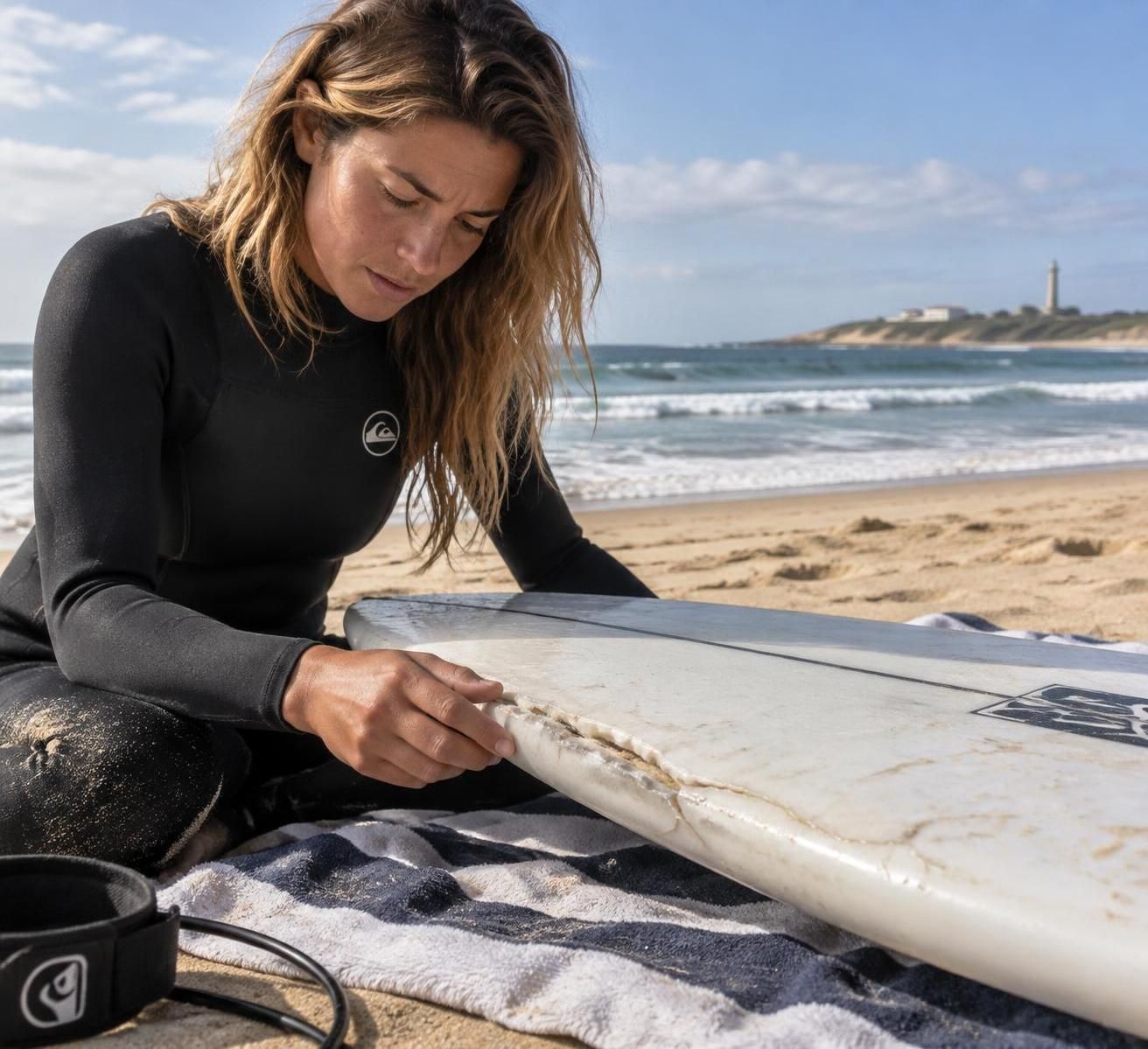
Board taking on water: the right steps before a repair in Hossegor
An open impact does not mean a board is beyond repair, but how you handle it after the accident affects what comes next. The goal is to limit water entry and prevent moisture already inside from becoming trapped under a cover or in a closed board bag.
Transporting a cracked board without making the damage worse
Once on the beach, keep the board away from wet sand and place it in the shade. Gently rinse the exterior with fresh water if necessary, without directing water into the opening; then blot around it with a clean cloth, without trying to fill or clean out the cavity.
Suitable tape can provide temporary protection from dirt during a short trip, but it must not be applied to a wet area or give the impression that the damage has been repaired. Remove it as soon as possible to allow ventilation, and let the repair shop know it was used.
If the opening is significant, clean, loose outer protection can prevent rubbing during transport. In a board bag, position the board so the damaged spot does not bear the weight of the whole board; upon arrival, take it out to prevent moisture from lingering.
A crushed nose or displaced fin box should not be forced back into place with your fingers. Broken fiberglass can be sharp: handle the edges carefully and leave fragments in place until an assessment is made.
How long should you dry a board after water gets inside?
There is no universal answer to the question of how long to dry a board. The amount of water, construction, size of the opening, and ventilation conditions all affect the situation; a surface that feels dry does not prove the core is dry.
Place the board in a ventilated, temperate area away from direct sunlight, with the damaged area positioned to encourage any possible drainage. Do not leave it in a hot car or use a heat gun or intense heat source: heat can worsen delamination or damage the foam.
Léa notices a few drops around her rail after rinsing. Rather than immediately pouring resin into the crack, she keeps the area accessible and tells the repair shop about the presence of water: this information will help organize the inspection and drying process.
A professional may decide to open up the area further, allow moisture to escape, and inspect the substrate before closing it back up. The quoted repair time should therefore specify whether drying is included or will be assessed after inspection.
Staying safe on the way back
With a damaged board, getting back to shore takes priority over catching one more wave. In the event of current or fatigue, choose a return route suited to your ability and ask for help if needed; the condition of the equipment must not distract from sea conditions.
How baïnes work and safety basics in Hossegor should be understood before a session. Sound equipment never replaces reading the currents, and a weakened board is one more reason to remain cautious.
The useful rule: ventilate without heating, protect without sealing in. Once moisture has been taken into account, material compatibility determines the type of repair possible.
Epoxy/polyester resin repair: identifying your board’s construction
Two similarly shaped boards may have different foams and laminations. To repair a surfboard in Hossegor without unpleasant surprises, knowing its construction helps you choose a compatible product and provide the repairer with the right information.
PU foam board and polyester lamination
A classic construction combines polyurethane foam, often called PU, with a fiberglass and polyester resin lamination. Depending on its manufacture or a previous repair, it may also include other products compatible with the substrate.
Polyester resin is common on PU boards, but using it requires proper preparation, correct mixing ratios, and safety precautions. A repair is not simply a fill: fiberglass, adhesion, and finishing all contribute to strength and watertightness.
A yellowed area alone does not make it possible to determine the type of foam with certainty. If the manufacturer’s label is missing, it is best to look up the model specifications or ask a professional before buying a kit.
EPS foam and epoxy resin: beware of incompatibilities
EPS foam is generally paired with an epoxy lamination. Some solvents found in conventional polyester resins can attack exposed EPS: applying the wrong product to a hole can therefore make the damage worse instead of sealing it.
The word “epoxy” on a kit does not eliminate the need to check its compatibility with the board, other materials, and the type of repair. A resin suited to the substrate must also be used according to the manufacturer’s instructions, particularly for mixing and curing.
Léa owns an EPS board with foam visible beneath a chipped rail. Even though the hole looks small, she decides against the polyester tube found at the bottom of a trunk: identifying the construction comes before speed.
Sandwich constructions and soft foam boards
A sandwich board has several layers, sometimes with an intermediate material between the outer skins. A local impact may affect a larger area than the visible mark; internal crushing or separation cannot necessarily be fixed with a simple drop of resin.
Soft foam boards also come in a variety of constructions. A solution suitable for a traditional laminated board is not automatically suitable for their coating, core, or inserts: the repairer needs to know the model and the area involved.
Previous repairs can sometimes complicate diagnosis. A white mark, filler, or color touch-up may conceal a lamination different from the original one; take a photo of that area and mention any known work.
| Construction | Key consideration | Before repairing |
|---|---|---|
| 🏄 PU and polyester | Check the condition of the fiberglass and core. | Confirm that the product is compatible with the board. |
| 🧩 EPS and epoxy | Some polyester products can damage exposed foam. | Choose a solution explicitly compatible with EPS. |
| 🛠️ Sandwich | An impact can damage several layers. | Have soft or delaminated areas inspected. |
| 🌊 Soft-top | Coatings and construction vary by model. | Provide the brand, model, and photos. |
Identifying the material is not just a matter of terminology: it is essential to avoid an incompatible repair. The next question is the level of work actually required.
Small ding repair in Hossegor: repair it yourself or contact a repair shop?
A small, dry, accessible, and clearly identified chip can sometimes be repaired at home with a suitable kit. Conversely, the visible size of the damage is not enough to make the call: a tiny crack around a fin box can have far greater mechanical consequences than a superficial chip on the deck.
Conditions for a small DIY repair
A simple repair is limited to localized damage, with no persistent water ingress, no soft area, and away from highly stressed components. The construction must be known, the surface clean and dry, and the manufacturer’s instructions understood before applying anything.
A repair kit is not a universal solution. You need to check the type of foam it is suitable for, curing conditions, and the time before immersion; a product advertised as fast does not guarantee proper curing if the required temperature or exposure is not met.
Work in a ventilated area, with the protective equipment indicated on the packaging, away from children and animals. Resins, hardeners, and sanding dust require careful handling; leftover products and contaminated consumables must be disposed of according to local collection guidelines.
Before putting the board back in the water, visually check that the repair is continuous and observe the specified curing time. If the result remains sticky, has an open edge, or reveals a new crack, do not surf it: have the area inspected.
Damage that requires a professional
Significant water ingress, delamination, a deep break, a soft structural area, or impact damage to a sandwich construction require a repair shop assessment. The same applies if the material is unknown or a previous repair is coming loose.
To repair a fin box, alignment and anchoring matter just as much as watertightness. A simple bead around the plug does not guarantee that the part is properly secured to the structure; a fin box that fails while surfing can make the board unpredictable.
A severely crushed nose, a split tail, or a rail opened over several inches also requires an assessment of the fiberglass and foam. The repair shop can determine whether damaged material needs to be removed, the volume rebuilt, and the fiberglass layup redone.
In Léa’s case, the presence of water and exposed EPS foam point toward a professional repair. A kit might have concealed the opening, but it would not have determined whether the inside was dry enough.
Has your board been damaged?
A few questions to determine whether it’s best to contact a repair shop in Hossegor or whether a small DIY repair may be possible.
This questionnaire does not replace having your board inspected by a professional.
The best savings do not come from repairing every ding yourself: they come from reserving DIY repairs for damage that is genuinely simple. For everything else, understanding the repair shop’s work helps you compare quotes more effectively.
Hossegor surf repair shop: how does the assessment work?
A professional repair begins with a question that is often impossible to see in a photo: how far does the damage extend beneath the surface? The repairer examines the construction, the location of the impact, and the stresses the board will need to withstand again.
Surfboard inspection, opening, and drying
The initial inspection focuses on the outer skin, the foam, nearby cracks, and any previous repairs. The professional may check for a soft area around the impact and determine whether the damage affects a rail, a fin box, or a particularly stressed area.
A photo often provides an initial indication, but it does not always replace a hands-on inspection. A seemingly small mark may conceal moisture or delaminated fiberglass; conversely, a dramatic-looking mark may be limited to the finish.
When the material is damaged, the repairer may open up and remove any parts that are no longer bonded in order to reach sound material. This step may reveal more extensive water ingress than expected, which is why a price quoted from a photo can sometimes be only an estimate.
Drying is then adapted to the board’s actual condition. Ask whether an interim inspection is planned and when the shop will confirm the timeframe: this is especially useful for a rental or a short stay.
Rebuilding, fiberglassing, and finishing
Depending on the damage, missing volume can be rebuilt with compatible materials. The professional then prepares the surfaces and applies the necessary fiberglass layers to restore a strong, watertight shell.
For a fin box, positioning requires particular attention: the part must be correctly aligned and anchored in sound material. A repair that looks clean on the surface is not enough if the underlying attachment remains fragile.
After curing, sanding reshapes the area, then a finish may be applied depending on the quote. A clear repair, a color touch-up, and a high-end cosmetic finish do not require the same amount of labor.
Finally, the inspection includes the edges, local rigidity, and finish quality. Ask what was done, whether any special precautions are needed, and when the board can go back in the water.
Understanding the steps behind the quoted timeframe
A repair shop promising a quick turnaround may be referring to a small, dry impact, not a waterlogged board. Wait times may include the assessment, drying, the various resin curing stages, finishing, and the shop’s workload.
For Léa, a useful quote therefore distinguishes between two scenarios: work on sound material, followed by a reassessment if opening it up reveals more moisture. The board’s pickup date becomes more reliable when these conditions are made explicit.
A good conversation is not limited to asking “for tomorrow?”: it helps determine what will be repaired and under what conditions the turnaround time can be met. The remaining question is who to entrust the work to in the area.
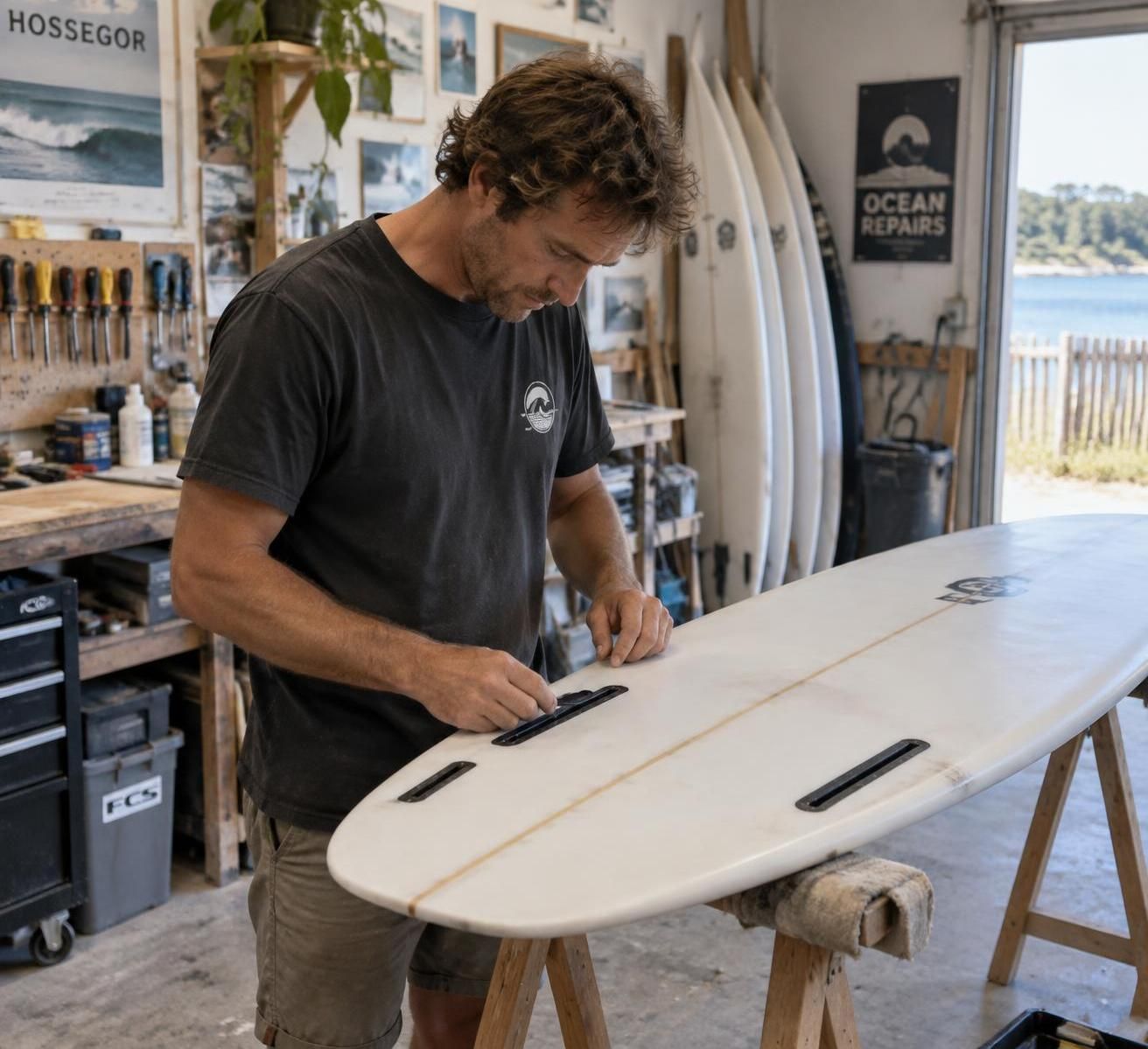
Repairing a surfboard in Hossegor: comparing local workshops
Together with Capbreton and Seignosse, Hossegor forms a convenient area for finding a repairer, shaper, or surf shop that can refer you to a workshop. The following businesses have pages dedicated to repairs; before heading over, confirm the services, drop-off address, and availability directly.
Sauvages Surfboards near Capbreton and Hossegor
The Sauvages Surfboards repair page notably covers work on cracks, delaminations, and fin boxes, as well as boards with a range of construction types. It is an option to consider for damage beyond a simple cosmetic chip.
The information also mentions the possibility of drop-off through a partner school and local transport options. These arrangements may change: check the drop-off point, service areas, and applicable fees before planning your trip.
For an effective request, send an overall view of the board, then a close-up photo of the damage with a scale for reference. If a fin is loose or the board has taken on water, mention it in your first message so the workshop can guide the assessment.
L’Agréou in Seignosse and Maku Surf in the area
The surf repair page for L’Agréou in Seignosse invites customers to request an estimate or bring their board to the shop. This option may suit a surfer based around Le Penon, subject to confirming opening hours and intake conditions.
The website for Maku Surf and its repair services also offers a dedicated local contact point. Specify the board's construction and ask whether the repair you need is carried out on site or arranged through a partner.
Geographic proximity is not the only criterion. For a damaged fin box, ask for confirmation that this type of work is handled; for EPS or sandwich construction, make sure the workshop works with the material involved.
Comparing options without turning the search into a race of promises
A detailed response about the assessment, drying, and finish is often worth more than a simple claim of speed. Compare equivalent services: a clear finish repair does not necessarily include color touch-up, and shop drop-off may add transport to the workshop.
For Léa, two estimates can therefore differ without being contradictory: one concerns an accessible dry crack, while the other allows for a wider opening if moisture is confirmed. Comparison becomes useful when each proposal describes its scope.
The pages cited serve as contact points, not as a guarantee of immediate availability. Direct confirmation of the service and appointment slot remains essential before leaving a board or making a trip.
Surfboard repair prices: getting a reliable estimate and turnaround time
The price of surfboard repair varies depending on the depth of the impact, construction, presence of water, location, and desired finish. An amount without a description of the damage does not allow for a serious comparison between two workshops.
Published rates and availability must be confirmed with professionals when making your request. No price range is provided here without a dated and verified rate for a specific repair; the same caution applies to turnaround times quoted from a single photo.
What affects the cost of a surfboard repair
A small surface chip on a dry board may require limited preparation. At the other end of the spectrum, a torn-out fin box may involve opening the area, rebuilding the support, repositioning the part, and repairing the fiberglass laminate.
The finish also affects the quote. A functional, clean repair may remain visible, while a touch-up intended to match the original color and appearance requires additional work; specify your expectations from the start.
Construction also affects the materials and techniques used. A sandwich board or soft-top may require a specific assessment, while an old repair with poor adhesion may need to be removed before the new work is carried out.
Collection, delivery, or drop-off fees are not necessarily included in the workshop price. Ask for these amounts separately, as well as the cost of any replacement part.
Repair time: distinguishing an estimate from a commitment
A stated timeframe may begin when the board is received, after the quote is approved, or only once the board is dry. This distinction matters during vacation: ask for a return date or time window, the conditions that could change it, and how confirmation will be provided.
Water ingress is a major variable. If the workshop must wait for drying or discover the extent of the crack when opening the area, an initial quote may be adjusted with your approval before work continues.
To compare two offers, send the same photos and ask the same questions: whether the assessment is included, materials, finish, transport, any replacement part, timeframe, and return conditions. A written quote prevents confusing an indicative estimate with a price confirmed after inspection.
If your schedule is tight, mention your departure date rather than demanding an express repair. The professional can say whether a safe return is compatible with their schedule or suggest another arrangement.
When should you consider a temporary replacement solution?
A rental or loaner board may be more suitable than rushing back into the water, especially when the board needs to dry. Ask the rental provider for a board suited to your level, build, and the day's conditions.
To choose a sensible session with this different equipment, understanding tides and their influence on surfing in Hossegor provides a useful reference point. Tides alone are not enough: swell, wind, currents, and crowd levels also matter.
The right quote answers three questions: what damage, what service, and what date under what conditions? Before accepting it, carefully preparing the drop-off makes the workshop's job even easier.
Preparing for drop-off and protecting your surfboard after repair
A repairer saves time when essential information arrives with the board. In turn, the surfer gets a more relevant estimate and reduces the risk of omissions: this is especially welcome when the swell returns during the stay.
Checklist before dropping off a board in Hossegor or Capbreton
- 📷 Photograph the whole board and the damage in detail: add a ruler or an object of known size next to the impact, without covering the cracks.
- 🧩 Identify the material: provide the brand, model, and construction if known; if in doubt, say so rather than guessing.
- 📏 Describe the damage: specify its location, approximate dimensions, and whether there is a soft area or a loose fin box.
- 💧 Report any water ingress: mention the date of the impact, any sessions since then, and any leakage observed.
- ⏰ Indicate the urgency: provide your desired pickup date and ask whether drying could affect the schedule.
- 🧳 Prepare for transport: remove detachable accessories when possible without forcing them, identify the board bag, and ask whether it should stay at the workshop.
For a damaged fin box, do not remove a stuck fin by applying strong twisting force. Explain the situation to the professional: they will decide how to remove it without making the damage worse.
Before leaving, also photograph the board’s overall condition and confirm the requested service in writing. When picking it up, review the repaired area, the agreed finish, and when the board can go back in the water with the workshop.
Transport, storage, and monitoring after a heavy session
A board bag limits minor knocks during transport, but it does not make a board invulnerable. In the car or on a roof rack, avoid pressure points on the nose, tail, and fin boxes; check the straps without crushing the rails.
After your session, a fresh-water rinse and drying in the shade help keep the equipment clean. A board left damp for a long time in a warm board bag remains exposed to unfavorable conditions: take it out and let it breathe.
Store it in a temperate place, protected from falls and direct sunlight. A towel or board bag is not enough to protect a board left in an overheated vehicle; heat can contribute to delamination issues.
After a demanding session, quickly inspect the rails, nose, tail, and areas around the plugs. A recent mark addressed in time may only require a minor repair, while an ignored opening can let water in during subsequent sessions.
Getting back in the water with an inspected board
Before your first session after repair, check that the fins are properly fitted and that the repaired area has no raised edges or unusual feel. Follow the workshop’s recommendations, especially if a finish or bonding still needs time.
A quick check before heading out lets you enjoy your session without turning every suspicious sound into a worry. The habit to keep: spot issues early, act appropriately, and allow the time needed for a job well done.
Frequently asked questions about surfboard repair in Hossegor
Can you surf with a crack in the rail?
An open crack, visible fiber, or any doubt about watertightness means you should stop the session. A simple paint mark may be superficial, but a crack whose edges move or that clearly catches should be checked.
How long does a board that has taken on water need to dry?
The duration depends on the amount of water, the construction, and the damage. Keep the board in the shade in a ventilated place, away from intense heat, and have the workshop inspect the core before sealing the area back up.
Can polyester resin be used on an EPS board?
Standard polyester resin can attack exposed EPS foam. You need to identify the construction and choose a product that is explicitly compatible; if in doubt, seek a professional assessment.
How much should you expect to pay for a damaged fin box?
The price depends in particular on the condition of the core, whether the fin box needs replacing, the lamination, and the finish. Request a dated estimate after inspection and check whether parts and labor are included.
What should you send a repair shop before dropping off your board?
Send an overall photo and close-ups with a scale, the brand and construction if known, the date of the impact, signs of water intrusion, and your preferred pickup date.