
In Hossegor, having a board made is not simply about choosing a color, a logo, or a length written on a label. A custom surfboard is born from a precise exchange about the waves you actually surf, the surfer’s build, their level, and the sensations they want to develop. On a coastline where sandbanks shift and sessions can go from a small, mushy wave to a fast beach break in just a few days, having the right equipment makes a real difference.
The work of a Hossegor shaper makes it possible to tailor a board to a specific purpose: catch more waves at a shifting peak, maintain hold in a hollow section, regain speed on a less powerful sandbank, or improve without riding a board that is too radical. This guide clearly distinguishes handcrafted manufacturing, production models, simply buying from a shop, and repairs. The goal is simple: order a board that performs in the water, lasts on land, and suits the real-world needs of the Hossegor surfer.
Hossegor shaper: understanding handcrafted surfboard manufacturing
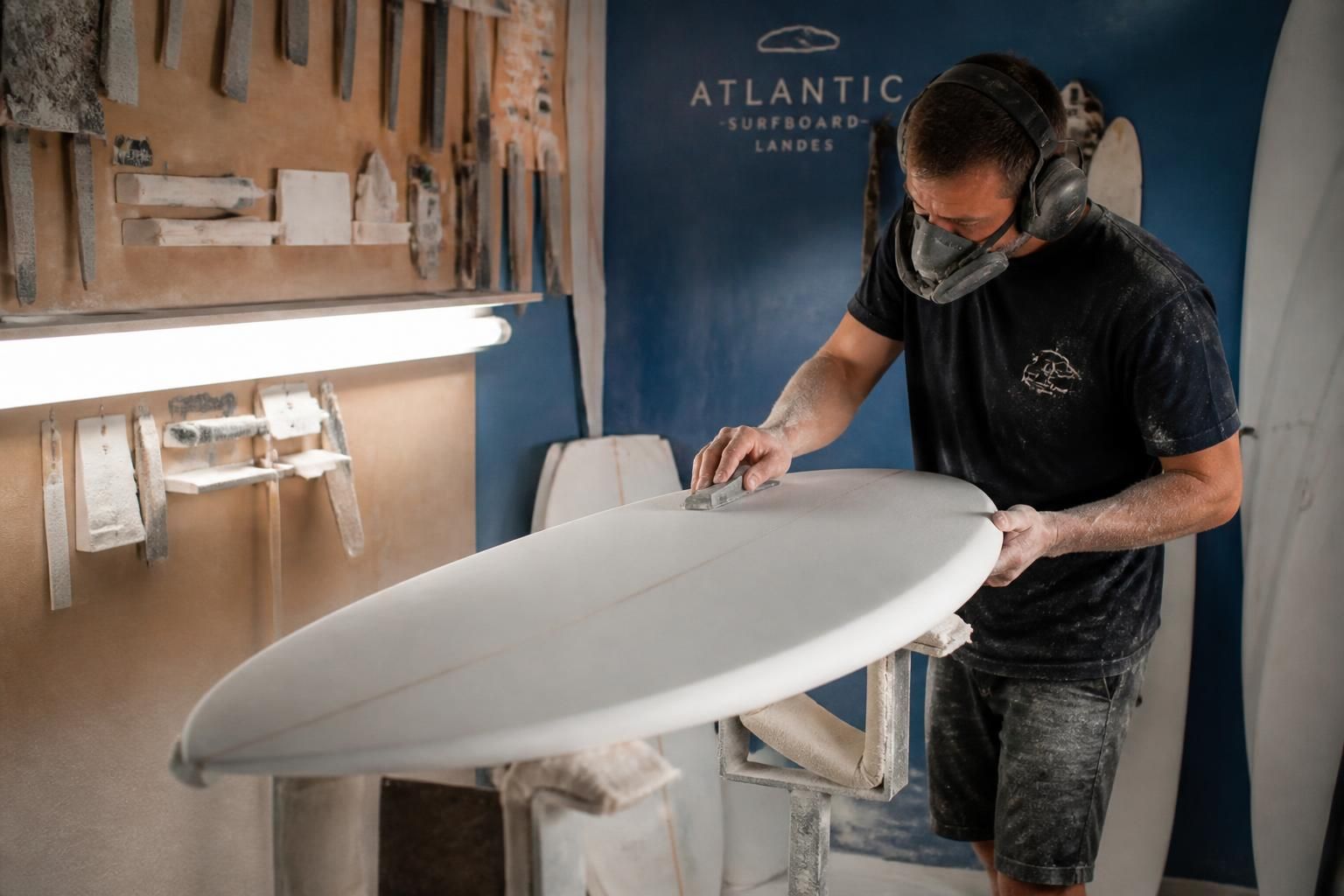
A shaper is a professional who designs a board’s volume and lines. Their work generally begins with a raw foam blank, then continues with shaping the bottom, deck, rails, and ends. This stage of Hossegor board shaping determines the board’s future behavior: how easily it paddles, its speed, stability, hold, and turning ability.
Hand shaping is not merely manual manufacturing. Above all, it is the ability to translate a surfer’s request into consistent technical choices. Two boards with the same length can perform radically differently. A 5’10 fish with plenty of volume up front, low rocker, and a wide tail will not perform like a refined, more drawn-out 5’10 shortboard designed for fast waves.
Handcrafted board, customization, and production model: three different realities
A handcrafted surfboard can be handmade without being fully customized. Some workshops offer tried-and-tested shapes produced in several sizes. The customer then selects a base model, dimensions, fin setup, and finish. This option provides access to local expertise while keeping the decision-making process simpler.
Customization goes less far than a fully custom board. It often involves the tint, pin line, tinted resins, logo, traction pad, fins, or a slight volume adjustment. It does not necessarily change the mold, outline, or rocker. A customized surfboard can therefore be beautiful and visually unique while remaining very close to an existing model.
A fully custom board involves a discussion about dimensions, intended use, and technical trade-offs. The shaper defines or adjusts the dimensions, volume distribution, rails, tail, rocker, and construction. It is not necessarily the best solution for everyone: for a beginner, a forgiving, wide, stable production board may be more suitable than a highly specialized custom board.
- 🏄 Custom shape : geometry and construction determined according to the surfer and their intended use.
- 🎨 Customization : decoration or options selected around an existing shape.
- 🛍️ Stock model : a ready-to-go board available at a surf shop or from a manufacturer.
- 🔧 Repair : work performed on an existing board, without creating an entirely new one.
In the area, several professionals publicly promote shaping or custom orders. The website of OW Surfboards notably offers handcrafted board manufacturing and boards tailored to skill level and riding style. BELL Hossegor details a configuration process covering dimensions, tail, fins, and finishes.
The value of a local workshop lies less in sales talk than in the quality of the questions asked. A good conversation prevents choosing a board that looks “ideal” on paper but is poorly sized for everyday sessions. The right board is the one that helps you progress in the waves you actually surf, not the one that looks impressive on the rack.
Custom surfboard in Hossegor: knowing when custom truly adds value
Ordering a custom board makes sense when standard equipment no longer meets an important requirement. This often involves a particular body type, frequent surfing, a specific progression goal, or a very clearly defined playground. The sandbanks of surf Hossegor can produce powerful, hollow waves, but also softer, wind-affected, or inconsistent conditions: a single board does not perfectly cover every day.
Custom becomes relevant for regular surfers who already know their preferences. For example, Léa, a fictional 62 kg surfer who surfs two to three times a week, paddles easily but loses speed on flat sections. A shaper can keep the length short, add volume under the chest, give it more width at the widest point, and choose a tail that maintains drive. The result will not necessarily look spectacular; above all, it will make more sense underfoot.
Body type, paddling power, and technical level
Weight matters, but it is never the only criterion. Two people weighing 80 kg may need very different volumes depending on their paddling, age, mobility, consistency, and chosen waves. An athletic surfer who surfs year-round can handle a fairly compact board. A beginner adult with few sessions per year will benefit more from a stable, generous, forgiving board.
Your level should be described without ego. Saying “intermediate” is not enough. A useful discussion clarifies whether take-offs are consistent, turns are committed, peak reading is independent, and the surfer can get through the break when conditions pick up. Difficulties matter as much as successes: lack of speed, late take-offs, instability on the rail, hesitation backside, or difficulty holding a line in the pocket.
Riding goals and the waves you surf
A surfer who wants to work on smooth turns in medium-sized waves will not need the same board as someone aiming for late take-offs on a hollower wave. A board designed for mellow sessions around Seignosse may favor float and natural speed. For faster conditions in Hossegor, a little more rocker and refined rails can help control entry into the wave.
Equipment never replaces ocean awareness. Before increasing volume or shortening a board, you also need to understand channels, currents, sets, and exit zones. People returning after a long break can complement their approach with surf lessons in Hossegor : a few coached sessions quickly reveal actual technical needs.
Conversely, buying a radical board to “progress faster” often has the opposite effect. A board that is too thin or too narrow reduces the number of waves caught, and therefore the time spent learning. Progress starts with frequent, controlled, repeated take-offs.
Preparing your brief for a surfboard-making workshop in Hossegor
An appointment with a craftsman becomes effective when the future owner arrives with concrete information. The goal is not to recite technical vocabulary, but to honestly describe your surfing. A skilled shaper turns simple observations into manufacturing parameters: “the board sinks on take-off,” “it is slow in weak surf,” “it bounces in chop,” or “it slips out when the wave gets hollow.”
Preparing this brief also helps avoid copying a friend’s or professional surfer’s board. It may be perfectly suited to their build, power, and style while being unusable for someone else. Dimensions alone do not explain everything: volume, foil, and construction profoundly change the feel.
Useful information to share with the shaper
- 📏 Height and weight : they help establish an initial volume and width range.
- 📅 Surfing frequency : ten sessions per year and three sessions per week do not lead to the same choice.
- 🌊 Regular spots : Landes beaches, occasional reefs, trips, soft waves, or fast beach breaks.
- 🏄 Observable skill level : paddling quality, independence, consistency of take-offs, and the types of maneuvers truly mastered.
- ⚙️ Boards already ridden : dimensions, known volume, appreciated qualities, and perceived drawbacks.
- 🎯 Main goal : make takeoffs easier, gain speed, make tighter turns, surf deeper in the pocket, or travel light.
A photo of your current board, the dimensions written on the stringer, and a short video from a session can be very helpful. They are often more valuable than a vague assessment of your level. The shaper can spot a stance that is too far back, inefficient paddling, or a board that bounces in choppy water. The project then becomes clearer based on facts.
It is useful to distinguish between the ideal quiver and the realistic quiver. An amateur may dream of a board for every wave size but only use one or two models throughout the year. In that case, a versatile mid-length or a generously sized fish may sometimes be a better investment than an ultra-specialized shortboard. The choice should reflect the percentage of sessions, not just the best waves of the season.
Questions to ask before confirming an order
The quote should specify the dimensions, volume if the workshop provides it, construction, fin setup, type of finish, and included items. It is also reasonable to ask about the deposit amount, estimated lead time, conditions for changes before lamination, and warranty terms. Lead times depend on the workshop’s workload, materials, and the complexity of the decoration, so they should be confirmed directly with the professional you choose.
The decision is never simply “shorter” or “longer.” An honest brief gives the shaper the information needed to create a technical solution rather than a mere decorative object.
Volume guide
What litre range for your future board?
A few details are enough to get a cautious recommendation before speaking with a shaper in Hossegor.
This is a deliberately conservative estimate: it provides a range, not a board prescription.
Custom surfboard design: the technical choices that change how it performs in the water
A useful custom order does not require the customer to become a naval engineer. Still, it is valuable to understand the main terms used in the shaping bay. Volume indicates buoyancy, but its distribution matters just as much. A board can have high volume and still be difficult to surf if it is concentrated in the wrong area for the rider.
The outline is the board’s silhouette when viewed from above. A wide shape generally offers more buoyancy and stability, while a narrower outline promotes quick rail-to-rail transitions. Between the two, the shaper chooses a compromise suited to wave size, weight, and the desired style.
Rocker, rails, and tail: three essential factors
Rocker refers to the board’s longitudinal curve. Low rocker generates speed more easily on a less-steep wave, but requires precision when the face becomes steep. More pronounced rocker makes it easier to enter the pocket and reduces the risk of nose-diving, at the cost of sometimes less-easy paddling and lower natural speed on flat sections.
Rails are the edges of the board. Thick, round rails offer forgiveness and buoyancy. Thinner rails grip more and provide a more precise feel, but require better control. For a rider who loses balance at takeoff, the solution is not always to reduce length: slightly increasing stability or softening the rail can be more effective.
The tail acts as the final control zone. A squash tail remains versatile, a round tail promotes smoothness, a swallow tail often provides grip and liveliness in small waves, while a pin tail is better suited to long arcs and powerful conditions. No tail is “the best” in every situation.
| Element 🔎 | Desired effect 🏄 | Watch point ⚠️ |
|---|---|---|
| Generous volume | Easier paddling and wave catching | May limit precision if poorly distributed |
| Wide outline | Stability and speed in soft waves | Less comfortable in a very tight pocket |
| Pronounced rocker | Control on steep faces | Requires more energy to generate speed |
| Thin rails | Grip and precise turns | Less forgiving for an unsteady skill level |
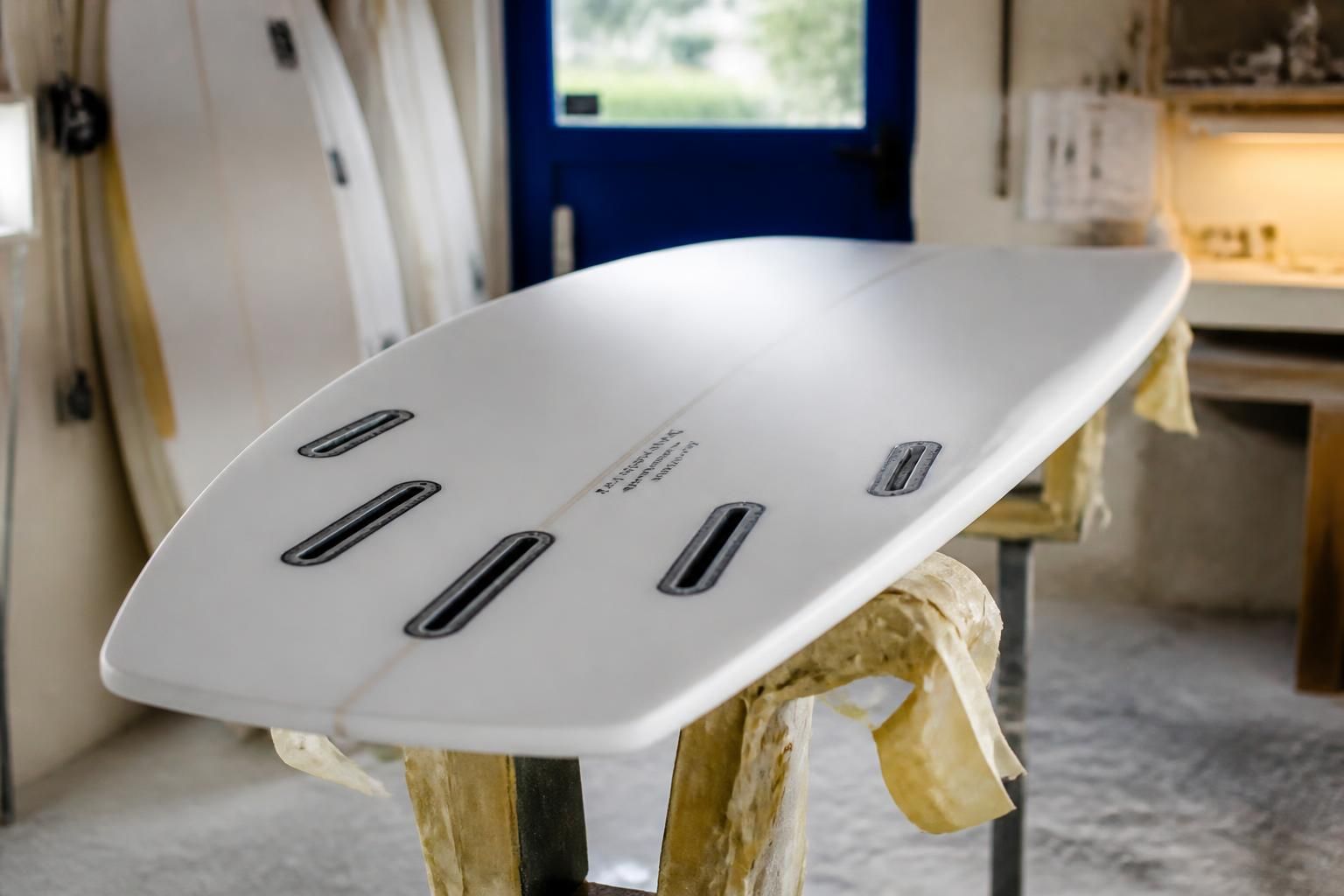
| Five-fin box setup | Try it as a thruster or quad | Does not replace a suitable shape |
The fin setup also deserves discussion. A thruster remains a versatile and predictable configuration. A quad often provides speed and solid hold on certain lines, while a single fin promotes a smoother glide on suitable shapes. Multiple fin boxes offer flexibility, but their value depends on actual use.
To compare the available formats without confusing a workshop order with an immediate purchase, the guide dedicated to surf equipment in Hossegor helps put each type of board in its intended use. Technique becomes useful as soon as it sheds light on a concrete feeling in the wave.
Surfboard manufacturing: from foam blank to final inspection
Making a board involves several stages, some of which remain invisible once the board is finished. The first phase is the discussion: the shaper gathers information from the surfer, explains the trade-offs, and confirms the intended use. Next comes the choice of blank, also called a foam blank, which will serve as the basis for shaping.
On a polyurethane blank, the shaper marks reference points, cuts the outline, then works the curves using planes, sanding blocks, and sanding tools. Precision lies in the transitions. A slight change in thickness between the nose and center can alter paddling; a difference in rail shape changes how water releases out of a turn.
Lamination, finishes, and quality control
After shaping, the board moves on to lamination. Fiberglass cloth is saturated with resin to protect the foam blank and create the board’s rigid structure. The process requires particular attention around the rails, fin boxes, leash plug, and impact-prone areas. A light finish can make a board lively, while a more robust construction increases durability but adds weight.
Glassing can include tints, specialty fabrics, a polish, or a matte finish. These choices are aesthetic, but they also affect price, lead time, and sometimes weight. A complex design must be approved from the outset, especially when it involves multiple layers or tinted resin.
The final inspection checks overall flatness, sanding, fin box installation, and the absence of visible defects. The surfer should inspect their board upon delivery: dimensions, expected finish, plug and fin placement, and rail integrity. This precaution does not reflect mistrust; it simply ensures that the approved project is the one delivered.
PU, EPS/epoxy, and alternatives: choosing a consistent construction
PU combined with polyester lamination remains a classic construction. It offers a flex and feel appreciated by many surfers, and repairs are often familiar to repair shops. However, its susceptibility to pressure dents and environmental impact call for careful maintenance.
EPS covered with epoxy is generally lighter at comparable volume and absorbs less water when intact. It can provide noticeable buoyancy and a distinctive responsiveness. It should not be repaired with just any resin: an unsuitable repair may damage the foam. Hybrid constructions, recycled blanks, cork, or wood offer other options, each with its own trade-offs in weight, cost, repairability, and feel.
A wood board-building workshop offers a different approach. In Saint-Vincent-de-Tyrosse, about a fifteen-minute drive from Hossegor and Capbreton, Capitan Board workshops offer guided board-building sessions. The idea is to make your own board over several days, with materials and tools provided. As prices and dates may change, a direct quote remains essential; historical pricing information does not constitute a commitment for 2026.
A good construction is not one that promises everything at once: it matches the intended use, planned maintenance, and budget actually available.
Custom board or stock model: budget, lead times, and realistic choices
A production model has a major advantage: it can be seen, carried under your arm, and sometimes tested quickly. For a beginner surfer, for a first board after lessons, or for an urgent need before a trip, this choice is often practical. The surf shops in Hossegor cover precisely this logic of immediate purchase, used boards, outlets, and comparing available models.
Custom boards offer more adjustment, but require time. The price depends on the model, size, construction, fin options, finish, and artwork. There is therefore no single credible price. The future owner should request a written quote and check what is included: possible board bag, fins, leash, pad, repair of a manufacturing defect, or cosmetic touch-up.
| Profile 👤 | Suitable solution ✅ | Budget and lead time to plan for 💶⏱️ |
|---|---|---|
| Beginner who catches few waves | Stable production board or sound used board | Limited budget, quick availability |
| Regular intermediate | Proven workshop model or adjusted custom | Compare quotes and allow for production time |
| Surfer with specific needs | Fully custom surfboard | Price varies depending on construction and finishes |
| Damaged but suitable board | Specialized repair | Often more economical than replacement |
Deposit, lead time, adjustments, and after-sales service
A deposit is standard when an order involves materials and labor time. Its amount, cancellation policy, and validation stages should be clarified before work begins. Some adjustments may still be possible as long as the shape is not finished; after glassing, major modifications become complex, if not impossible.
Lead time depends on the season, the workshop, blank availability, glassing, and finishing. Placing an order before busy periods can sometimes help avoid last-minute pressure. Above all, avoid ordering a board a few days before a trip in the hope that a craftsman can shorten the essential steps: resin, drying, and finishing each take the time they take.
The warranty deserves a direct question. It generally covers manufacturing defects under the stated conditions, not impacts against a car, knee dings, hits on hard sand, or a collision in the lineup. A serious shaper also explains how to care for the board: rinse it, dry it in the shade, check for dings, transport it in a board bag, and avoid prolonged exposure to heat.
The right comparison is not just between two prices: it compares lifespan, suitability for your surfing, and the quality of post-delivery support.
Surfboard repair in Hossegor: when to consult a specialized workshop
A crack, even a subtle one, is never purely cosmetic. If water gets into the foam core, the board can become heavier and deteriorate from the inside. The first step is to dry the area, avoid going back in the water with the damaged board, and not cover a wet ding with tape. The right repair depends on the material, the size of the damage, and its location.
Returning to the shaper who made the board is especially wise when a complex area needs to be restored, a recurring weakness needs to be checked, or a special finish needs to be preserved. For technical work on a board of any brand, a specialized repairer may be the right choice. The website of Shaping & Custom lists repair work, longboard restoration, glassing, and small custom work in Soorts-Hossegor, for various constructions including PU, EPS, and wood.
Damage requiring prompt attention
- 💧 Open crack : risk of water infiltration into the foam core.
- 🧱 Torn-out or cracked fin box : a safety and structural integrity issue.
- 🪵 Crushed rail : deformation that can affect handling and crack the laminate.
- 🦶 Delamination : an area that sounds hollow or lifts underfoot.
- 🌡️ Board exposed to heat : internal pressure can create blisters or separations.
Not all small superficial dings require lengthy downtime, but a visual assessment is still advisable. Using repair resin without knowing the board’s construction can lead to poor results. On an EPS board, some solvent-based products are unsuitable. When in doubt, it is better to seek advice from a workshop than turn a minor ding into a major repair.
Repairing should not be confused with looking for a new board. If a board works very well for its owner, restoring a rail or a fin box can be a sensible, economical, and more resource-conscious choice. On the other hand, repeatedly repairing a board that has become too small, too fragile, or unsuitable for the surfer’s current level does not solve the underlying problem.
Safety also applies in the line-up. A damaged fin, a sharp rail, or a questionable leash plug puts both the owner and other surfers at risk. Repairing early protects the equipment, the budget, and the people around the wave.
Hossegor shaping workshop: factual guidelines for contacting professionals
Choosing a workshop does not mean creating a ranking. It is more useful to identify the services publicly advertised, then contact professionals directly with a precise brief. Availability, lead times, appointment addresses, available constructions, and prices must be confirmed when making the inquiry, as these details vary by season.
The references below are based on activities presented on accessible official websites and on public information provided by the businesses. The stated verification date is March 2026. Verification with the business is still necessary before traveling or paying a deposit.
| Workshop or brand 🏄 | Advertised activity 📌 | Public address / stated area 📍 | Listed specialties 🔧 |
|---|---|---|---|
| OW Surfboards | Artisanal shaping and custom boards | Hossegor, Landes | Boards suited to skill level and riding style |
| BELL | Custom board orders | Hossegor | Dimensions, tails, fins, and customizable finishes |
| Toy Surfboards | Custom shaping and design | Landes, Hossegor area stated | An approach combining fluid mechanics and intuition |
| Escoda Surfboards | Local and custom manufacturing | Hossegor, Seignosse, and Capbreton stated | Boards based on skill level, style, and wave types |
| Shaping & Custom | Repairs, glassing, and minor custom work | Soorts-Hossegor | PU, EPS, wood, longboard restoration |
| Capitan Board | Participatory board-building workshops | 25 rue de la Cotterie, 40230 Saint-Vincent-de-Tyrosse | Collaborative board creation, including wooden boards |
For those drawn to a highly personalized approach, Escoda Surfboards offers its custom surfboard service centered on local craftsmanship designed for a variety of waves. Fans of unique shapes can also check out Toy Surfboards, whose presentation highlights shaping and design work rooted in extensive experience.
During the initial contact, a clear request saves time: the type of board you are looking for, current dimensions, session frequency, maximum budget, desired finish, and a realistic deadline. The professional can then respond with a credible project rather than a vague estimate.
A well-chosen board also supports a responsible approach: repair rather than throw away, keep it in a board bag, avoid unnecessary trips, and choose a construction you will be able to maintain. The best workshop is the one where technical discussions remain simple, transparent, and directly connected to the waves you surf.
Practical questions about custom surfboards and surfboard shaping in Hossegor
Ordering a board often raises the same questions: what budget to plan for, how long to wait, what terms to use with a craftsman, and how to deal with a damaged board? Helpful answers remain concrete, as they concern everyday surfing as much as manufacturing.
A surfer hesitating between a custom board and one available immediately can start by noting the conditions they actually surf over a month. This small observation often reveals a simple reality: most sessions take place within a much narrower range of size and power than imagined. It is an excellent basis for ordering the right board.
How much does a custom surfboard cost in Hossegor?
The price varies depending on dimensions, foam type, lamination, fin boxes, finish, and artwork. Ask the workshop for a detailed quote, including options, deposit, any accessories, and after-sales service terms.
How long does it take to make a surfboard?
Lead time depends on the order book, material supply, lamination, and the chosen finish. A craftsman should confirm the lead time when you place the order; it is better to plan ahead than to order urgently before a trip.
What should you tell a shaper to get a suitable board?
Provide your height, weight, actual skill level, surfing frequency, usual spots, the dimensions of your previous boards, and any difficulties encountered. Explaining your main goal is more useful than asking for a copy of another surfer’s board.
Can a cracked surfboard be repaired?
Yes, and it is advisable to act quickly if the foam may absorb water. The repairer chooses a method compatible with PU, EPS/epoxy, wood, or hybrid construction. An EPS board should not be repaired with unsuitable resin.
Is a stock board enough to improve in Hossegor?
Yes, especially for a beginner or someone looking for a solution available quickly. A custom board becomes particularly worthwhile when volume, intended use, body type, or usual waves require precise adjustments.