
In Hossegor, the best tide for surfing is not automatically high or low tide: it is the one that makes the day’s sandbar work, with a swell suited to your level. A window around mid-tide can be a first slot to consider, but never a guarantee. A small swell may pass over a sandbar that is too covered without breaking; conversely, a very low water level can turn a promising wave into a sudden closeout over just a few inches of water.
The right approach is to consider together the tide times, their range, swell period, wind, and observation from the beach. La Sud, La Centrale, La Gravière, and La Nord do not react in the same way, and their setups evolve as the sand shifts. For a beginner, the priority remains a suitable area, qualified supervision, and accessible whitewater waves—not a time presented as magical. For an experienced surfer, the challenge is instead to identify the depth that opens up the waves without making getting out dangerous. Here is a decision-making method applicable year-round, without confusing forecasts, local trends, and actual observed conditions.
High or low tide in Hossegor: understanding the cycle before choosing
High tidehigh tide is the maximum level reached during a tidal cycle. Low tide refers to its minimum level; between the two, the water rises or falls, gradually changing the depth over the sandbars.
The rising tide is therefore a phase, not a moment. It begins after low tide and continues until high tide; the falling tide follows the reverse path, with sometimes very different consequences on the same peak.
A useful mental model for Hossegor waves
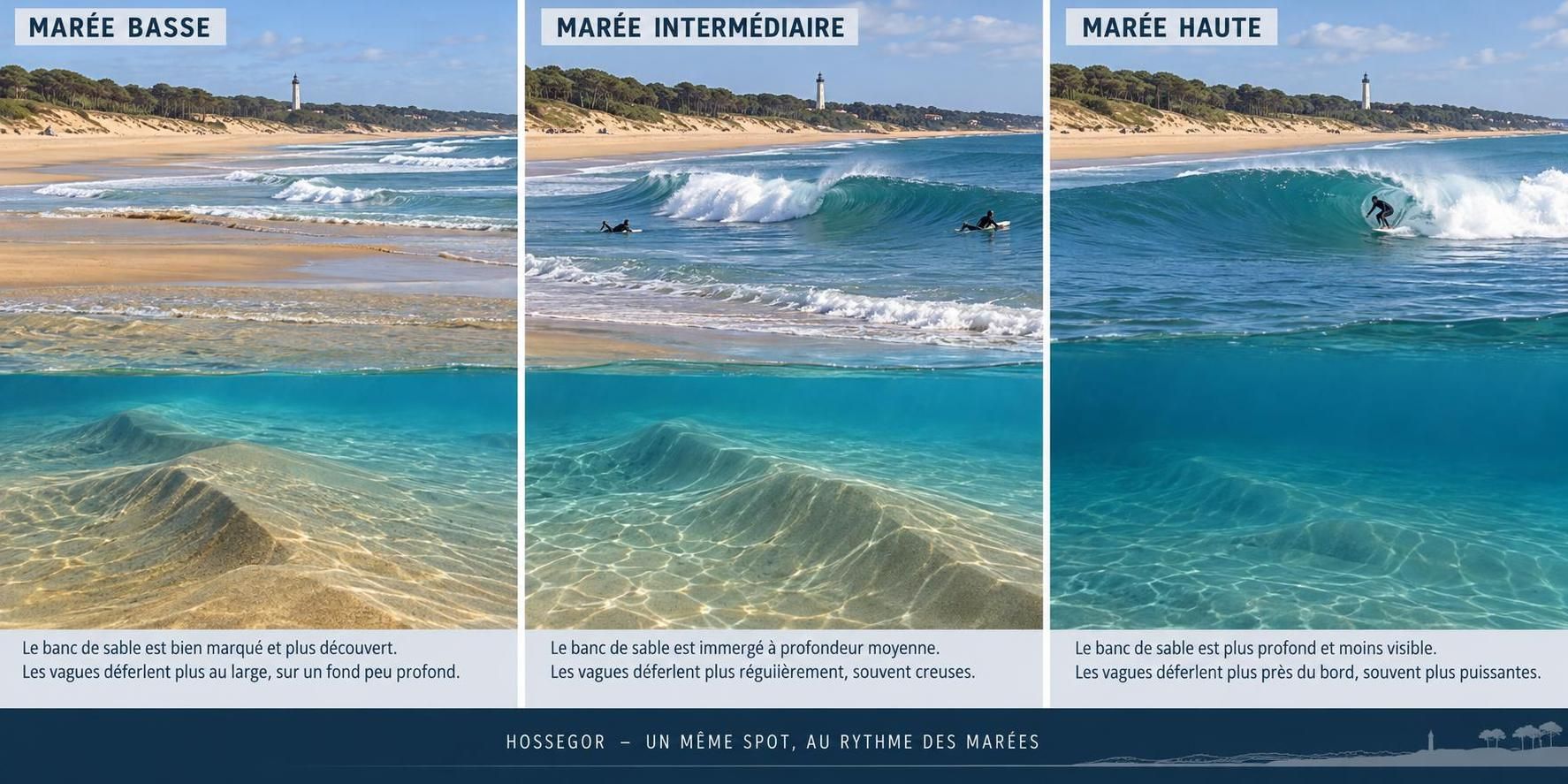
Imagine a mound of sand beneath the ocean and a vertical ruler placed beside it. The mound represents the seabed, while the water level moves along the ruler: when the depth becomes shallow enough relative to incoming waves, they begin to break.
With more water, a small swell can pass over this mound without breaking. With less water, it can hit the bottom too abruptly and close out along its entire length; between these two situations, a favorable depth can allow it to open into a right or left.
This explains why neither high tide nor low tide is a universal answer. The shape of the sandbar, wave height, and direction together determine where waves break and how they open up.
In the Landes region, the tidal pattern is mainly semidiurnal: most days have two high tides and two low tides. A rise or fall lasts approximately six hours, but exact intervals should be checked in a local forecast rather than inferred from a fixed rule.
Rising and falling mid-tide: two situations to distinguish
Mid-tide commonly refers to an intermediate phase of the cycle. However, the midpoint between two times is not necessarily the exact moment when the height reaches half its range: the curve is not a straight line.
Two passes at a comparable water level can also produce different conditions. Flows in the channels, wind, the arrival of new swell, or crowd levels may have changed between the rise and fall.
Take Léa, a fictional intermediate surfer who observes a closing-out peak at low tide. An hour later, the increased depth may allow her to find a rideable shoulder; it is not the word “rising” that improves the wave, but a setup that has become more favorable.
Conversely, a falling tide can reveal a sandbar that was previously too submerged. The same movement can then make the section too shallow: a good window therefore has a beginning and an end, not just a central time.
Why “two hours after low tide” remains an imperfect reference point
Advice expressed in hours can be useful when it describes a recently observed setup. However, it loses precision if the tidal range changes: two hours after a small tidal movement does not correspond to the same depth as two hours after a large tide.
The rule of twelfths, sometimes used to estimate changes, remains an educational approximation. To decide on a session, a local water-level curve is preferable, especially when the desired window is narrow.
It is also necessary to distinguish changes in water level from horizontal water movement. The slowdown around high or low tide does not mean that wave currents or rip currents stop.
Vocabulary thus becomes a practical tool: “rising low tide” marks the beginning of a phase, while “high tide” describes a maximum. The right question is the available depth over the sandbar, not simply the name of the tide.
Tide times in Hossegor: reference station, heights, and local time
A search for “Hossegor tide times” quickly returns a chart, but a chart does not always explain its source. Before settling on a time, identify the calculation location, hydrographic source, and displayed time zone. A beach, a nearby port, and a regional station are not interchangeable points.
For the method presented here, Saint-Jean-de-Luz, in the Socoa area, is the regional hydrographic reference point to identify in the documentation used. This does not mean that its times and heights apply directly to Hossegor’s beaches: use a local forecast for Capbreton or Hossegor, or the appropriate official corrections when available.
Check what a local forecast actually represents
A service may display “Hossegor” while using interpolation, a model, or data from a nearby port. The page should make this source clear; otherwise, the information is useful for general guidance but does not justify minute-by-minute precision.
Geographic proximity alone is not enough to justify an improvised correction. Adding a few minutes to a nearby station because another surfer recommends it is not a reliable method: corrections must come from documentation suited to the location in question.
To plan a time slot, a chart such as the one with the published times for Hossegor can make it easier to read. However, check its source, location, and legal time information before comparing it with a forecast app.
Daylight saving time, standard time: avoid a shifted session
In mainland France, local time is normally UTC+1 in winter and UTC+2 in summer. Some tools make this conversion automatically; others let you choose a time zone or display UTC directly.
Do not add an hour to a time already given in local time. On a phone set to another country, also check whether the app follows the device’s time zone or the spot’s: an apparent difference between two services may come solely from this setting.
On October 9, 2026, mainland France is still on daylight saving time, or UTC+2. The time change takes place on October 25; this detail becomes useful when a schedule covers several weeks around this transition.
Read the provided figures without treating them as a permanent forecast
The dataset provided for this article indicates, in particular, a high tide on October 9 at 4:34 p.m., with a height of 4.24 m, followed by a low tide at 10:40 p.m., at 0.48 m. These values are, in this case, a dated reading example, not an announcement of the next tide at the time you view this page.
Their difference gives a tidal range of 3.76 m between these two extremes. However, the absence of a station and vertical reference explicitly associated with this excerpt prevents it from being presented as a verified local forecast or a navigation document.
A height of 4.24 m does not indicate the depth beneath a surfboard. It is measured relative to the document’s reference datum; to know the water available above a sandbar, you would also need to know the elevation of that seabed in the same system.
Finally, astronomical values do not fully describe the level actually observed. Wind, atmospheric pressure, and storm surge can alter the situation, while swell and shore break determine how far the water reaches up the beach.
Léa can therefore use the times to plan her arrival, then adjust her choice from the sand. The chart organizes the day; it replaces neither an identifiable source nor observation of the coastline.
Tide coefficients in Hossegor: interpreting tidal range without predicting waves
The tide coefficients indicate the relative importance of astronomical tidal movement according to the French convention. Their usual scale ranges roughly from 20 to 120: low values correspond to neap tides, while higher values correspond to spring tides.
This number is unitless. A coefficient of 90 does not mean 90 centimeters of depth, a specific current speed, or a quality rating for surfing in Hossegor.
Coefficient and tidal range: two complementary pieces of information
The tidal range is the difference in height between successive high and low tides, expressed in meters. The coefficient indicates the relative amplitude of the cycle, but local water levels are more directly useful when comparing two surf windows.
A high coefficient generally comes with greater vertical movement. The shoreline exposed at low tide and the stretch of beach covered at high tide can then be very different, depending on the slope and morphology of the site.
A low coefficient reduces this range, without guaranteeing calm conditions. A long, powerful swell can produce dangerous waves during neap tides, even if the water level changes relatively little.
| Coefficient guide | Practical interpretation | Session decision |
|---|---|---|
| 🌊 Low, around 20 to 45 | Generally limited range; some depths change less over the cycle. | Check whether the sandbar is actually working: a poor setup may persist. |
| 🔎 Moderate, around 45 to 90 | More pronounced changes, with windows varying according to underwater contours. | Consider local water level, swell, and peak openings together. |
| ⚠️ High, above 90 | Large vertical range and potentially faster changes in the breaking zone. | Regularly reassess access points, exits, and currents. |
These categories are educational guidelines, not safety thresholds. A beginner does not become self-sufficient because the coefficient is low; an expert does not automatically benefit from an ideal sandbar when it is high.
Why a large tidal range can shorten the ideal window
Suppose a sandbar offers its best shoulders within a fairly narrow depth range. During a large cycle, that range may be passed through more quickly than during a small tidal movement, especially during phases when vertical change is greatest.
The peak does not necessarily disappear because the sand has shifted. It may simply stop breaking in that spot, or break closer to shore, as water coverage changes.
This distinction avoids a misleading idea: a sandbar does not physically vanish in a few seconds because of the coefficient. Its visible behavior can change quickly, while changes in the seabed result from sediment transport.
For Léa, a large tidal movement mainly means planning a session that can be reassessed. If the shoulder gets short, the channel speeds up, or the exit worsens, staying out simply because “the tide is still good” serves no purpose.
Currents cannot be read from a single number
A large range can influence water exchange in certain channels. On an open beach, rip currents also depend on the water pushed toward shore by waves, the gaps between sandbars, and the geometry of the baïnes.
The coefficient therefore cannot directly calculate their strength. A neap-tide day with strong swell can have a far more problematic current than a large tide with small waves.
To compare several days, note the local range, swell size and period, then the observed behavior of the spot. This log helps you understand recurring setups without giving the coefficient more power than it has.
The coefficient indicates how much the waterscape may change; it never tells you on its own whether the waves will be good or accessible.
Sandbars in Hossegor: depth, power, and beach break mobility
Hossegor is a collection of beach breaks, meaning waves that break mainly over sandy bottoms. Unlike relatively stable rocky terrain, these bottoms are reshaped by swells, currents, and periods of heavy surf.
The available depth cannot be reduced to a uniform number along the beach. Ridges, hollows, and channels coexist; moving sideways by just a few meters can be enough to go from a section that opens up to an area that closes out.
Why water level changes wave shape
As it approaches shallower water, a swell transforms, slows down, and steepens. Breaking occurs when depth and wave steepness no longer allow the wave to hold its shape; the sandbar profile then influences how abruptly it breaks.
Over a gradual rise, a wave can peel with a relatively forgiving slope. Over a steeper rise, it can hollow out quickly, throw its lip, and offer a barrel—or close out without leaving a rideable line.
Adding water can soften a setup that is too shallow, but it can also drown a sandbar that will stop working. Taking water away can make a small swell surfable, then produce a break that is too violent: the result depends on the starting point.
Low tide is therefore not synonymous with gentle waves. It can instead greatly reduce the margin between the board, the body, and the bottom, while making the takeoff steeper.
Shorebreak and fast waves: two realities not to confuse
Shorebreak refers to waves breaking very close to shore. It develops when waves cross a relatively deep area before meeting a steep coastal slope; some high-tide setups favor it, though this is not a general rule.
A wave can also be fast while breaking farther offshore. Its peeling speed depends in particular on the angle between the swell and the sandbar: if a large section of the crest breaks almost simultaneously, the surfer has little time to find an exit.
Risk is not measured solely by apparent height. A modest wave breaking over very shallow sand can cause serious injuries, especially during a headfirst fall.
Why last week’s advice can become wrong
A succession of swells can carve out a channel, move a sandbar, or create a new opening. After a storm, the beach and seabed may behave very differently, even if the times and tidal coefficients resemble those of a successful session.
Changes do not happen only in winter. A sustained summer swell, several days of wind, or an energetic event can sometimes alter the breaking zones and routes back out to sea.
Léa finds a spot that regularly opened up around mid-rising tide. The following week, the peak closes out while a new right appears farther away: repeating the old timing without observing the visible contours would be a bad idea.
From the beach, repeated breaking lines suggest shallow areas. Gaps in these lines may correspond to deeper zones, but they do not automatically provide safe routes to get back out.
Building local knowledge without treating the spot as fixed
A simple log can record the tide stage, forecast height, swell, wind, and a few observations: distance from the peak to shore, openings, drift, or difficulty getting out. A photo taken from the same spot also helps compare setups.
These notes should be dated and put into context. A recommendation becomes more useful when it says “this sandbar worked like this with this swell” rather than claiming “this beach always works at this tide.”
Apps provide parameters; reading the seabed explains how they translate into surf conditions. In Hossegor, lasting advice describes a method of observation, not a fixed appointment with the sand.
Hossegor · Educational comparison tool
Choosing a surf time in Hossegor
High or low tide? Compare five situations to know what to observe, which lead to investigate, and when to call it off.
| Situation to compare | Required observation | Option to consider | Reason not to proceed |
|---|
No situations match. Change your search or filters.
On small screens, scroll the table horizontally. “Learn more” displays the questions to consider.
The right approach: observe from the beach, reassess if conditions change, and seek local advice. Neither a rising nor a falling tide guarantees good waves or a safe session. Educational information only, with no live times or measurements.
La Sud, La Centrale, La Gravière, and La Nord: which tide should you check?
Beach names provide reference points, not automatic instructions. The tendencies of each spot must be compared with the existing sandbanks and the day’s conditions. Two peaks on the same beach may, in fact, require different water depths.
A guide to Hossegor’s surf spots helps locate the areas and understand their character. However, the final decision should remain tied to what is actually breaking in front of you, not the spot’s reputation.
La Sud: a sometimes accessible fallback, never guaranteed for beginners
La Sud can offer conditions that are less exposed than areas farther north, depending on swell direction and size. It is therefore worth checking when other beaches are too powerful, without becoming a consistently safe refuge.
A low to mid tide can make certain sandbanks work, while more water can sometimes produce gentler waves. In other setups, high tide mainly leaves breaking waves near the shore: conflicting advice often reflects different seabeds.
When learning, look above all for consistent whitewater, available space, and an area designated by an instructor. A small open-face wave may suit Léa, while a beginner would be better off staying in an appropriate teaching environment.
La Centrale: check the sandbank before choosing a time
La Centrale can be inconsistent, with waves breaking close to shore and periods when no worthwhile peak takes shape. However, it would be excessive to claim that it can never produce a surfable session.
Coastal seabeds and regional bathymetry influence swell propagation, but attributing every bad day solely to the Capbreton Canyon oversimplifies the mechanism. The presence of an active sandbank, the direction of wave sets, and water depth remain decisive.
A mid-range tide can sometimes be worth watching. If the sets close out in a shorebreak or the return to shore seems rough, changing areas is better than waiting for a supposedly ideal time.
La Gravière: precise tide depth and advanced skill level
La Gravière is known for its hollow, fast waves, often demanding as soon as the swell carries energy. The best tide at La Gravière is not automatically the rising low tide, even though this phase can produce great setups on certain sandbanks.
With little water, the break can become particularly harsh. A rising tide may open a more surfable window, then close it again when the sandbank is too covered or the waves shift to another area.
A small swell at high tide may lack shape; a larger swell may work at a different tide level. In all cases, reading the takeoff, being able to handle a fall, and mastering exits matter more than the desire to find a tube.
La Nord: a powerful spot, not a reassuring low-tide option
La Nord is mainly known for working during large swells, with waves that can break far from shore. The distance to cover, the power of the sets, and the currents require specific experience.
Some setups are sought around a low to mid tide, but that does not make the spot easy. Claiming that low tide necessarily produces gentle waves suitable for intermediate surfers would be misleading.
A surfer who is already unsure about their ability to get through the break should not use a time as an argument for giving it a try. Here, actual skill level, physical preparation, equipment, and knowledge of the site are major factors.
Les Culs Nus, farther north, also offer varied peaks, with no guarantee of accessibility along their entire length. The best spot is the one whose waves, currents, and exits match your surfing today.
Swell, wind, and skill level: finding the best time to surf in Hossegor
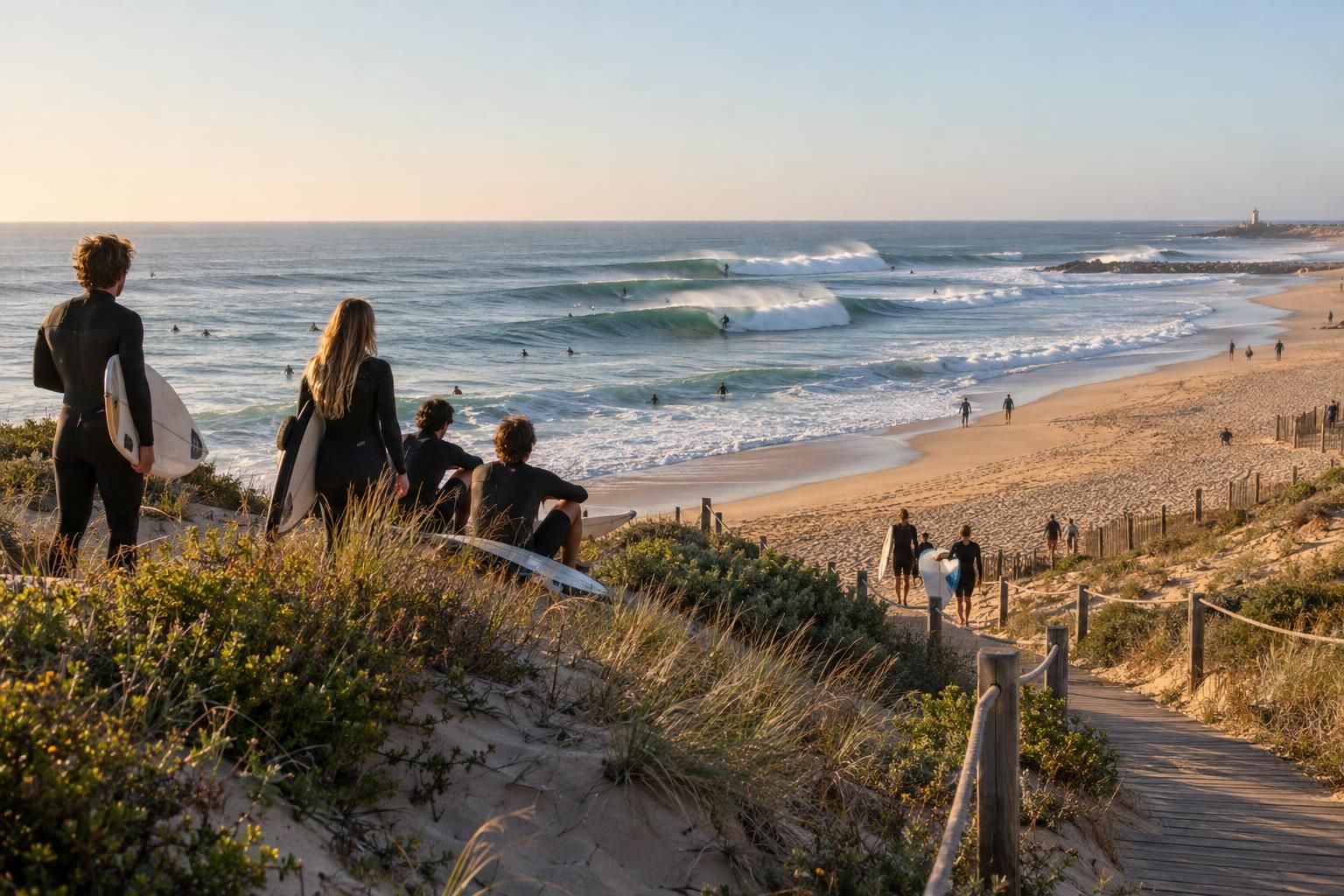
Once you have considered the tide phase and the spot, you need to look at what the ocean is actually bringing. The forecast swell height offshore is not necessarily the wave height at the beach. Direction, period, bathymetry, and exposure alter that translation.
A forecast of 1 meter can therefore correspond to very different conditions depending on whether it is short-period wind swell or an organized long-period swell. The displayed size alone is therefore not enough to determine the required skill level.
Height and period: read them together, not as separate numbers
The period represents the interval between two successive crests, generally expressed in seconds. At comparable height, a longer swell carries more energy flux and can change significantly as it approaches shallow water.
Modest waves on a chart can then produce powerful, spaced-out sets. The calm between two sets does not mean the spot has become easy: it may simply precede a larger sequence.
For Léa, comparing a forecast of 0.8 m at 7 seconds with 0.8 m at 14 seconds is therefore essential. The second scenario may require a much larger safety margin, even if the app displays the same height.
Values such as 0.5 to 1.5 m and 9 to 14 seconds sometimes describe conditions sought by skilled surfers. They are not either a universal local formula or a safe range for beginners.
Swell direction and wind: why a good-looking chart can disappoint
A west or northwest swell can efficiently feed several areas, but each direction changes the exposure and approach angle on the sandbars. A slight variation can favor a right-hander, make a peak close out, or increase lateral drift.
On this Atlantic-facing coast, an east wind is generally offshore. When it remains moderate, it can smooth the wave faces and help them stay open; when too strong, it complicates the takeoff and can quickly carry a person or their equipment away.
A west wind is generally onshore and often degrades the surface. It does not eliminate every opportunity to surf, however: small, suitable whitewater waves can still be useful for a lesson, while a crosswind can make an advanced peak less appealing.
The detailed forecasts for La Gravière make it possible to compare these parameters. Automatic colors or ratings should remain secondary to raw data and visual checks.
Skill level and crowds: two filters as important as the weather
A beginner seeks supervised progress in an appropriate area. An intermediate surfer needs accessible waves, a manageable takeoff, and a clear way out; an expert may seek more hollow waves, without being exempt from assessing the consequences of a fall.
Crowds also change the difficulty. A weak peak that is packed increases the risk of collisions, reduces room to maneuver, and can prevent you from calmly choosing your wave or return route.
The local surf report can supplement the forecast with recent observations. Always check the time of the report: a morning report does not necessarily describe the afternoon wind or water depth.
Season: adjust expectations without letting it decide for the day
Summer often brings more small swells and more crowds. Fall and winter can bring more energy, but no season guarantees an easy window or a perfect day for experienced surfers.
Water temperature, daylight hours, and the presence of lifeguard supervision should also factor into the choice. The best time to surf is when favorable water depth, manageable energy, and conditions suited to your level come together.
Before a session in Hossegor: a 20-minute decision-making protocol
Effective preparation does not mean piling up apps. It means turning a few reliable pieces of information into a revisable decision: go in, wait, change beaches, or call it off. All of these options are part of competent surfing.
The protocol begins before you leave, then continues at the water’s edge. The goal is to arrive with a time-window hypothesis, not an obligation to surf because the trip or rental has already been paid for.
Check the right data and prepare an alternative
Choose an identifiable tide source, a swell and wind forecast, then recent local information. Compare times in the same time zone; if two tools differ significantly, look for differences in location, model, or settings before deciding.
Also identify the expected changes throughout the session. A favorable start may be followed by strengthening wind, a rapid rise in water level, or a shift in where the waves break: preparing only for the time you go in leaves out half the problem.
Plan for a second area and a clear reason to call it off. For Léa, this could be the absence of a usable shoulder, a drift she does not know how to handle, or a shorebreak too brutal to get out safely.
- 🕒 Check the times, heights, sources, and local time settings.
- 🌊 Compare swell height, period, and direction with the expected wind.
- 👀 Arrive early to observe for 15 to 20 minutes before making any decision.
- 🗣️ Ask for advice from an instructor or lifeguards when they are present.
- 🔁 Change spots if the conditions do not match your expected skill level.
- 🛑 Skip it if the currents, wipeouts, or exit exceed your abilities.
Watch several sets rather than just one nice wave
Fifteen to twenty minutes is a useful minimum for seeing different sets and how some surfers move around. This timeframe offers no guarantee: very widely spaced swells may require longer observation.
Identify the biggest set, not just the average waves. Watch where it breaks, how far it pushes surfers, and whether they can get back without excessive effort.
Also watch how people get out: does a surfer wait a long time before reaching the sand? Is their board thrown by the shorebreak? An apparently easy entry can hide a much more difficult return as the depth changes.
People in the water provide useful clues, but their comfort does not prove that the spot suits you. An experienced surfer may be able to handle a section or current that is far beyond the abilities of a newcomer.
Ask specific local questions
“Does it work?” often calls for an answer that is too general. Instead, ask which sandbar is working right now, how it changes with the tide level, where the permitted area is, and what difficulties getting back out have been observed.
For a first experience, surf lessons and camps in Hossegor offer the benefit of a suitable area selection. Serious supervision may also decide to move or postpone the session: that is a sign of caution, not a failed session.
Set limits before getting in the water
Set a duration that matches your endurance, a position marker, and signs that it is time to get out. If the wind picks up, the drift increases, or the waves close out more, reassess before you are exhausted.
Let someone know where you plan to go and avoid surfing alone in demanding conditions. Also leave yourself a buffer before nightfall: reduced visibility makes orientation and assistance more difficult.
The best protocol leaves real room for changing your mind. A successful session begins with a reasonable decision and remains reasonable until you return to the beach.
Safety in Hossegor: baïnes, currents, and limits based on the tide
Low tide is never a guarantee of safety for beginners. It can make a baïne more visible, but it can also expose shallow ground, concentrate certain flows, or make falls more dangerous.
Conversely, high tide can hide features identified earlier and bring the break closer to shore. Being cautious means understanding the risks at hand, not automatically associating a tidal phase with a green light.
Baïnes and rip currents: spot them without improvising
A baïne is a sandy coastal depression, often separated from the open ocean by a sandbar. Depending on the configuration, waves, and water level, flows can carry water offshore or along the beach.
A channel where waves break less may be a deeper area and sometimes a rip current. This relatively calm appearance should not be interpreted as an invitation to enter.
Possible signs include a band of murky water, foam moving away from shore, or repeated drifting by water users. However, no single sign is enough to fully identify a current from the sand.
If you are being carried away, do not exhaust yourself by fighting the flow directly. Try to float, signal that you are in trouble, and keep your board as support when available; moving sideways to get out of the current should only be considered if your abilities and the situation allow it.
Instructions given locally by lifeguards remain the priority. For someone in difficulty, alert emergency services rather than going out to help them without training or suitable equipment; 112 can be used to request emergency assistance.
Shorebreak and shallow water: protect your head and neck
A wave breaking close to shore can throw the body onto the sand with considerable force. The danger also exists with waves that seem small, especially when the lip falls onto very shallow water.
Never dive headfirst into water of unknown depth. During a fall, try to protect your head and limit contact with the bottom, without extending your legs to land in uncertain depth.
Equipment also matters: a loose board can injure its owner or someone nearby. Keeping space, avoiding letting go of your board when it can be controlled, and not entering a crowded area reduce some of this risk.
Beginners: choose the setting, not just the time
For a first session, an instructor should choose an area where the whitewater, seabed, currents, and number of people in the water allow for learning. Low tide may be suitable in some conditions; a mid-tide phase may be better in others.
A large swell is not automatically suitable just because the student stays close to shore. Currents, incoming sets, and equipment being carried by the water can make even this area unsuitable.
Lifeguard supervision does not mean surfing is allowed everywhere within the supervised area. Respect areas designated for swimmers, signs, flags, and instructions from on-site teams; outside supervised hours, the absence of lifeguards reduces the possibility of immediate assistance.
Fatigue, cold, and respect for the coastline: keep a margin
A suitable wetsuit, a leash in good condition, and a board matched to your skill level are necessary, but they do not make up for a poor decision. Cold and repeated trips through the break can quickly reduce judgment and the ability to get back.
Léa therefore leaves the water as soon as her drift increases, even if a few nice shoulders are still visible. Waiting until she is completely tired would turn an otherwise enjoyable session into a forced return.
Also respect priority rules, keep your distance, and use designated access paths to avoid damaging the dunes. A good surf window leaves room to fall, get out, and share the ocean without putting others in difficulty.
Which tide should you choose for surfing in Hossegor?
There is no ideal tide phase for every spot. Consider a low to mid-tide window or around mid-tide depending on the sandbars, then factor in depth, swell height and period, wind, and skill level. Observing from the beach remains crucial.
Is an incoming tide better than an outgoing tide?
Not necessarily. An incoming tide can make a sandbar that is too shallow more workable, while an outgoing tide can reveal a sandbar that is too submerged. However, currents, wind, and bottom configuration can make either phase unsuitable.
How do you read a tidal coefficient to prepare for a session?
The coefficient indicates the relative strength of astronomical tidal movement, not wave quality. Compare it with local tide heights to understand the range, then assess the swell, sandbars, and currents. A low value does not guarantee safety.
What is the best tide at La Gravière?
Some sandbars work well during a rising low tide or at intermediate depth, but no rule applies year-round. With little water, waves can be very hollow and dangerous. The spot requires a precise assessment and an appropriate skill level.
Should a beginner always surf at low tide?
No. Shallow water, currents, and closeouts can make this phase dangerous. A beginner should favor a suitable area chosen with an instructor, follow local instructions, and refrain from surfing when conditions exceed the learning environment.