
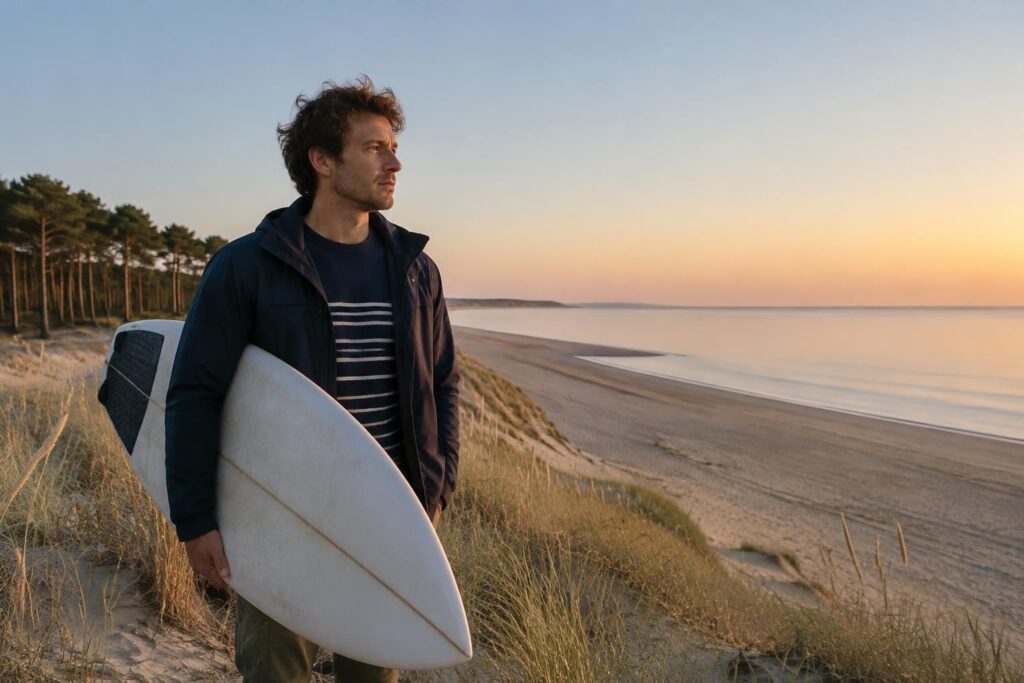
A surfer from Morbihan and a long-distance traveler, Erwan Simon explores little-known spots while defending the waves of his native coastline. In Saint-Pierre-Quiberon, his commitment helped create France’s first wave reserve: an initiative that puts ocean preservation at the heart of surf culture.
Erwan Simon, a surfer-explorer devoted to Brittany
Erwan Simon learned to surf at Fort-Bloqué, between Guidel and Ploemeur in Morbihan. For more than ten years, he has traveled the world’s coasts in search of little-known waves, an adventure recounted in his book Surf Explore.
His expeditions have taken him to some sixty countries, including less expected destinations such as Kazakhstan. Yet this journey around the world has not drawn him away from Brittany: Quiberon’s Côte Sauvage remains an anchor point and a playground whose balance deserves to be protected.
From Fort-Bloqué to the world’s little-known spots
Simon’s path brings together two complementary pursuits: exploring new breaks and observing what makes each wave unique. A spot is more than a beautiful right-hander or a well-formed peak; it also depends on coastal geography and the conditions that allow the swell to break.
This experience shapes his watchful perspective. For surfers, the loss of a wave is not an abstraction: construction or changes to the coastline can permanently alter a sandbank or access to a spot.
The Saint-Pierre-Quiberon wave reserve: protecting a Breton spot
With the association France Hydrodiversité and scientists, Erwan Simon helped create a wave reserve in Saint-Pierre-Quiberon, presented as the first initiative of its kind in France. The project aims to recognize the value of a coastal area and better account for the natural conditions that shape its waves.
For a surfer discovering the Côte Sauvage, what is at stake is visible in the landscape: it is not only about today’s session, but also about being able to return to the same playground tomorrow. The reserve thus places preservation at the center of the discussion on coastal development.
What is a wave reserve for?
A wave reserve seeks to bring attention to a heritage that is often less recognized than terrestrial landscapes or biodiversity. It encourages dialogue and a better understanding of areas where swell, seabed, and coastline come together to produce a break valued by surfers.
This approach does not replace environmental regulations or on-the-ground vigilance. Rather, it provides a framework for discussing monitoring, marine ecology, and development decisions before a spot is altered.
| Reference point | What it indicates |
|---|---|
| Fort-Bloqué | The place in Morbihan where Erwan Simon learned to surf. |
| Some sixty countries | The scope of his explorations in search of waves. |
| Saint-Pierre-Quiberon | The website of France’s first wave reserve, an initiative of the France Hydrodiversité association and its scientific partners. |
| Surf Explore | The book in which he recounts his travels and discoveries. |
Coastal monitoring and marine ecology: surfers’ best practices
Surfers often get to know their spot over the course of sessions: changes in a sandbar, access changes, or debris after a big swell. These observations do not replace scientific monitoring, but they can help document changes and raise relevant alerts.
To stay on the right track, a few simple actions connect surfing with respect for the ocean:
- Observe the spot over time and report unusual changes to the shoreline or access points.
- Respect coastal environments, by staying on designated paths and avoiding damage to dunes and vegetation.
- Take part in local discussions when projects may alter the coastline or swell conditions.
- Share safety guidelines and useful information with other surfers, especially on an exposed coast like Quiberon’s.
The strength of a sentinel also lies in sharing knowledge: waves remain a common good when users, scientists, and local stakeholders engage in dialogue.
Erwan Simon, a voice for preserving Brittany’s waves
Erwan Simon’s journey shows that exploration and local attachment are not at odds. Having surfed in many countries also highlights the fragility of surf spots: some remarkable waves, once altered by human activity, never regain their original configuration.
In Brittany, his commitment brings the discussion back to a concrete question: how can we preserve the conditions that sustain a spot without reducing the coast to its sporting use alone? For the surfing community, the answer lies in understanding the environment, dialogue, and constant attention to the ocean.
Who is Erwan Simon?
Erwan Simon is a surfer from Morbihan and an explorer. He discovered surfing at Fort-Bloqué, traveled through around sixty countries, and recounted his adventures in Surf Explore.
Where is the wave reserve created with his association located?
It is located in Saint-Pierre-Quiberon, on the Morbihan coast. The initiative, led with France Hydrodiversité and scientists, is presented as France’s first wave reserve.
What is the purpose of a wave reserve?
Its aim is to recognize the value of a spot and encourage consideration of the natural conditions that create its waves, particularly in discussions about coastal development.
In which book does Erwan Simon recount his explorations?
He recounts his travels and discoveries in Surf Explore.