
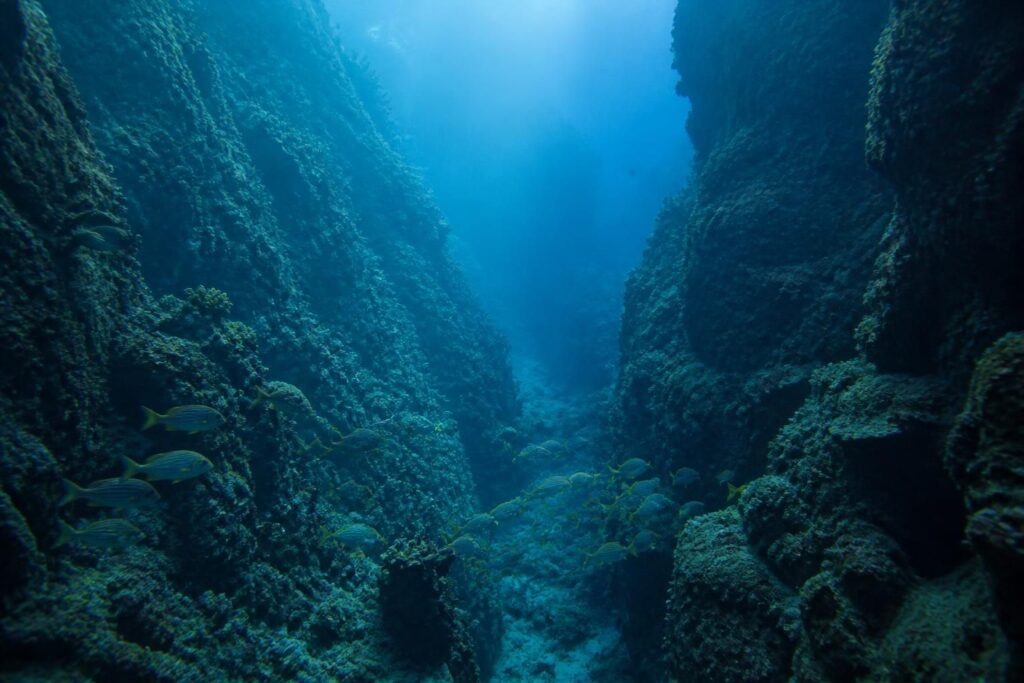
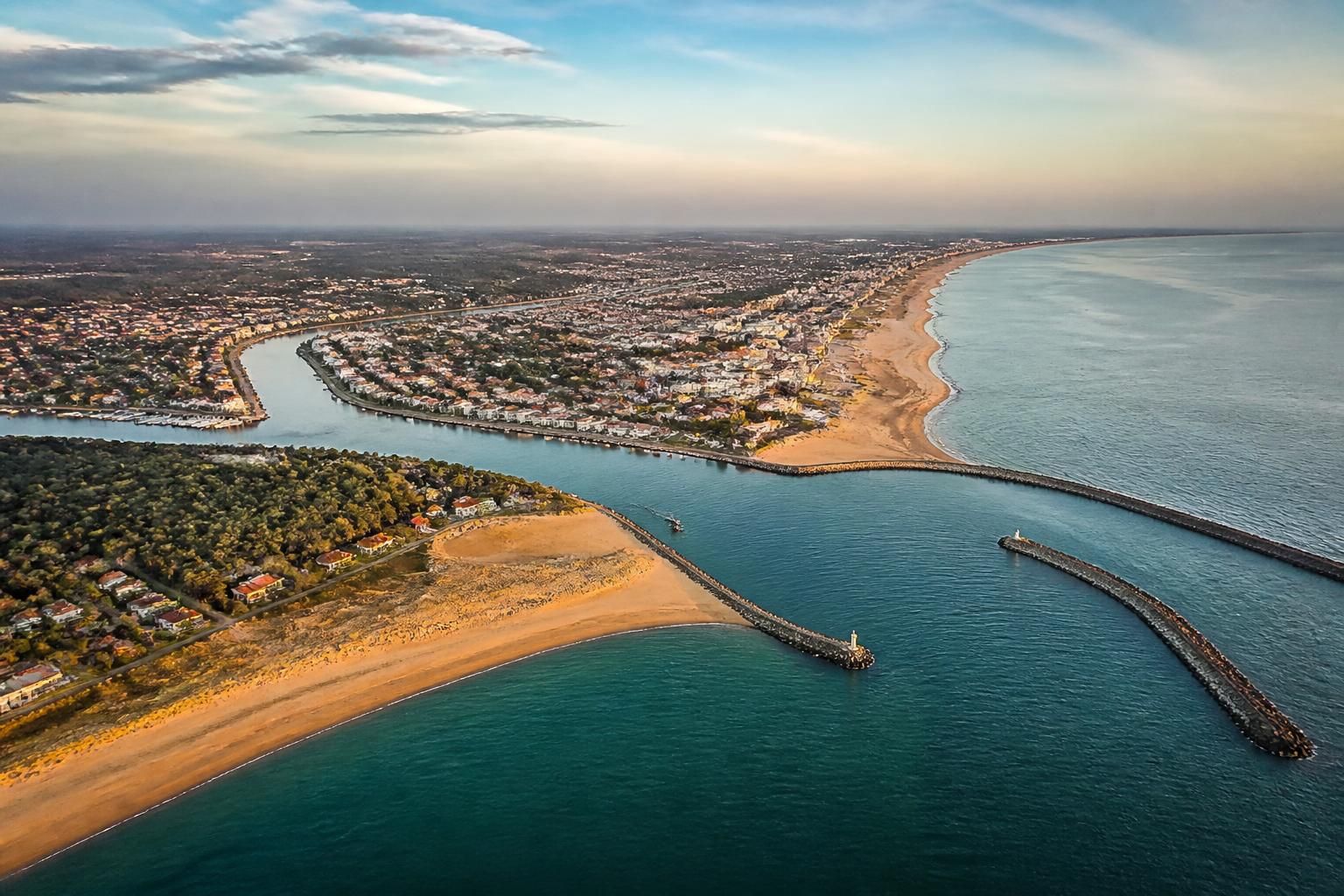
Just steps from the jetty, a underwater landform of titanic proportions lies literally beneath the waves. Invisible at high tide, it nevertheless drives the wild forces that make Hossegor’s La Nord roar and attract both big-wave surfers and giant cetaceans. Focus on the Gouf de Capbreton, a submarine canyon plunging 4,500 m into the Atlantic.
Capbreton: the submarine canyon that channels swells and shapes Landes tubes
The Gouf begins 300 m from the breakwater, dropping straight to a depth of 100 m in less than 500 meters horizontally, then extends down to 4,500 m. This abyssal void ocean acts like a funnel: Atlantic swells, focused in the trench, emerge compressed and more powerful over Hossegor’s sandy shelf. The result: regular, cylindrical walls of water, like carbon copies of a Hawaiian pipeline, which can be monitored in real time via the Capbreton beach camera.
A 4,500 m abyssal gash beneath the waves
Created by the separation of the Iberian and Eurasian plates, the canyon stretches for 300 km to the Santander abyssal plain. Only 3% of the world’s canyons have a coastal head: a distinctive feature that led geologists to adopt the Gascon term “gouf” for this type of structure.
Tectonic origin and marine geology: when the Adour carved its path
Before 1578, the Adour flowed into the sea at Capbreton. Its fossil bed guided sedimentary erosion and carved a straight gorge at the heart of the local marine geology. The perfect alignment between the Pyrenean fault and the Gouf is a reminder that tectonics still shape the spot, from the continental shelf to the abyss.
Quick timeline
| Period | Key event | Impact on surfing |
|---|---|---|
| 15 Ma | Gradual opening of the canyon | Formation of the underwater topography that focuses the swell |
| 1578 | Diversion of the Adour toward Bayonne | Stabilization of coastal sandbanks |
| 1990-2020 | Start of high-resolution bathymetric surveys | Detailed understanding of the Nord’s mechanisms |
| 2023 | First dive Under The Pole scientific | Discovery of black corals at 90 m |
Biodiversity: a hotspot for cetaceans and deep-sea corals
The canyon draws up cold, nutrient-rich waters. This permanent upwelling sustains a remarkable ecosystem right beneath the surfboards.
- Common dolphin : nearly permanent resident.
- Sperm whale : regularly spotted 6 km from shore.
- Orca : seasonal visits documented since 2024.
- Black corals and white gorgonians between 60 and 150 m.
- Giant squid hunting in the shadow of the walls.
It is no wonder the coast ranks among the richest areas along the Atlantic coast, as noted in the feature on Hossegor, the surfing capital.
Scientific diving: exploring the mesophotic zone
Between 45 m and 110 m, light fades but life flourishes. The 2023-2026 missions revealed species not yet recorded, confirming that local biodiversity remains largely unknown. New campaigns are scheduled to combine LIDAR and ROVs to map every crevice of the underwater topography.
A socio-economic driver rooted in the Landes region
The port of Capbreton benefits from the canyon’s natural protection: even during storms, the deep waters dampen surface turbulence. Surf schools take advantage of these same waves to offer weekend clinics, from children’s camps to intensive weekends. Hikers and nature enthusiasts also encounter birdwatchers on the coastal trail, featured in the guide to hikes in the Landes.
Why does the Gouf amplify Hossegor’s waves?
Because the swell, compressed in the narrow canyon, grows in amplitude before suddenly breaking over the shallow plateau, creating hollow, powerful waves.
Can you dive directly into the canyon?
No, the drop is too steep and the currents are strong. Exploration is carried out from vessels equipped with ROVs or through supervised technical dives down to 110 m.
Which cetacean species are most commonly seen?
Common dolphins, bottlenose dolphins, sperm whales, as well as fin whales during spring and fall migrations.
Does the canyon affect the local weather?
Indirectly, yes: the depth dampens the swell during strong winds, providing calmer anchorage and a marine microclimate conducive to outings at sea.