
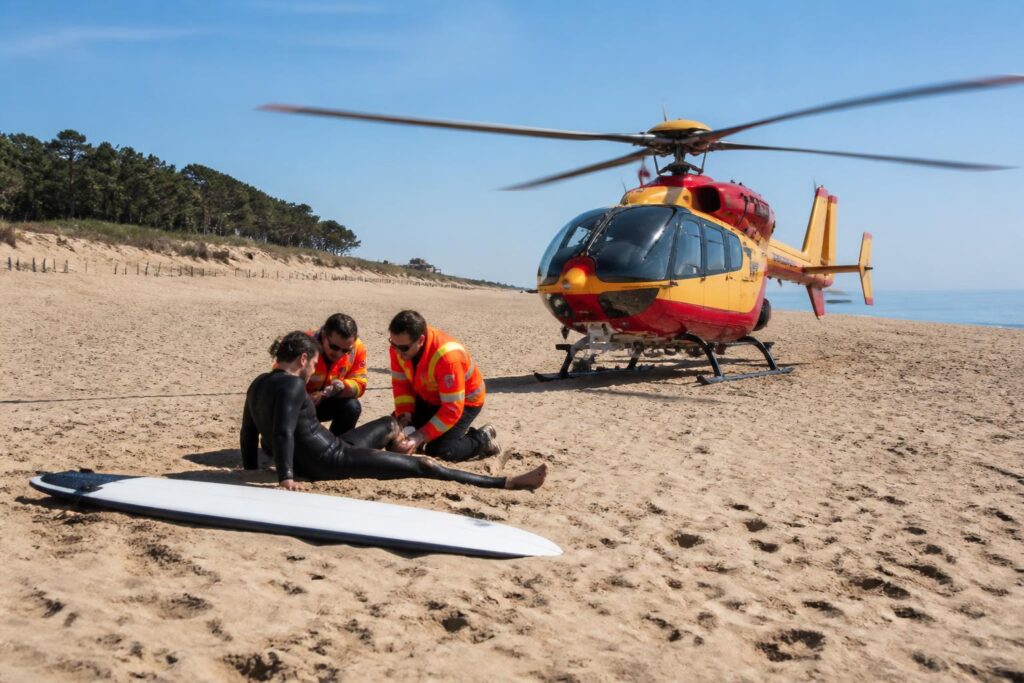
The alert hit like a closing set: at exactly noon on August 7, lifeguards activated the chain of rescue after the heavy fall of a surfer at the legendary beach of Culs-Nus, in Soorts-Hossegor, in the Landes. The SAMU 40 helicopter landed on the still-warm sand, leaving the beach umbrellas flapping in the west wind. The rider, conscious but unable to move, was evacuated to Bayonne for a full cervical assessment.
Injured surfer at Culs-Nus: timeline of an rescue airlift
11:30 a.m.: the station chief spots a surfer in distress, brought in by a surf school coach surf stationed at the inside.
11:34 a.m.: the swimming area is closed off, and lifeguards begin the trauma protocol.
11:40 a.m.: diagnosis on the sand: suspected cervical flexion-compression injury after a “nose-dive at takeoff.”
11:48 a.m.: the mobile emergency unit arrives, with a cervical collar and vacuum mattress.
11:57 a.m.: helicopter lands, taking off for Bayonne Hospital two minutes later.
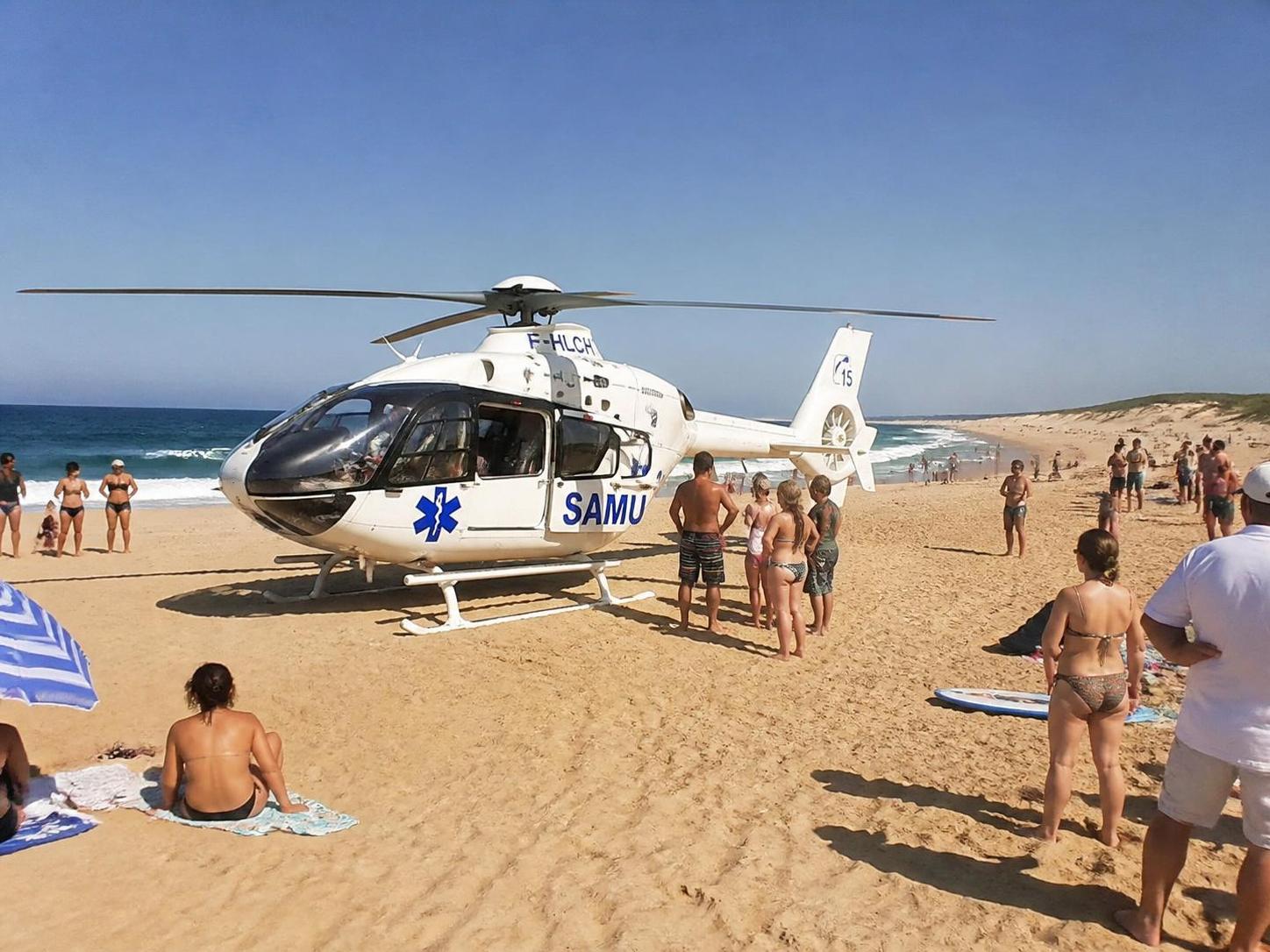
Solid swell and shifting sandbars: a high-risk cocktail
The Arcachon buoy recorded a 2.1 m peak and a 13-second period. With a tidal coefficient of 105, the ebb exposed ultra-steep sandbars: at low tide, less than a meter of water beneath the lip. The result? A late takeoff becomes a face-plant straight onto the hard bottom. Locals insist: “This summer, Boîteux and Culs-Nus leave little room for error.” Beginners should stick to the whitewater at La Nord or head to Capbreton.
Emergency response in the Landes: from beach to operating room in under fifteen minutes
The precise timing illustrates the synergy between SNSM, SMUR, and CROSS Adour. Since 2024, every lifeguard station in the Landes has had a geolocated QR code to guide air crews: the SAMU 40 Bell 429 simply follows the arrow. An analgesic infusion is now started as soon as the patient is placed on the mattress, limiting unnecessary movement before the scan.
Surf-related injuries: updated 2026 protocol
Teams now use the spine board “Low Drag,” introduced in 2025 after a series of accidentssimilar to those in Biscarrosse. Being lighter, it reduces extraction time in powerful shorebreaks.
| Season | Recorded severe accidents | Helicopter evacuations | Main cause |
|---|---|---|---|
| 2024 | 12 | 5 | Board-to-head collision |
| 2025 | 18 | 7 | Impact with sandy bottom |
| 2026* | 9 (Jan–Jul) | 4 | Cervical trauma in shorebreak |
*Preliminary CROSS Adour data.
Staying safe at Culs-Nus: quick checklist
- Check the sandbars at low tide before getting in the water.
- Use a short leash to avoid the board’s “boomerang rebound.”
- Exit through the nearest baïne to avoid the shorebreak.
- Never attempt a vertical maneuver in less than 80 cm of water.
- Keep 18 or 196 on speed dial: every second counts in rescue.
Why do sandbars change so quickly along the Landes coast?
Long winter swells move thousands of cubic meters of sand. In spring, the first westerly winds reshape these deposits; even a minor summer storm can carve out a new sandbar. The result: a hollow peak yesterday can become a brutal shorebreak today.
What is the helicopter response time on Landes beaches?
SAMU 40 aims to land within 12 minutes from takeoff in Dax to arrival on site between Capbreton and Mimizan. Weather, beach crowds, and tides can extend this timeframe, but the 2025–2026 average remains under 15 minutes.
Is an impact vest useful against cervical injuries?
It limits how far the torso sinks into the water and cushions chest impacts, but it does not directly protect the vertebrae. The best prevention is still to avoid late takeoffs in shallow water and to know the spot’s topography.
Are group lessons allowed at Culs-Nus despite the danger?
Yes, but schools must adapt the time slot and area. Most instructors move beginners to La Sud on the outgoing tide and keep only experienced surfers at Culs-Nus when the bottom is hazardous.