
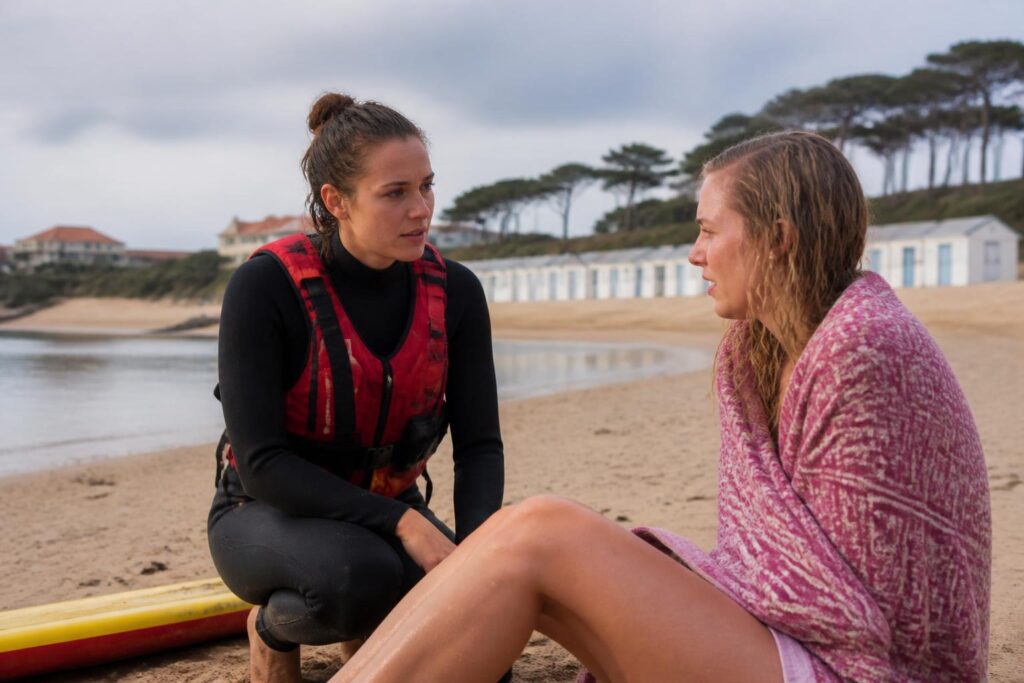
When the Landes swell bares its teeth, only the real crew knows a line-up can quickly turn into a disaster zone. On August 30, at Santocha beach in Capbreton, an incident shook the surf community like a wipeout on a slab at dawn. Sandrine Carassou, a renowned instructor at the Go and Surf school, found herself on the front line pulling a German tourist from hellish conditions. This rescue highlighted the daily commitment of local watermen and waterwomen, far from podiums and flashy Quiksilver or Oxbow sponsorships. When the ocean gets serious, no one knows who will have the instinct or courage to dive into the chaos: that day, the ocean showed no mercy.
An extreme rescue on Capbreton’s Santocha beach
Head to Santocha, a Capbreton spot well known to seasoned riders. That Saturday, the orange flag was flying, with swell lining up around 8 feet, generated by former Hurricane Erin. Alerted by a dark mass being tossed between two sets, Sandrine Carassou, 44, fins on but without a board or Aqualung gear, rushed into the water. A 30-year-old German woman, newly married and there to celebrate her honeymoon, was fighting for her life, caught in the treacherous currents typical of the area. From the first approach, the situation took a critical turn: the victim resurfaced between two sets, only to be swallowed up by each new wave.
Risk factors during a rescue in Capbreton
Without flotation support, managing a distressed victim in a current zone requires technical skill that is rarely recognized outside the pro circuit. According to Sandrine, “we had to let her go several times,” overwhelmed by the day’s massive sets. Faced with the emergency, three lifeguards joined the effort. Together, they pulled the young woman from the spot and onto the sand, her heart stopped. Long minutes of resuscitation followed as the medical helicopter, funded by the Region rather than Roxy or Rip Curl, was dispatched.
- Very powerful cyclonic swell (see the swell conditions on Hossegor Cyclone).
- No Bic Surf or rescue board.
- Victim exhausted by intense bay current.
- Santocha wave in heavy swell described here: Wave Hossegor.
| Risk factors | Impact on rescue |
|---|---|
| Cyclonic swell | Risk of aspiration and brittle series, difficult to rescue |
| No rescue board | Difficulty stabilizing the victim |
| Baïne current | Extra physical effort for the rescue swimmer |
| Maximum stress for the victim | Unpredictable actions, danger for the rescuer |
Post-shorebreak: supporting the victim and family after the rescue
A surf coach’s commitment does not end once back on dry land. On the sand, the victim’s partner, Mikaëla, desperately searched for her other half. Facing the language barrier, Sandrine became a translator and source of moral support, a role far removed from a standard “safety training” session at Tribord or Decathlon.
Essential support for family and friends
In the cafeteria at Bayonne Hospital Center, Sandrine stayed until the end, relaying every vital update to Mikaëla and the family who had rushed over from Germany. It is hard to imagine the emotional impact of such a situation outside the surf microcosm: the relatives would speak powerful words to the rescuers. “You didn’t just save Célina’s life, but ours too.”
- Linguistic and moral support throughout the night.
- Monitoring health status until recovery from induced coma.
- Shock management for immediate family and friends.
- Emotional involvement over several days.
| Post-rescue action | Consequences for the family |
|---|---|
| Translation of each medical step | Stress reduction, understanding the situation |
| Night-time presence at the hospital | Ongoing psychological support |
| Contact with medical teams | Better management of anxiety |
The place of surf instructors in the culture of lifesaving in Hossegor and Capbreton
This act of heroism reopens a central debate in Hossegor and along the entire coast: what recognition do surf instructors receive within the safety chain? Like the historic figures celebrated in the pages of Surf Session or Patagonia ambassadors, these coaches face the same risks as lifeguards, often without the coverage or official recognition that comes with it.
Issues of recognition and compensation for independent instructors
The lack of clear status leaves independent and self-employed surf professionals exposed: during a rescue, they sometimes cancel their lessons without any guarantee of being paid, put their safety on the line, and fight for a minimum of recognition. It is an issue raised with every major swell, when the system’s strength is tested not only by the local community, but also by local authorities and even equipment makers such as Bic Surf, Roxy, and Patagonia, which invest in prevention. It is not just about branded boards or leashes, but about respect for those who make sure every session does not turn into a nightmare.
- Instructors on the front line of bay-related tragedies.
- Little or no specific coverage in the event of an accident.
- Compensation compromised when a rescue interrupts a course.
- The debate is accentuated during large cyclonic swells (see details here).
| Profile | Current care | Rescue risk |
|---|---|---|
| Freelance surf instructor | None or very low | High, no dedicated insurance |
| Municipal lifeguard | Covered by the Town Hall or the State | Supervised by the NS collective |
Risk management and prevention on the Landes coast: surf culture, hazards and responsibilities
Every summer, the list of interventions grows: rescues in the shorebreak, incidents involving bay currents, or unlikely accidents such as being buried under sand. Municipalities—supported by aquatic equipment giants like Tribord, Oxbow, and Decathlon—implement restrictions and awareness campaigns, sometimes shared all the way to line-ups or on Surf Session’s “prevention” pages.
List of preventive measures observed in Hossegor and Capbreton
- Reinforced signage (flags, multilingual information panels).
- Mixed NS and instructor patrols on heavy swell days.
- Annual lifesaving courses for partner surf schools Quiksilver, Rip Curl or Bic Surf.
- Municipal by-laws to limit the depth of holes on the beach.
- Coordinated operations during “wave-submergence” alerts (read the full alert).
| Safety measures | Direct profit |
|---|---|
| Orange/red flag for heavy swell | Early warning for locals and tourists |
| Increased presence of seasonal supervisors | Reactivity in critical situations |
| Anti-hole signs on the beach | Reduced risk of accidental burial |
Questions / Answers
-
What are the main risks of swimming and surfing in Capbreton?
The combination of powerful swell, unpredictable bay currents, and strong shorebreak makes it a demanding spot, especially during cyclonic events. The main risks are drowning, wave-related injuries, and shifting sand. -
What role do surf instructors play in accident prevention?
They provide continuous monitoring, share safety information, and sometimes lead the front-line response when a rider, swimmer, or walker is in trouble. Their knowledge of the spot and local hazards is invaluable. -
What equipment is recommended for rescue operations?
Ideally, you need a rescue board (such as a Bic Surf), fins, a leash, and, if possible, an Aqualung-style first-aid kit. But in reality, many rescues are carried out barehanded, as Sandrine showed this time. -
Where can I find out more about swell and safety in Hossegor?
Reliable resources include surf-hossegor.com/houle-cyclonique-hossegor-surf/ and surf-hossegor.com/vague-hossegor/, as well as Météo France’s weather alert page. -
How can I learn beach prevention and rescue?
Several local surf schools, partnered with Roxy, Quiksilver, or Oxbow, offer training open to everyone, from safety basics to bay-current rescues and first-aid skills.