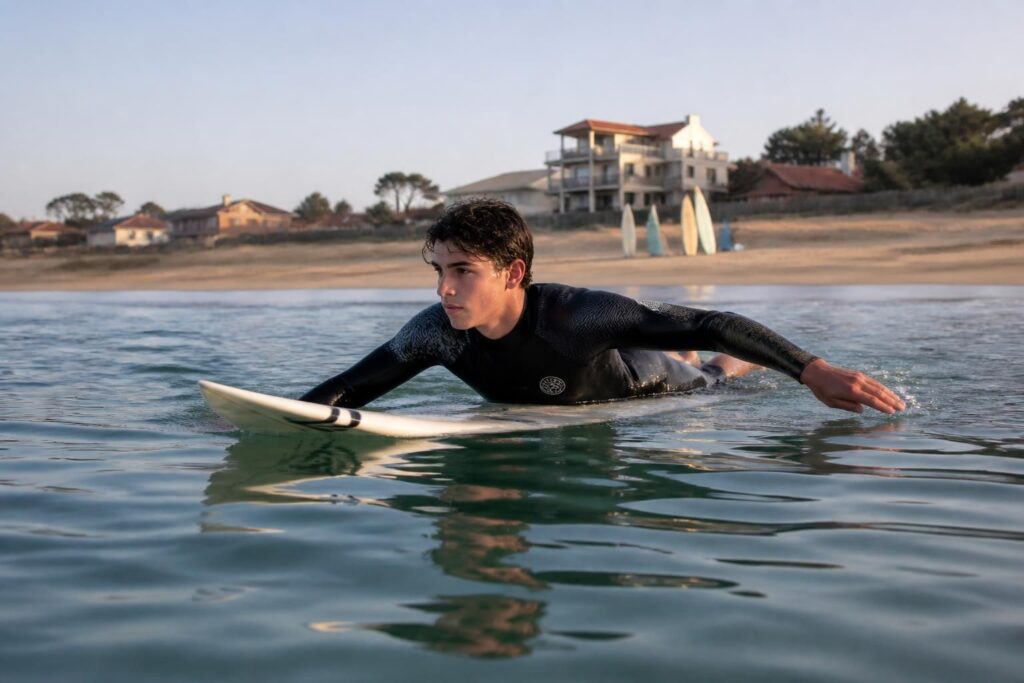
At fifteen years old, the Larmor native Illan Cariou already follows a pro routine: up at dawn, a quick wax, and tides analyzed down to the millimeter to power through up to seven hours of training a day. The goal: land a podium finish at the next European Championship in junior paddle surfing, scheduled in Peniche at the end of 2026. Breton coaches are talking about a future master of the water given how much his intense training blends surfing, paddling, and elite-level swimming.
Next-Level Preparation for a Highly Competitive European Event
On the Morbihan coast, winter swells forge the toughest paddlers. Illan complements every swell session with cardio runs along the seawall and core work under the watchful eye of the club’s performance team. The idea is simple: keep up with the relentless pace of the elimination heats and maintain clean flow when the lip closes out suddenly.
Seven Hours of Training: Breaking Down an Extraordinary Workload
The young athlete does not simply rack up takeoffs. His typical day is divided into carefully timed blocks, inspired by methods observed during the latest French Championships.
Surfing, Paddling, and Swimming: A Winning Mix for Athletic Performance
With no consistent reef break in Larmor-Plage, Illan swims lap after lap in an Olympic-size pool. His coaches confirm it: swimming boosts lung capacity and paddling speed, both essential when he needs to get back to the peak before the next heat.
- 2 hours of technical paddling on flat water to build shoulder strength.
- 1 hour 30 minutes of cardio swimming in the pool: 4 km of intervals.
- A 45-minute surf-foil session to work on reading waves.
- A mobility and proprioception workshop at the end of the day.
Equipment, Spots, and Mentors: The Recipe for Rapid Progress
Under the guidance of shapers from the Landes coast, Illan rides a 7’0’’ 78-liter board modeled after those of the champions featured in Tya Zebrowski and her world qualification. When there’s no swell, it’s off to the sandbanks detailed in the spots of Nouvelle-Aquitaine to keep up the rhythm of take-offs.
| Day | Main spotlight | Technical focus | Total duration |
|---|---|---|---|
| Monday | Guidel Outside | Backside bottom turn | 5 hr 30 min |
| Tuesday | 50 m pool, Lorient | Swimming endurance | 4 hr |
| Wednesday | La Sud, Hossegor | Generating speed between sets | 6 hr |
| Thursday | Cap Fréhel | Reading long-period swell | 5 hr |
| Friday | Coastal rescue training center, Hossegor | Hypoxic breathing | 4 hr 30 min |
Setting sights on the title: handling the pressure and staying master of the waters
The European competition for juniors requires nerves of steel. To avoid the stress of the morning call, Illan meditates for ten minutes before each session, a technique popularized by the finalists featured in the overview of young French talents. The club’s internal stats already show a 12% gain in paddling speed since January 2026: indicators that confirm the upward trajectory toward top-level sporting performance.
Why does a young paddle surfer spend so much time in the water?
Putting in the hours means experiencing a wider range of conditions: cross swells, onshore winds, chop, or glassy water. This variety builds adaptability, which is essential when European heats offer changing conditions in less than an hour.
Is swimming really essential for paddle surfing?
Yes, because it works the same muscle groups as paddling and improves lung capacity. Many coaches require 3 to 4 pool sessions per week to maintain transition speed between waves.
What is the main risk of such a high training volume?
Shoulder injuries remain the biggest threat. This is why mobility, core-strengthening, and active recovery sessions are systematically incorporated to prevent inflammation in the rotator cuff.
What equipment should a junior aiming for European competition prioritize?
A board between 75 and 80 liters to maintain maneuverability, a paddle adjusted to 15 cm above the rider’s height, and a leash of at least 9 feet to secure the board in the event of a powerful wipeout.